
Too prone to failures: Heidelberg plans to convert H2 garbage trucks to diesel.
Heidelberg city has had its H2 garbage truck inspected technically and plans to convert it to diesel due to its extremely high downtime. The waste management department states in its proposal to the city’s main and finance committees that the vehicle “will never be able to reach a permanently reliable operating condition.”
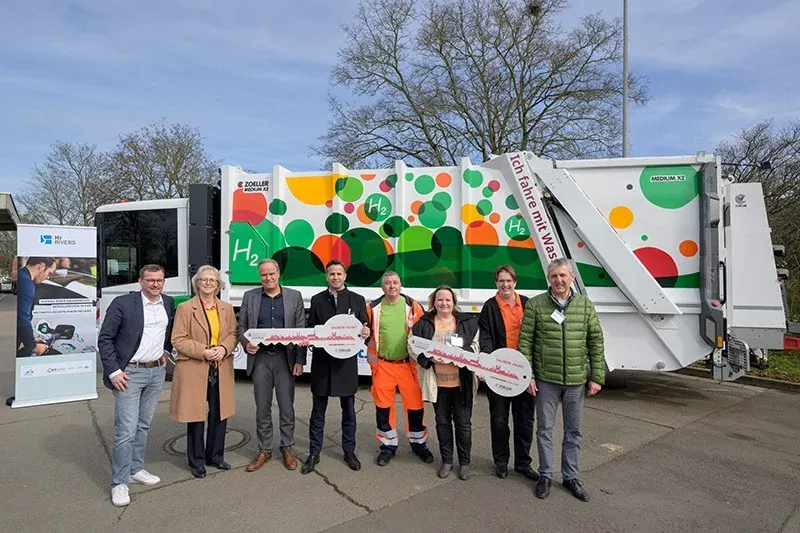
Disappointment followed in Heidelberg after its delivery in 2023 (image).
Image: Rothe
Heidelberg’s Department III, responsible for waste management, street cleaning, and central workshops (ASZ), states in the document that the H2 waste collection vehicle acquired in 2022 “has significant technical problems and resulting downtime.” After technical evaluation, the officials conclude that the waste vehicle will never function reliably on a permanent basis. The consequence: “To keep the existing structure, including the dumping system, in use, a new chassis with conventional propulsion is required.”
The main and finance committee of the city of Heidelberg also provided a figure for the misinvestment. The H2 waste collection vehicle cost nearly 1.2 million euros gross in procurement in 2022, with the purchase being subsidized at that time under the H2Rivers program by nearly 745,000 euros. The relevant department cites a current residual book value of just over 200,000 euros gross (after deducting the subsidy). The subsidy’s earmarking period was two years and ended in 2024. During this time, the vehicle could not be sold. But now, according to the officials, action must be taken. The vehicle’s failure rate ranged from 44 to 85 percent from 2023 to August 2026, with an average of 64 percent.
The vehicle in question is specifically an H2 garbage truck based on a Mercedes-Benz eEconic, equipped with a fuel cell range extender and a Zöller dump body. It was developed as part of the H2Rivers demonstration project along with two other similar units, which were sent to Mannheim and Ludwigshafen. The Heidelberg H2 garbage truck has an 85-kW battery and a 30-kW fuel cell aboard. The four tanks it carries have a total capacity of 16.8 kg of hydrogen. Its range is said to be around 250 km.
Heidelberg’s Department III comments: “After consulting with other municipal operators that use hydrogen-powered waste collection vehicles, it turns out that the identified problems and downtime occur in a similar manner with many other vehicles as well.” This is a major issue because the hydrogen-powered waste collection vehicle is actually considered the main vehicle in Heidelberg’s waste management system, and due to its high downtime, it must be constantly replaced by an older backup vehicle.
Therefore, the department now advocates converting the H2 waste vehicle to diesel. “To do this, a chassis with conventional propulsion needs to be acquired, on which the existing structure and equipment can be mounted. The no longer needed hydrogen-powered chassis will be used as a parts storage facility for the fleet,” states the proposal.
The conversion is to be carried out by an external specialist company. Estimated cost: 240,000 euros gross. This is expected to be significantly cheaper than purchasing a new comparable waste collection vehicle outright, for which the department estimates a price of 426,200 euros gross. The city assumes a delivery and conversion time of about one year.
Elsewhere as well, H2 garbage trucks are less reliable or practical compared to conventional or battery-powered waste collection vehicles. For example, Leipzig’s sanitation department also presented a report to its city council in mid-year showing that the city’s 16 H2 garbage trucks achieved only a 45.6 percent utilization rate in the first two years. In early 2026, Bielefeld made headlines by retiring its seven hydrogen garbage trucks, as the fleet had to travel long distances at short notice to obtain fuel.