
ZSW reports that its pilot plant for cathode materials is now in full operation.
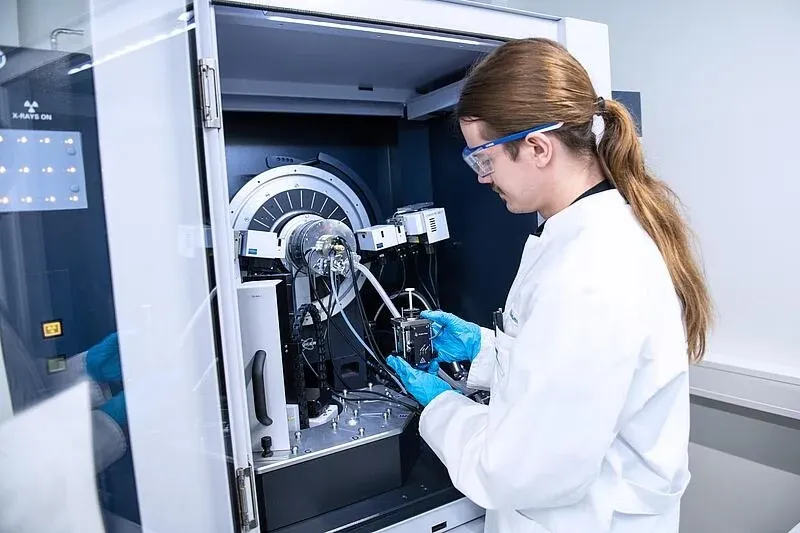
The Center for Solar Energy and Hydrogen Research Baden-Württemberg (ZSW) has put a pilot plant in Ulm into full operation, capable of scaling battery cathode materials from laboratory scale to batches of up to 100 kilograms under real conditions.
ZSW’s pilot line in Ulm is now fully operational.
ZSW emphasizes that the “Powder-Up!” pilot line in Ulm is Germany’s first independent facility capable of scaling battery cathode materials from laboratory scale to this extent. It was funded by grants from the federal government and the state of Baden-Württemberg and is now available to industry and researchers.
ZSW also emphasizes that cathode materials “significantly determine the performance and safety of high-performance batteries.” However, it is a major challenge to translate research advancements into industrial cell production. The new pilot line is designed to address this issue. According to the project leaders, it covers the entire process chain from synthesis to analysis and quality control. It also incorporates digital process management and highly automated analytics, which are intended to accelerate development cycles and provide data for AI applications.
"Those who want to produce battery cells competitively in Germany and Europe need access to the best materials," comments Prof. Dr. Markus Hölzle, member of the ZSW board and head of the Electrochemical Energy Technologies division in Ulm. "With Powder-Up!, companies can validate their own material concepts for industrial use, develop new synthesis methods together, or benefit from the digital data platform. Thus, ZSW serves as the national contact point for everyone who wants to develop improved battery materials and prepare them for mass production."
Cathode materials are known to form the positive electrode of batteries. However, according to ZSW, they represent the most expensive and environmentally problematic component, especially in lithium-ion batteries. In addition to lithium, they contain other critical raw materials such as nickel or cobalt. Moreover, “since they are indispensable in batteries, cathode materials are constantly being improved. Therefore, a focus in Ulm is on NMC cathode materials. […] By adjusting the proportions of nickel, manganese, and cobalt, it is possible to balance energy density, lifespan, stability, and costs for various applications,” states a accompanying statement.
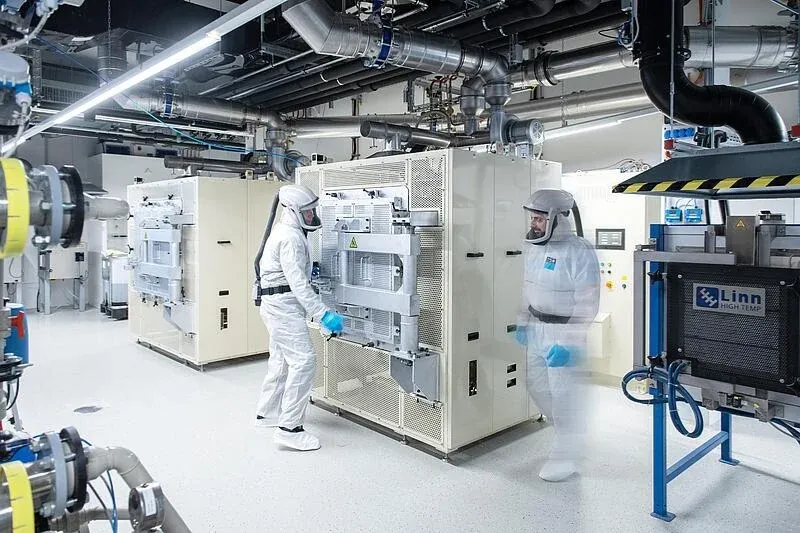
According to ZSW, shortly after the pilot line was put into operation, it was possible to scale up the first material samples from a few grams to the 15-kilogram range. A key step in this process is the thermal treatment of the materials at temperatures between 600 and 1,000 degrees Celsius, with the temperature having to be maintained with high precision. Special ovens are available in the facility to accurately replicate industrial processes for this purpose.
Currently, work in Ulm is also focused on a second category of cathode materials: lithium-iron-phosphate (LFP). Here too, ZSW states that quantities on a kilogram scale are already being produced. Another important topic identified by the initiators is materials for sodium-ion batteries.
The pilot plant covers approximately 2,400 square meters of usable space and brings together more than 135 systems and equipment under one roof. This setup supports both material development and scaling from a 10-gram to a 100-kilogram scale. Specialized apparatuses also enable the development of so-called synthesis routes using high-throughput methods, allowing many variants to be tested simultaneously and optimized quickly.
- 1/4
- 2/4
- 3/4
- 4/4
Material characterization in Ulm is also carried out using state-of-the-art methods such as Scanning Electron Microscopy (SEM), Focused Ion Beam Scanning Electron Microscopy for high-resolution analysis (FIB-SEM), Energy Dispersive X-ray Spectroscopy (EDX), Raman spectroscopy, Atomic Force Microscopy (AFM), X-ray Fluorescence Analysis (XFA), and X-ray Powder Diffraction (XRD). According to the experts, all these techniques enable detailed analysis of the structure, composition, and properties of materials. Electrochemical testing is conducted on button cells, which are also manufactured at ZSW and validated in the company’s own battery testing center. All data from synthesis and testing are then digitized and immediately integrated into further material development. This approach aims to significantly speed up development cycles and improve results.
It can be optimized further as needed.The pilot plant was built, as mentioned earlier, with funds from the Federal Ministry for Research, Technology, and Space (BMFTR) and the state of Baden-Württemberg. The state funded the building with around 10 million euros, while the federal government supported the plant’s technical equipment and necessary infrastructure with approximately 24 million euros. Construction began in early 2022. After procurement, construction, and installation, the plant was opened three years later in March 2025. However, it is only now that the plant is operating at full capacity. In 2024, electrive also reported on this pilot line previously.
Dorothee Bär, Federal Minister for Research, Technology, and Space, commented on the full deployment as follows: “My goal is to ensure that battery technologies and materials do not remain just concepts in laboratories. Instead, they must turn into tangible products — that is the core objective of Germany’s High-Tech Agenda.” Through Powder-Up!, her ministry, together with the state of Baden-Württemberg, has made targeted investments to make new battery cathode materials more quickly viable for commercial use. “In this way, we accelerate the transition from the laboratory to industrial application — so that ‘Made in Germany’ battery technology becomes a quality hallmark.”