
The Zeekr X charged at **257.2 kW** on a Supercharger. This is good news for 400 V systems and large batteries.
Photos and videos have appeared on X showing the Zeekr X (2026) being charged at a Tesla Supercharger. The European version with an LFP battery reached 257.2 kW there, and at other fast chargers even up to 264-284 kW, which is quite impressive for a car with a 400 V architecture.
Table of Contents
Show
Hide
For drivers of other brands, something else is more interesting: if these figures are accurate, Tesla has apparently already allowed higher currents on CCS2 than the previous 500 A for cars outside its own brand.
Not Tesla, but still faster than Tesla
The Zeekr X is a compact crossover with a length of 4.45 m and a wheelbase of 2.75 m. In Europe, it is available with an LFP battery of 61 kWh gross, around 59 kWh net, and it is this version that will benefit from the Golden Battery package, which allows charging the car from 10% to 80% in 18 minutes.
At a Supercharger, such a car was supposed to achieve 257.2 kW. This is more than what we typically see in the best Teslas equipped with V3 chargers. On even more powerful DC chargers, peaks of 264 kW and even 284 kW have been recorded. Given it’s a 400 V system with a small battery pack and LFP cells, the result is incredibly good. At least on paper, as obviously a single peak doesn’t determine the entire charging curve.
However, there’s a catch. To achieve a charging rate of over 4.5 C, meaning charging at a rate more than 4.5 times the battery pack’s capacity, the manufacturer must use cells designed for fast ion flow rather than maximum energy storage. The result is usually simple: better charging speed, but lower energy density.
This is exactly what can be seen here. The Zeekr X is also available with an NCM battery of 66 kWh gross, around 63 kWh net, which provides more energy and slightly better range, but it charges from 10% to 80% in just 30 minutes. The LFP version charges faster at charging stations but has less power onboard.
Where do these sudden over 500 amps come from?
It’s not the power itself that’s interesting, but the current. With a 400 V architecture, achieving 257.2 kW means a draw of at least 640 A. This is significant because for a long time, Superchargers were designed to provide currents above 600 A mainly for Teslas, while cars from other brands using CCS2 were limited to around 500 A.
If the Zeekr X truly received 257.2 kW at a Supercharger, it seems Tesla has updated CCS2 support to a newer specification for vehicles from other manufacturers as well. This is no longer just an interesting development related to a single Chinese crossover, but a potentially significant change for the entire 400 V vehicle group.
Models with very large batteries, especially those exceeding 100 kWh, stand to benefit the most. Examples include the BMW i7, Mercedes EQS, and first-generation Volvo EX90. The EX90 is capable of drawing up to 670 A, but Europe has long lacked stations that could deliver this level of power. If Superchargers start to support it, the difference in charging time could become tangible rather than just theoretical.
The Zeekr X is fast, but not perfect
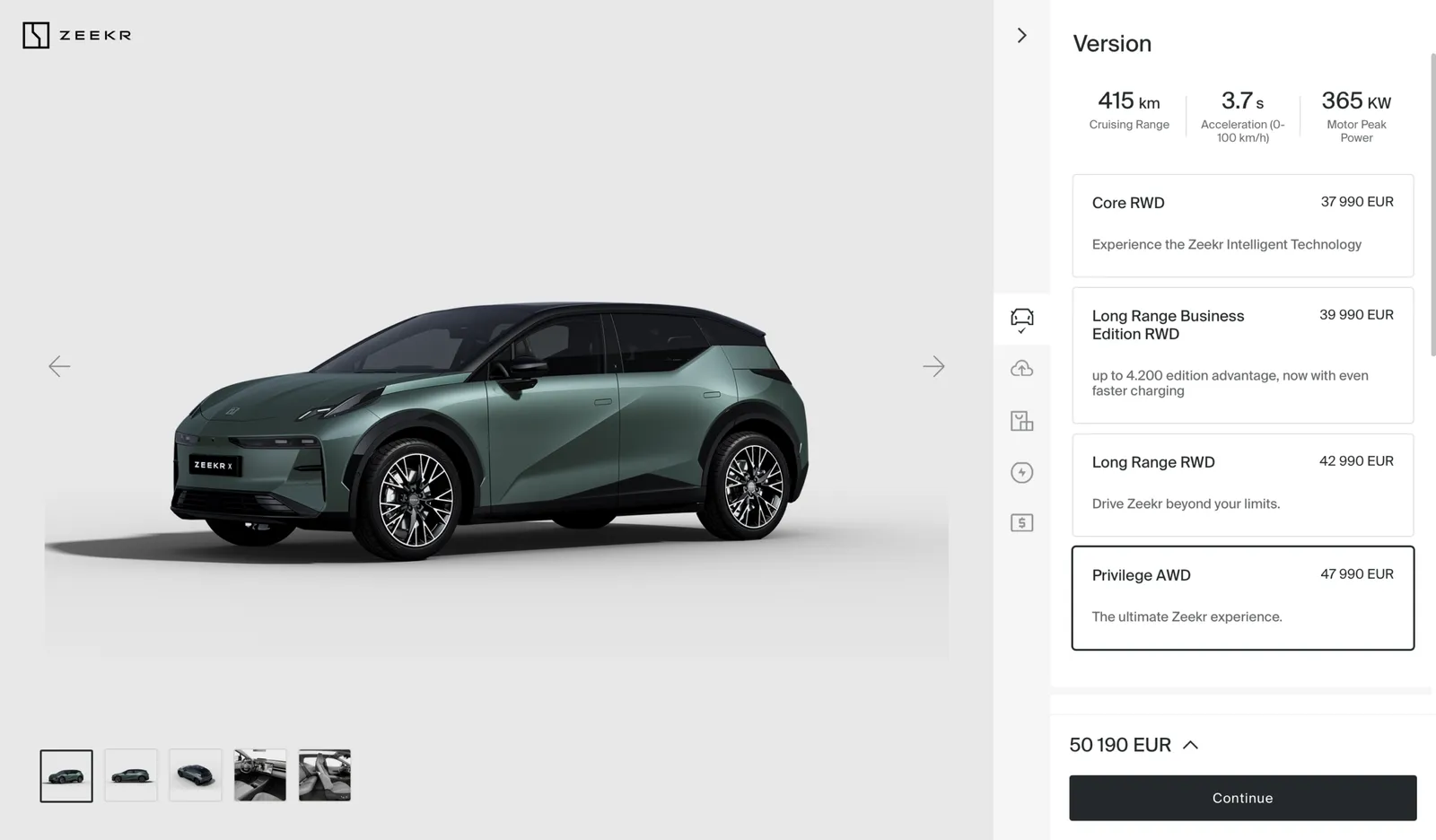
The Sam Zeekr X remains a rather unique offering. The range of both main versions is similar, as the LFP variant has rear-wheel drive while the NCM version comes with two engines. As a result, we see WLTP ranges of 405 and 415 km, but at 120 km/h speeds, the actual range is more likely around 240-250 km.
This is where the compromise becomes evident. With a wheelbase of 2.75 meters, it would probably be possible to fit a larger battery pack, even around 80 kWh, and turn it into a much more practical vehicle for long trips. However, that would make it less competitive compared to the larger and more expensive models in Geely’s lineup. Product marketing also plays a role in China.
In Poland, Zeekr is still not officially available. In the Netherlands, the model starts at 37,990 euros, which is about 165,000 zł, while the version shown in the video costs 47,990 euros, roughly 207,000 zł. This is already a price point where customers consider not only reaching 100 km of range quickly but also the convenience of charging on the road. And here, the Zeekr X offers a very strong advantage.
A full charging test is available on the video at: https://www.youtube.com/watch?v=ih_Ooh9hsGM
The silent hero of this story isn’t Zeekr itself, but the fact that Superchargers can finally stop treating CCS2 vehicles as second-class customers. Which 400 V model would you most like to see in such a test: the EX90, EQS, or i7?
LovEV Newsletter
Want more content like this?
Sign up — we’ll send you a weekly summary once the newsletter starts.