
A Zeekr 7X caught fire at a charger in China. The vehicle had previously been involved in a serious accident.
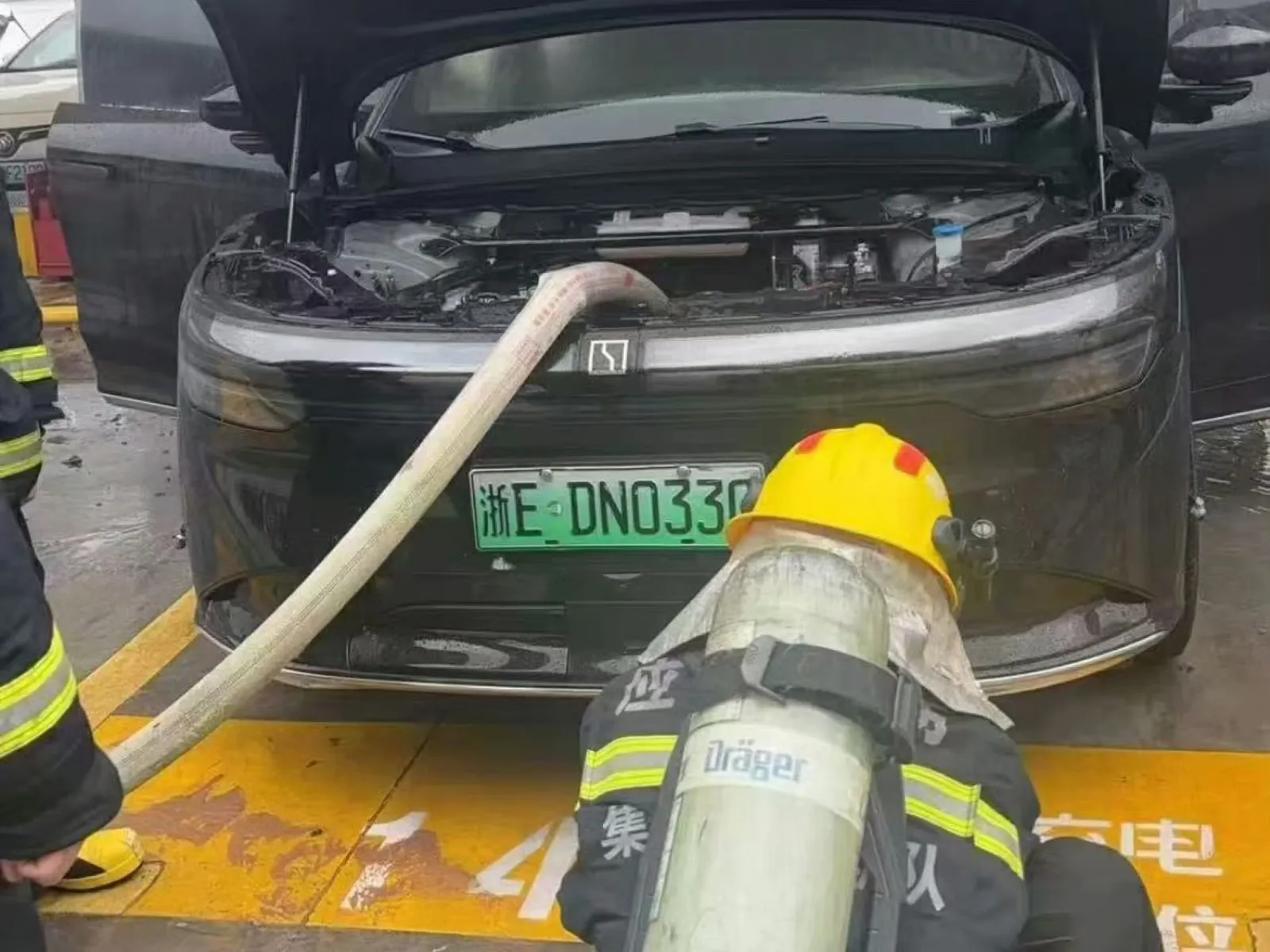
In Ningbo, China, a fire broke out in a Zeekra 7X parked at a charging station. According to footage and the brand’s subsequent statement cited by Chinese media, the vehicle was likely not connected to a charger at the time of the incident and had previously been involved in a serious collision.
Table of Contents
Show
Hide
The footage shows something interesting and important for assessing the incident: the cable of the charger located directly behind the car remains in its holder. This practically rules out the possibility that the vehicle was using that charger. However, it is not entirely certain whether it was connected to another station, as a taut cable can be seen on the left side, and the Zeekra 7X’s charging port is located at the back on the left side of the vehicle body.
The more interesting details are those of the car itself. The hood is open, some plastic covers appear to be removed, and there is a man standing next to the car whose role cannot be clearly determined. This doesn’t look like a typical “drive up, plug in the cable, wait” scenario. It seems more like someone has already been checking something or trying to access components under the front hood.
What’s visible in the video
The first phase doesn’t resemble a classic fire progression from a traction battery. There’s a loud noise, a flash appears, and flames come out from the front of the car as well. This could indicate a problem with the high-voltage system or ignition of something secondary, such as air conditioning fluid after damage to one of the system components. Moments later, intense sparking and an electric arc can be seen, with molten metal particles flying out from under the car.
The most important thing, however, is what happened next: the fire did not spread to the entire body of the vehicle, the interior was not affected, and even the tire next to the source of sparks did not catch fire. There is also no sign of the typical, rapid and intense thermal runaway of the entire battery pack. The fire department brought the situation under control relatively quickly.
This does not mean “nothing happened.” It simply means that based solely on the video, it is not possible to fairly conclude that a fire in the traction battery was the main cause.
Zeekr: The car was involved in a serious accident
In an official statement, the brand said that preliminary findings indicate this vehicle was previously involved in a serious traffic accident. The car did not undergo any inspection or repair at an authorized facility afterward. The cause of the fire is still under investigation.
This is bad news for the car owner, but fairly convenient news for the manufacturer. Zeekr doesn’t specify what was exactly damaged, how severe the previous accident was, or whether it involved the battery, HV bundles, converters, cooling system, or structural components. So we only have two definite facts: a previous serious collision and the lack of authorized inspection or repair.
In practice, this is enough to treat such a case differently from a car that caught fire due to normal use. Problems can arise much later after a severe impact. This applies not only to battery cells but also to high-voltage connections, wire insulation, seals, and battery cooling elements. Sometimes the car “runs normally” until it stops working.
The problem might not have been charging itself
This is probably the most interesting conclusion from the entire story. The location of the incident suggests charging, but the video footage does not provide clear evidence that it was indeed a DC charging session that caused the fire. If the car wasn’t actually plugged in, we’re more likely talking about a vehicle malfunction that occurred right by the charger.
This is important because the internet tends to operate predictably: as long as there’s a car near a charging post, the narrative becomes “the electric car caught fire while charging.” Here, however, the theory that “a damaged accident vehicle caught fire in the vicinity of a charging station” fits better. They are not the same thing.
The Zeekr 7X is a global model
The topic here is a car that isn’t a local novelty in the Chinese market. The Zeekr 7X is available globally, including in Europe. In the European version, the base model comes with an engine at the rear axle delivering 310 kW of power, a 75 kWh LFP battery, and a range of up to 480 km according to WLTP standards. The Long Range variant features a 100 kWh battery package, offering a range of up to 615 km WLTP, while the top-tier AWD version boasts 475 kW of power.
Specifications
Zeekr 7X Europe
Drive Type
RWD / AWD
Power
310 kW / 475 kW
Battery
75 kWh LFP / 100 kWh NMC
Range
480-615 km WLTP
Length
4,787 mm
Wheelbase
2,900 mm
Euro NCAP Rating
5 stars
In China, the model is also available in more powerful variants with different CLTC range homologations. Yet this doesn’t change the core issue: we’re talking about a vehicle that builds the brand’s global reputation, so any such incident will be analyzed much more carefully than a fire involving an anonymous, local model.
The conclusions are fairly simple, though not very impressive
Firstly, not every fire caused by an electric component near a charger is a “charging fire.” Secondly, vehicles involved in serious accidents require thorough diagnosis of the HV system and batteries, not just body repairs and error clearing. Thirdly, the used EV market will face increasing problems with this, as damage that’s invisible from the outside can resurface weeks or months later.
This single case does not undermine Zeekr’s safety nor confirm it. Instead, it shows something much more mundane: in electric vehicles, the most expensive part might not be the battery pack, but the illusion that “since it’s running, everything is fine.” Would you buy a used EV after repairs from outside an authorized service center if the seller assured you that the battery “had been checked”?