
I have already tried the best-selling car with its expected 155 HP hybrid engine made in Spain.
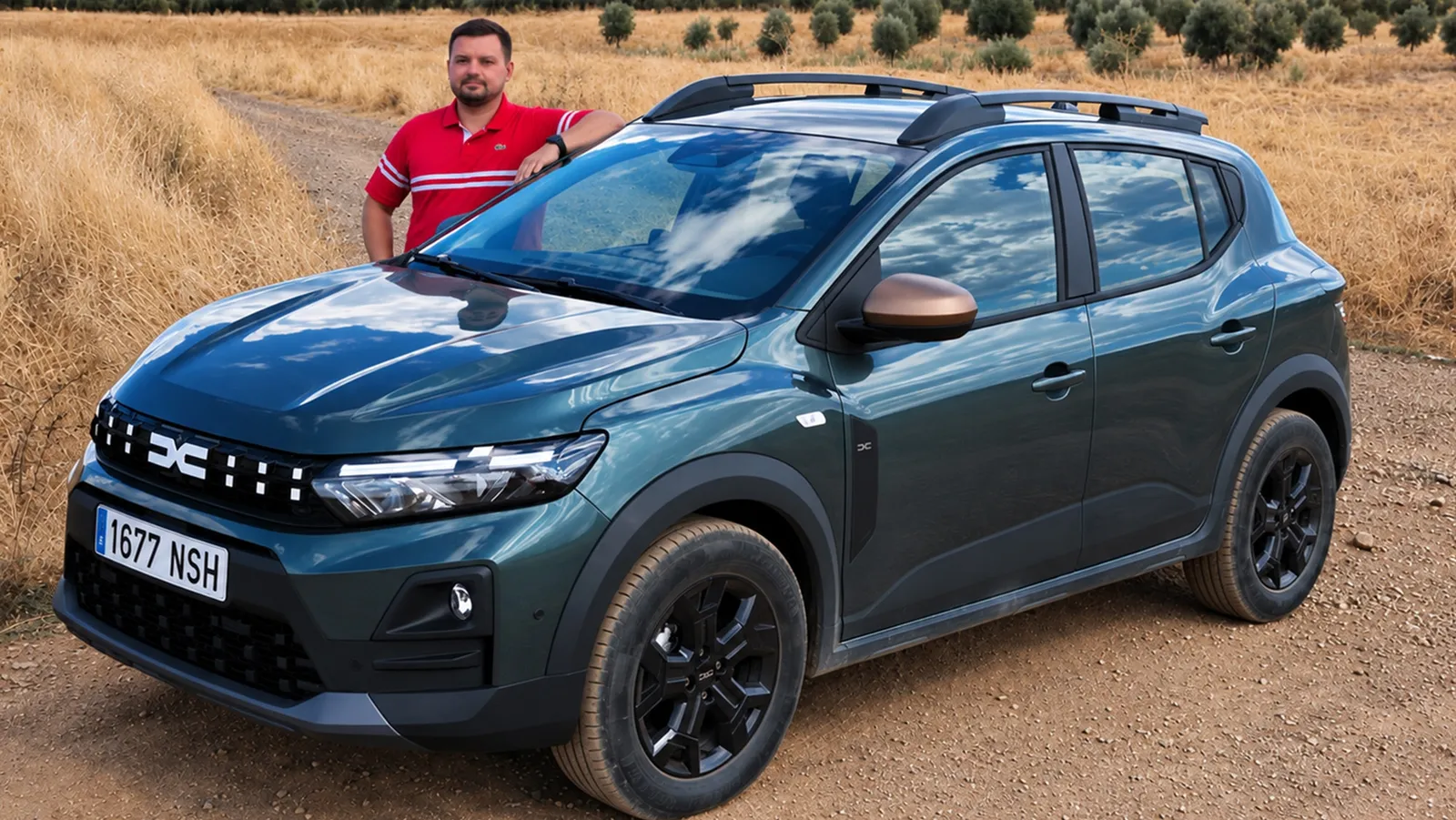
The Dacia Sandero, one of the cars that best understands what Spanish buyers are looking for, has just been equipped with what was likely its most missing feature. The new Dacia Sandero Hybrid 155 introduces a full hybrid powertrain with an automatic transmission and ECO rating for the first time, to a model that has for years stood out precisely for offering plenty of car for little money.
This isn’t just a symbolic electrification move. With 155 horsepower, it is also the most powerful version of the Sandero ever produced, a car that has actually been the best-selling among private buyers in Spain for years. So far in 2026, it has nearly reached 24,000 registrations. With this new version, it is expected to continue in that position.
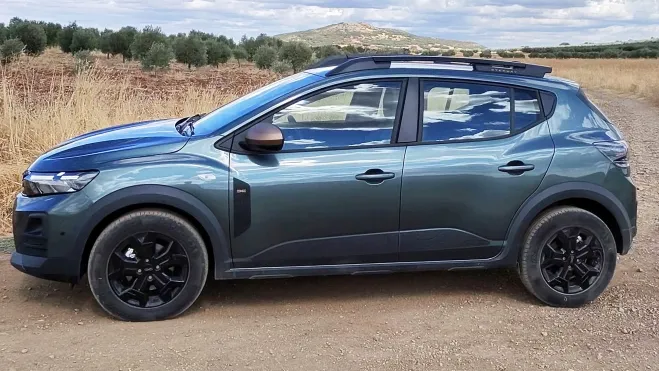
The Sandero’s hybrid engine is made in Spain
There’s another particularly interesting detail for our market. Although the Dacia Sandero continues to be assembled outside Europe, its HEV hybrid system and transmission rely heavily on Spanish manufacturing.
The mechanical assembly is developed and produced by Horse Powertrain in Valladolid and Seville, bringing to the Sandero a technology that Dacia already uses in models such as the Duster, Jogger, and Bigster.
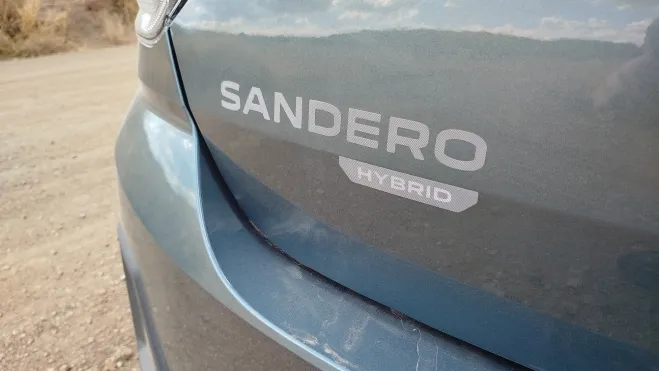
The system combines a 1.8-liter gasoline atmospheric engine with approximately 108 HP, along with two electric motors. The main motor produces 50 HP and is also responsible for driving the wheels, while a second electric motor with 20 HP functions as a high-voltage generator and starter.
The battery has a capacity of 1.4 kWh, giving a total power output of 155 HP. Everything is managed through an electric multi-mode automatic transmission without a conventional clutch, featuring four gears for the internal combustion engine and two more for electric operation.
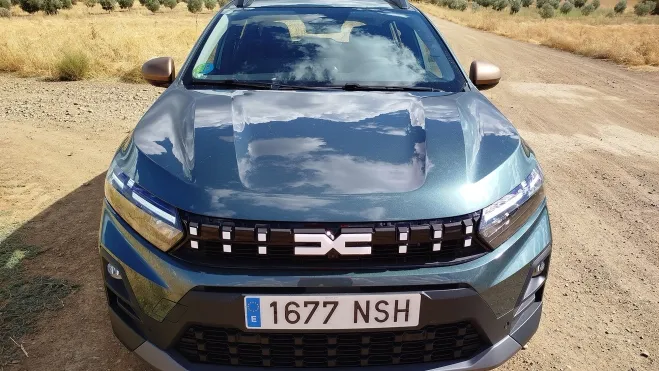
It always starts in electric mode and can have very low fuel costs in urban areas
The advantage of this approach is that it doesn’t require a plug. The Dacia Sandero hybrid always starts in pure electric mode and makes particularly good use of the electric motor during urban driving, at traffic lights, in congestion, and for low-speed maneuvers.
This allows its city driving behavior to be much smoother than that of conventional manual versions, while the electric motor’s immediate response makes it easier to accelerate or decelerate from a stop.
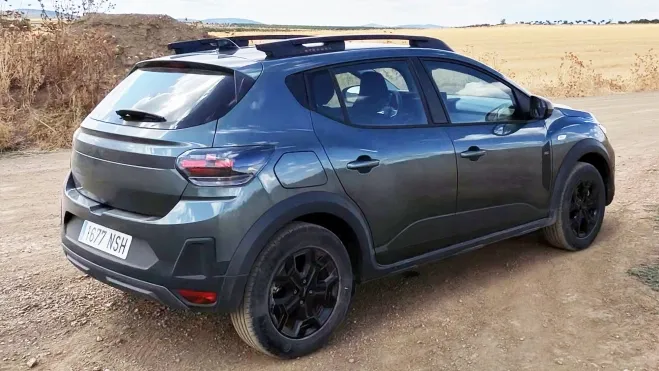
Dacia reports fuel consumption of 4.2 liters per 100 km for the Sandero berlina and 4.4 liters per 100 km for the Stepway. In my test with a Stepway model, I found it easy to approach the advertised fuel consumption without adopting particularly fuel-efficient driving habits.
In addition, its 155 horsepower delivers performance that was previously uncommon for this model: it accelerates from 0 to 100 km/h in 8.3 seconds and reaches a top speed of 180 kilometers per hour. All this is thanks to a powerful engine inherited from larger vehicles in the range, but in this case with smaller size and weight.
The battery doesn’t leave you without a trunk
The trunk retains 328 liters, exactly the same usable capacity as other versions (except GLP), and can be expanded to 1,108 liters by folding down the rear seats. No significant space is lost in the rear seating area either.
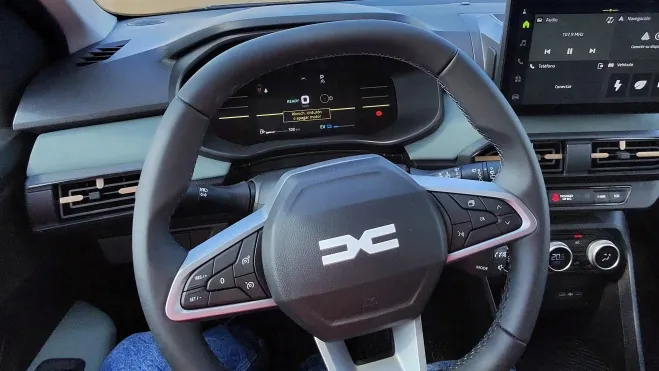
Inside, there’s a 7-inch digital dashboard specific to the hybrid model and a 10-inch multimedia screen that wirelessly supports Apple CarPlay and Android Auto. Dacia has also kept separate physical controls for climate control, which is becoming less common but something I consider a positive feature.
Hard to beat in terms of price
The Dacia Sandero Hybrid 155 doesn’t suddenly turn this model into a premium car.
It retains the typical finishes expected of its segment, category, and price point, with a suspension that clearly prioritizes comfort and a highly assisted steering system to make driving this vehicle easy and pleasant. The same applies to the engine, which is tuned for quick response while emphasizing smoothness and efficiency.
One factor that could make a difference is its price: the Dacia Sandero berlina Hybrid 155 starts at 19,890 euros in Spain, while the Dacia Sandero Stepway Hybrid 155, which we tested, begins at 21,290 euros. Orders are now open, and the first units are expected to arrive at Spanish dealerships by the end of October.
With 155 hp, an automatic transmission, ECO label, very low fuel consumption, and a starting price below 20,000 euros, the Dacia Sandero finally features an engine capable of competing directly with models such as the MG3 Hybrid+, Toyota Yaris Hybrid, or even the Renault Clio E-Tech.
The difference is that it does this while maintaining almost intact the philosophy that has made the Sandero a commercial success in Spain: space, simplicity, and price above everything else.