
Xpeng leads while Tesla catches up: these are the electric car brands that most and least convince Europeans
Electric cars are improving in range and charging speed, but their owners no longer settle for that alone. Given what they pay, they obviously expect the navigation system to plan trips well, the app to work when needed, and connecting the car to a charger not to be a hassle. The latest study by consulting firm UScale shows that the overall experience continues to improve, though there are huge differences among manufacturers.
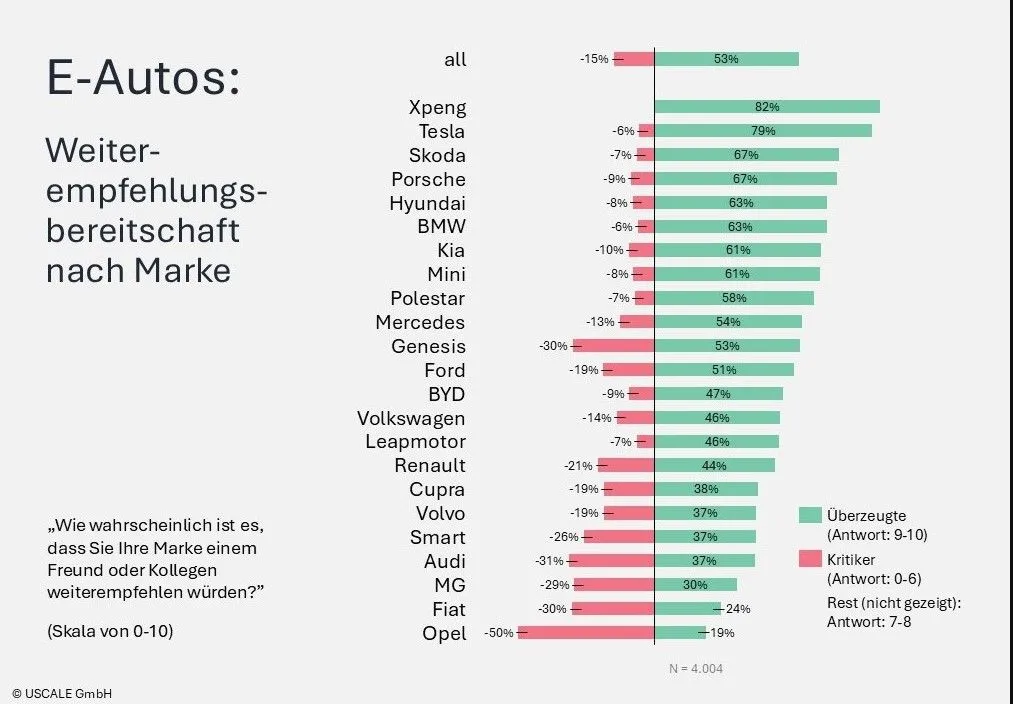
This year’s survey places Xpeng in first place, followed by Tesla, which has improved its position from sixth last year. Skoda completes the top three, with Porsche in fourth place. At the bottom of the list are MG, Fiat, and Opel, with the latter once again struggling at the very end. The results also don’t suggest a unified Chinese group: while Xpeng leads the rankings, BYD and Polestar are mid-table, whereas Leapmotor Smart and MG receive less favorable ratings.
The study includes responses from 4,004 drivers in Germany, Austria, and Switzerland who were interviewed online during June and July 2026 regarding electric cars no older than three years. There is an important nuance: the participants were recruited through social media, and UScale explicitly warns that they do not represent the average driver. They are users who pay special attention to details, both to recognize well-designed solutions and to criticize their flaws.
The recommendation index, known as NPS, rises from 33 to 38 points, its best result since the start of this series. 53% would actively recommend their car, 15% would advise against it, and 32% remain neutral. It’s important to distinguish this metric from a satisfaction percentage: the score is calculated by subtracting detractors from promoters and does not mean only that proportion of drivers are satisfied.
Technical improvements are evident in the reported range. 59% of participants claim their cars can achieve over 400 km of real-world range in summer, up from 50% the previous year. However, this distance no longer impresses as much: only 15% consider it very good, half the rate from 2023. As cars become more advanced, so does the standard by which their owners evaluate them.
Charging and software still make a difference
71% of respondents reported issues during charging, a slight improvement from the previous 73%, but still a high proportion. The most common complaints related to difficulty starting the charging process and unexpectedly low power output. This does not mean that all these people experienced malfunctions or ran out of charge: it refers to difficulties encountered during use, whose frequency and severity can vary.
There is still work to be done in finding chargers from the browser. Only 43% believe this function is well implemented, while 56% think there is room for improvement. For a car designed for travel, locating an appropriate charging spot and integrating it properly into the route is part of the charging experience, even if the battery and charger work without issues.
Mobile apps show one of the most striking differences between brands. 48% of participants reported problems with their car’s app, up from 50% previously. But the average hides very different situations: in Tesla, this percentage is only 8%; in Opel, it reaches 92%. Being able to reliably check the battery level or manage functions remotely remains an unfinished task for some manufacturers.
When asked where improvements should focus, the quality of car’s software comes top of the list with 44%, ahead of charging speed, mobile app, route planning, and range. UScale notes that as improvements are made to energy consumption and electric performance, complaints about software functionality have increased compared to last year.
Acoustic alerts add another source of dissatisfaction. Half of the participants find them annoying, but again there are significant differences: 29% in Mini, while around 80% in Kia and Hyundai. The study interprets this gap as evidence that how alerts are designed and integrated greatly affects their acceptance.
Xpeng stands out due to its charging capabilities, management system, and range, along with a significantly improved app. Its main areas for improvement are route planning and energy consumption.
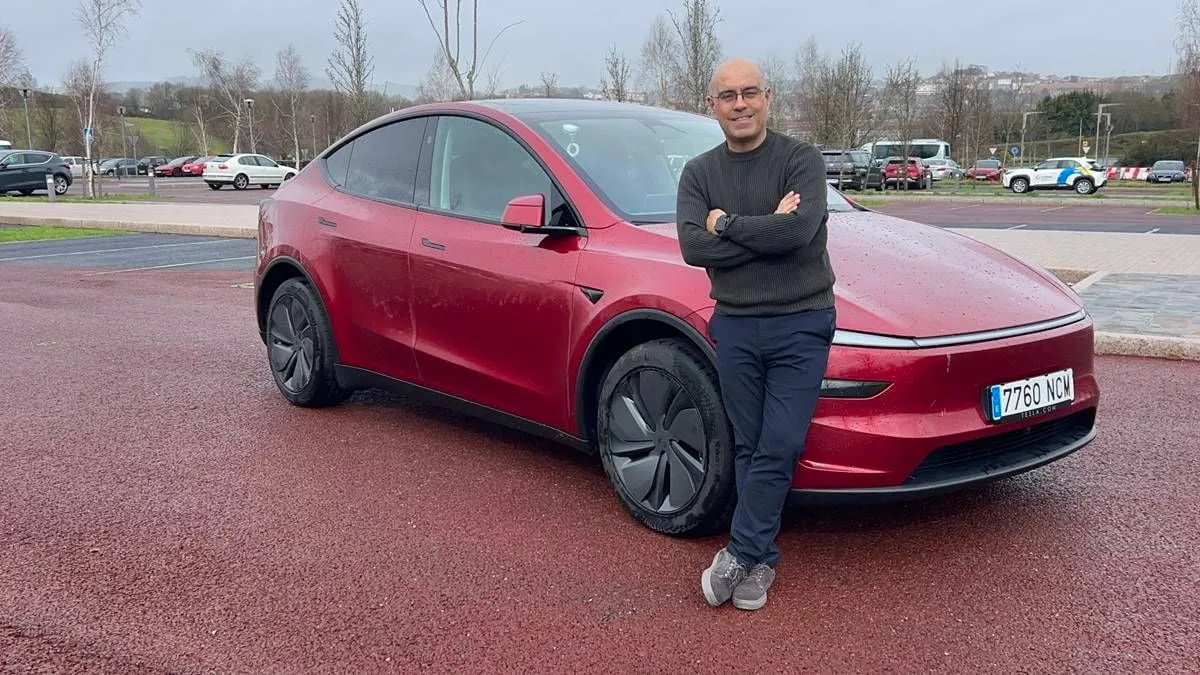
Tesla excels in several digital aspects as well as efficiency, though more than half of its users demand better charging speeds. Criticisms also persist regarding sound insulation, interior finishes, and driving assistants.
Skoda improves thanks to the Elroq, which enhances the Enyaq’s ratings in almost all evaluated aspects, though it still lags behind in navigation and computing performance. Porsche stands out for its fast charging and manufacturing quality, but falls short in software and planning features. Hyundai sees significant improvements, while BMW excels in digital functions and charging management; its new generation models are not yet included.
Among Volkswagen Group brands, the study shows that technical improvements do not guarantee a complete solution. The ID.7 performs better in terms of range, fuel efficiency, and charging compared to the ID.3, ID.4, and ID.5, but Volkswagen still falls below the overall average. Audi is also making progress with the A6 and Q6 e-tron, yet it faces more criticism regarding its software performance and continues to receive disappointing ratings for its app and vehicle quality.
The table below summarizes other key points from the survey. These are evaluations of the included vehicles and their users’ experiences, so they should not be interpreted as identical ratings for all models of each manufacturer.
Brand
Best-rated aspects
Main improvements requested
Kia
Range and improved software performance
Route planning
Polestar
Driving, navigation, and app
Consumption, features, and sound insulation
Mercedes
Advances in range, efficiency, and charging
Computer operations and performance quality
Ford
Improvements in consumption and Explorer’s performance
App and charging speed
BYD
Features, app, and navigation
Charging, consumption, and driving
Leapmotor
Range and app
Driving and route planning
Renault
Navigation and features
Charging speed and app
Cupra
App improvements
Persistent computer and charging issues
Volvo
Route planning with Google
Consumption, range, and features
Smart
Charging, range, and battery management
Driving, app, navigation, and consumption
MG
Range and equipment
Software and app
Fiat
Low consumption
Range, charging management, and app
Opel
—
App, charging management, software, and handling
The results impose a fairly specific requirement on manufacturers: the functions that support driving must work as naturally as the car itself. Longer range helps, but a faulty app or a navigation system that complicates stops can ruin the daily experience. And the differences between brands show that several of these issues already have solutions.
It is also a warning to traditional automakers, who see new players gaining ground in terms of customer satisfaction year by year. A satisfied customer is much more likely to buy from them again in the future.