
The Xpeng G9L starts at 259,800 yuan. This 5.12-meter-long SUV features all-wheel steering and a CLTC range of up to 755 km.
Xpeng has launched pre-sales for the G9L model in China and revealed its full lineup: 6 variants, including BEV and EREV options, with a starting price of 259,800 yuan. It is a large five-seater SUV measuring 5,120 mm in length, targeting the premium segment around 300,000 yuan, where brands like Li Auto, Aito, Xiaomi, and Zeekr are already established.
Table of Contents
Show
Hide
The most interesting aspect is that Xpeng isn’t trying to create “just another family electric vehicle” here. The G9L is packed with advanced technology: it comes standard with 800 V systems, rear-wheel steering, an 88-inch AR-HUD, three Turing chips, and a claim of covering 450 km in just 9 minutes. It represents the typical Chinese approach to this segment, where the level of equipment is designed to impress even before looking at the specifications sheet.
Xpeng G9L – What Kind of Car Is It?
The G9L is Xpeng’s new flagship crossover with two rows of seats and only five passengers. Its dimensions are 5,120 / 1,999 / 1,782 mm, with a wheelbase of 3,100 mm. For comparison, it is 198 mm longer than the BMW X5 G05 generation.
The body features several elements that are now standard in this segment in China: hidden handles, a sloping roofline, an active air intake, and prominently shaped rear bumpers. Its drag coefficient is 0.238 Cd, which is better than the Xiaomi YU7’s reported 0.245 Cd.
Maneuverability is highlighted as a key strength. Xpeng added steerable rear wheels, resulting in a turning radius of 5.4 meters. For a vehicle of this size, this is a parameter that truly makes a difference in urban driving and parking, rather than just looking good in investor presentations.
Six trims, two powertrains, one 800 V platform
Xpeng has divided the G9L lineup into 6 versions. Two are EREV, while four are pure BEV models. The manufacturer states that the 800 V platform is standard across the entire lineup, which has become expected in this class but is still not universal.
Specifications
Xpeng G9L BEV RWD
Xpeng G9L BEV AWD
Xpeng G9L BEV AWD long range
Xpeng G9L EREV AWD
Drive Type
Rear
AWD
AWD
AWD
Power
270 kW
430 kW
430 kW
370 kW
Battery
91.9 kWh LFP
91.9 kWh LFP
110 kWh NMC
63.3 kWh LFP
CLTC Range
702 km
660 km
755 km
435 km EV / 1,602 km total
0-100 km/h
6.8 s
N/A
4.45 s
4.95 s
Charging
800 V, +450 km in 9 minutes
800 V, +450 km in 9 minutes
800 V, +450 km in 9 minutes
800 V, +450 km in 9 minutes
Length / Wheelbase
5,120 mm / 3,100 mm
5,120 mm / 3,100 mm
5,120 mm / 3,100 mm
5,120 mm / 3,100 mm
Price
starting at 259,800 yuan
not disclosed
shown as the top pre-order configuration
not disclosed
The base BEV model comes with one engine at the rear axle delivering 270 kW, a 91.9 kWh LFP battery from CALB, and a CLTC range of 702 km. The AWD variant adds an additional 160 kW engine at the front, resulting in a total of 430 kW.
The top electric version features a larger 110 kWh NMC battery pack and a CLTC range of 755 km. It is this configuration that was shown at a price of 259,800 yuan during the pre-order period. If Xpeng maintains this price for the fully equipped version, competitors will need to respond not with higher specs but with discounts.
EREV: Xpeng Doesn’t Limit Themselves to One Option
The second option is EREV, which stands for an electric vehicle with a range extender. Here, AWD drive is standard: 160 kW at the front and 230 kW at the rear, totaling 370 kW. The 0-100 km/h acceleration time is 4.95 seconds.
The power comes from a 63.3 kWh LFP battery, while the combustion generator is a 1.5-liter turbo engine with 110 kW of power. Xpeng claims an electric range of 435 km in the CLTC cycle, along with a total range of 1,602 km when using a 60-liter fuel tank.
This is an important development, as the Chinese market continues to welcome EREV models in large family vehicles very well. Li Auto built its brand around this concept, and Aito is also pursuing the same strategy. Xpeng apparently decided that a pure BEV alone isn’t sufficient in this segment, even with 800 V systems and fast charging capabilities.
The claimed charging speed sounds impressive, but without actual data it remains just a claim
Xpeng claims to be able to achieve a range of 450 kilometers in just 9 minutes. This sounds impressive and fits into China’s current competition focused on minutes, seconds, and kilometers.
The problem is the same as usual: without releasing data on the charging curve, initial SoC level, battery temperature, and whether it’s the best result of a session or a repeatable outcome, such a figure is more of a slogan than a rigorous test. However, the presence of an 800 V architecture is good news, as it provides at least a technical basis for fast DC charging.
Interior: more of a lounge on wheels than a traditional SUV
The G9L has only two rows of seats, but Xpeng tries to make the most of this space. At the front, there’s a 17.3-inch central screen and an 8.8-inch dashboard display. Additionally, it features an 88-inch AR-HUD and a 9-inch digital mirror.
The equipment list includes 24-way front seat adjustment, zero gravity function, heating, ventilation, and 16-point massage. The manufacturer also boasts “AI active contouring,” which is active seat adjustment based on 91 pressure sensors with accuracy down to 2 grams. It sounds very Chinese: lots of technology, some marketing, and probably a mix of both.
The back seat area is even more interesting. The second row gets a foldable table, a 12.5-liter refrigerator, a 21.4-inch ceiling screen, and an additional 8-inch control panel. The right rear seat features zero gravity function and an electric footrest.
Interestingly, Xpeng also mentions the ability to fully unfold both front and rear seats into a flat bed over 1.8 meters long. This is no longer just a regular interior description but a direct response to the Chinese trend of “cars for resting, working, and camping.”
Trunk and Practicality
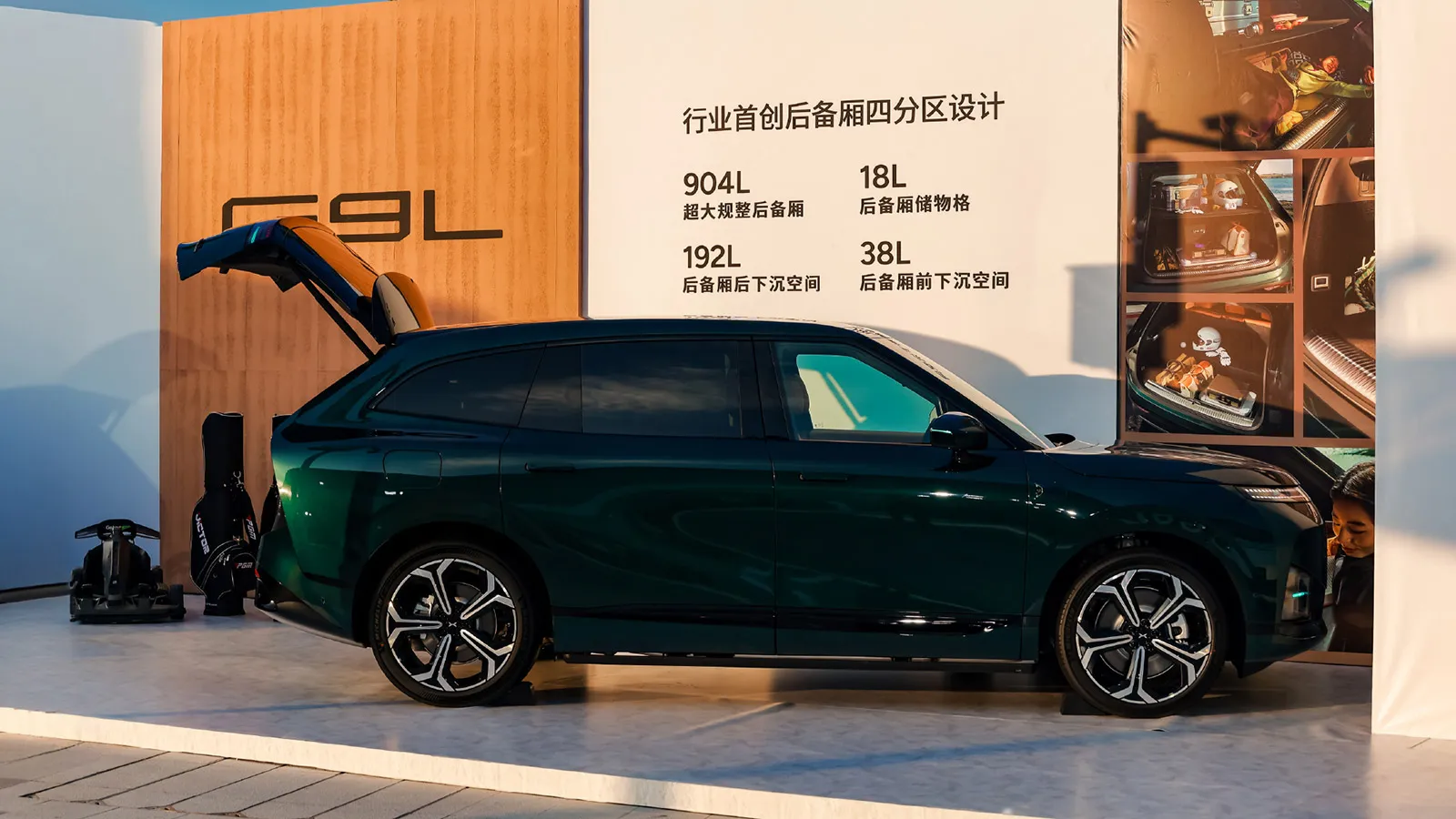
The trunk has a capacity of 1,152 liters, with an additional 230 liters of space under the floor. The BEV version also includes a front trunk with a capacity of 109 liters.
With a length of over 5.1 meters, such figures aren’t surprising, but the five-seater layout does make sense. Xpeng didn’t try to force in a third row, which in many SUVs of this class is often a makeshift solution for children or short trips.
AI, Chips, and Assisted Driving: Xpeng Plays Its Strongest Card
The G9L’s most technologically advanced feature is its driving assistance system and on-board computing. The car is equipped with up to 3 Turing chips, offering a total computing power of 2,250 TOPS.
Xpeng also announces the debut of a major update for its second-generation VLA model. It features a Vision-Language-Action approach, aiming to integrate environmental perception, command understanding, and vehicle response into one system. On paper, this sounds like the next step from traditional ADAS toward more flexible automation.
However, it’s important to separate the hardware from the end result. 2,250 TOPS sounds impressive in numbers, but computing power alone doesn’t guarantee performance quality. In this industry, we’ve seen many cars with “high-end hardware” that function only adequately in practice.
Price and Competitors
Presales begin at 259,800 yuan, and customers who pay a 1,000 yuan deposit can receive a 3,000 yuan discount on the purchase price. Xpeng also offers temporary bonuses for paint, interior trim, and larger wheels.
At this stage, the price of one configuration has been revealed, with the rest to be finalized closer to the market launch. Still, it’s already clear where the G9L aims to compete. The manufacturer targets a price range of around 300,000 yuan, with cars such as the following in mind:
Avatr 07L – 229,900–279,900 yuan
Xiaomi YU7 – 233,500–389,900 yuan
AUDI E7X – 269,800–359,800 yuan
Li Auto L8 – 369,800–429,800 yuan
Zeekr 8X – 356,800–500,800 yuan
From another perspective, Xpeng positions the G9L against the Li Auto Li L7 and the Huawei-backed Aito M7 as well. This shows that the brand isn’t targeting only “electric” car buyers; it also aims to attract those who currently choose EREV models with spacious interiors and powerful software.
G9L and GX are set to form Xpeng’s new flagship lineup
Xpeng states clearly that the G9L, along with the previously introduced GX, forms a pair of flagship models. The GX was launched in China at 279,800 yuan, with a temporary promotional price of 269,800 yuan.
This is a crucial moment for the brand, as the G9L is intended not only to boost sales volume but also to enhance Xpeng’s reputation in higher-end markets. This is especially important given the company’s mixed performance: in July, Xpeng delivered 38,027 vehicles globally, representing a 3.57% year-on-year increase but a 5.23% month-on-month decline. From January to July, the total was 204,004 vehicles, indicating a 12.78% year-on-year drop.
The G9L thus appears to be an attempt to enter a market segment where margins are often better and customers are less sensitive to the base price alone.
Xpeng has packed the G9L with everything that sells well in China’s premium-tech market today: 800 V, EREV alongside BEV, swivel rear wheels, a large HUD, plenty of AI features, and an extremely luxurious interior. So the question isn’t whether this car has what it takes to attract attention, but rather whether it can stand up to Li Auto, Huawei, and Xiaomi at this price point with these claimed specifications. Which aspect of such a car is more important today: real-world charging and driving performance, or the cabin and software?