
XPENG G9: 391 kW at the charger and 12 minutes to 80 percent charge. Electric cars are changing rapidly
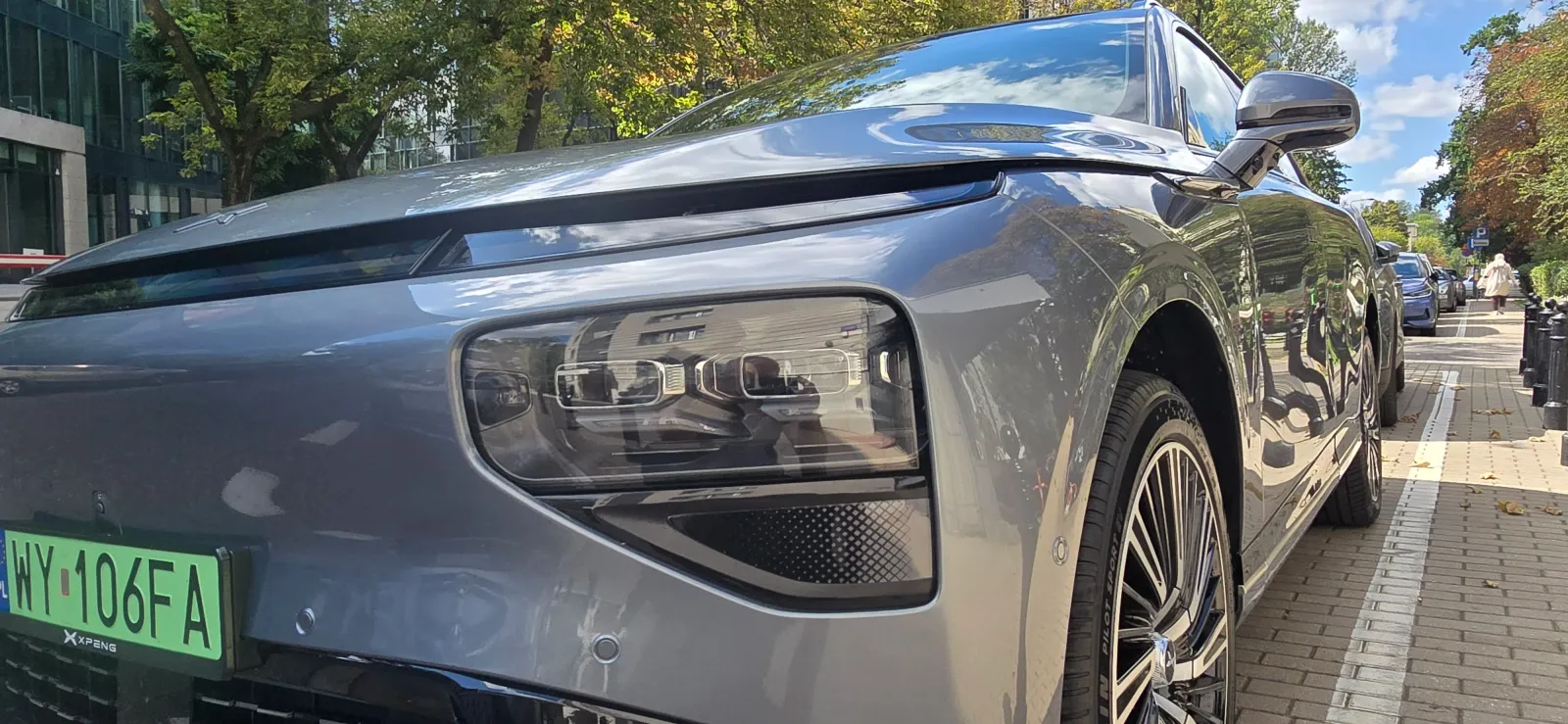
XPENG G9: An assessment without regard to origin
Just a few years ago, Chinese electric cars were primarily associated with their attractive prices. They were meant to be a cheaper alternative to European brands, and in exchange for lower costs, one could accept inferior materials, poorer handling, or underdeveloped multimedia systems. The XPENG G9 clearly shows how quickly this perception became outdated.
This is a car that shouldn’t be judged based on its origin. It’s much more sensible to compare it directly with large electric SUVs from premium brands and see where it performs better and where it falls short. After a few hundred kilometers behind the wheel, one thing is clear: the G9 has several very strong advantages.
The interior truly delivers a premium feel
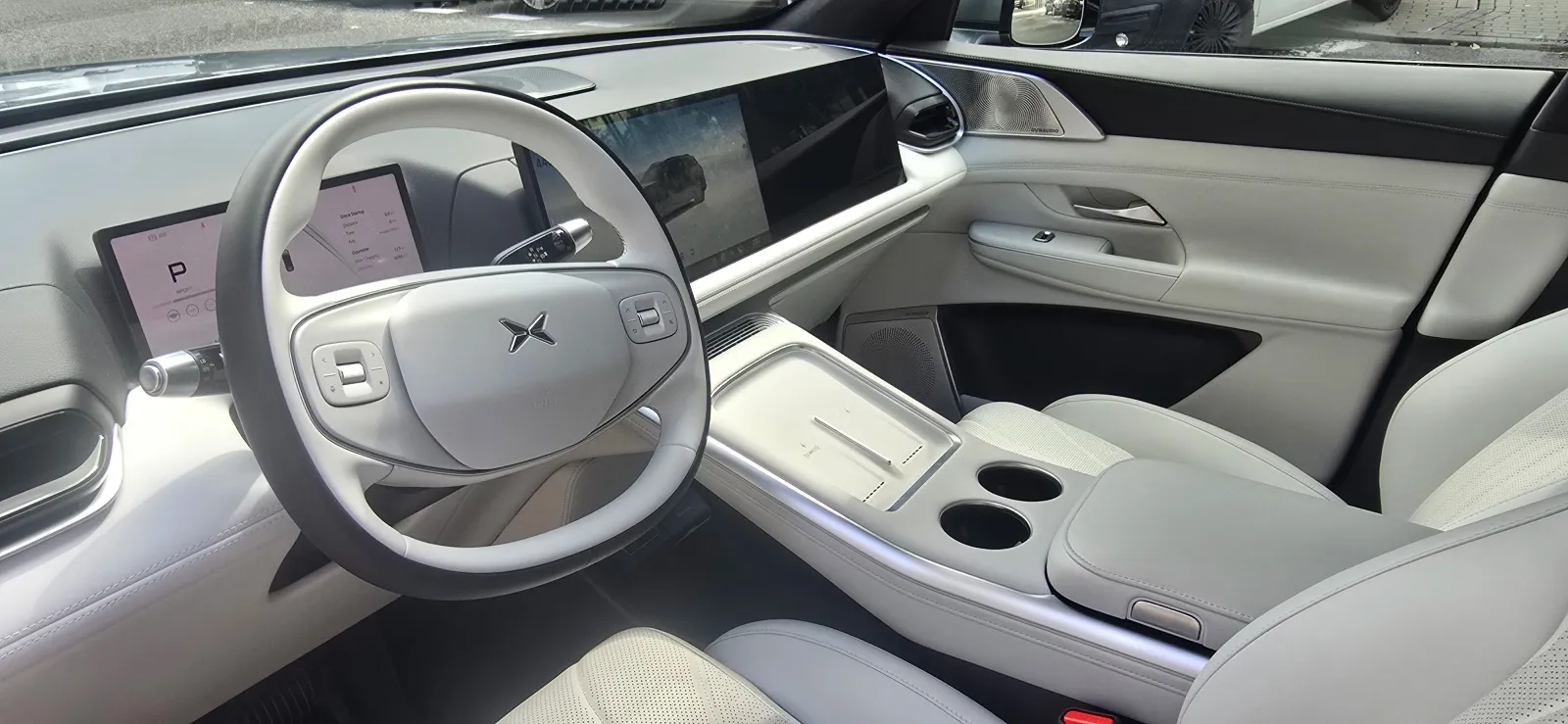
The first good impression comes even before the car starts moving. The quality of the materials is very high; most surfaces that the driver and passengers come into contact with are soft and pleasant to the touch, and the fit of the components is flawless. There’s no sense here that the manufacturer focused all its attention on screens and flashy features while cutting corners on the quality of the cabin itself.
The seats are very comfortable and perform well during long trips. They come equipped with heating, ventilation, and massage functions. These are not just cosmetic extras. During several hours of driving, the ventilated seats and the ability to activate massage truly improve comfort.
The cabin also gives a very good impression in terms of ergonomics and space. Everything is modern, but there’s no sense of clutter. The car becomes familiar quickly, and it takes only a short time to use its most important functions naturally.
Ride comfort is one of the G9’s biggest strengths
The XPENG G9 is designed primarily with comfort in mind. Its suspension handles uneven surfaces very well, allowing it to cover long distances smoothly. The car doesn’t try to force itself to act like a sports SUV, even though its more powerful versions offer excellent performance.
In my opinion, this is a wise decision. With such dimensions and the car’s character, smooth driving, stability, and passenger comfort are far more important than overly stiff suspension settings.
Despite its large weight, the G9 handles with great confidence. On highways it maintains stability, requiring no constant steering adjustments and offering a sense of peace. The steering response is predictable, and the car doesn’t feel as large as its external dimensions would suggest.
Quietness is another strong point
In an electric vehicle, quietness takes on special importance. The absence of an internal combustion engine makes it much easier to hear tire noises or air sounds. In the G9, these elements are very well insulated from the cabin.
At highway speeds, it remains quiet and peaceful inside. There’s no need to raise one’s voice while talking, and long drives don’t cause fatigue from noise. Combined with its soft suspension and comfortable seats, this makes it an excellent car for long trips.
A lot of space for the family
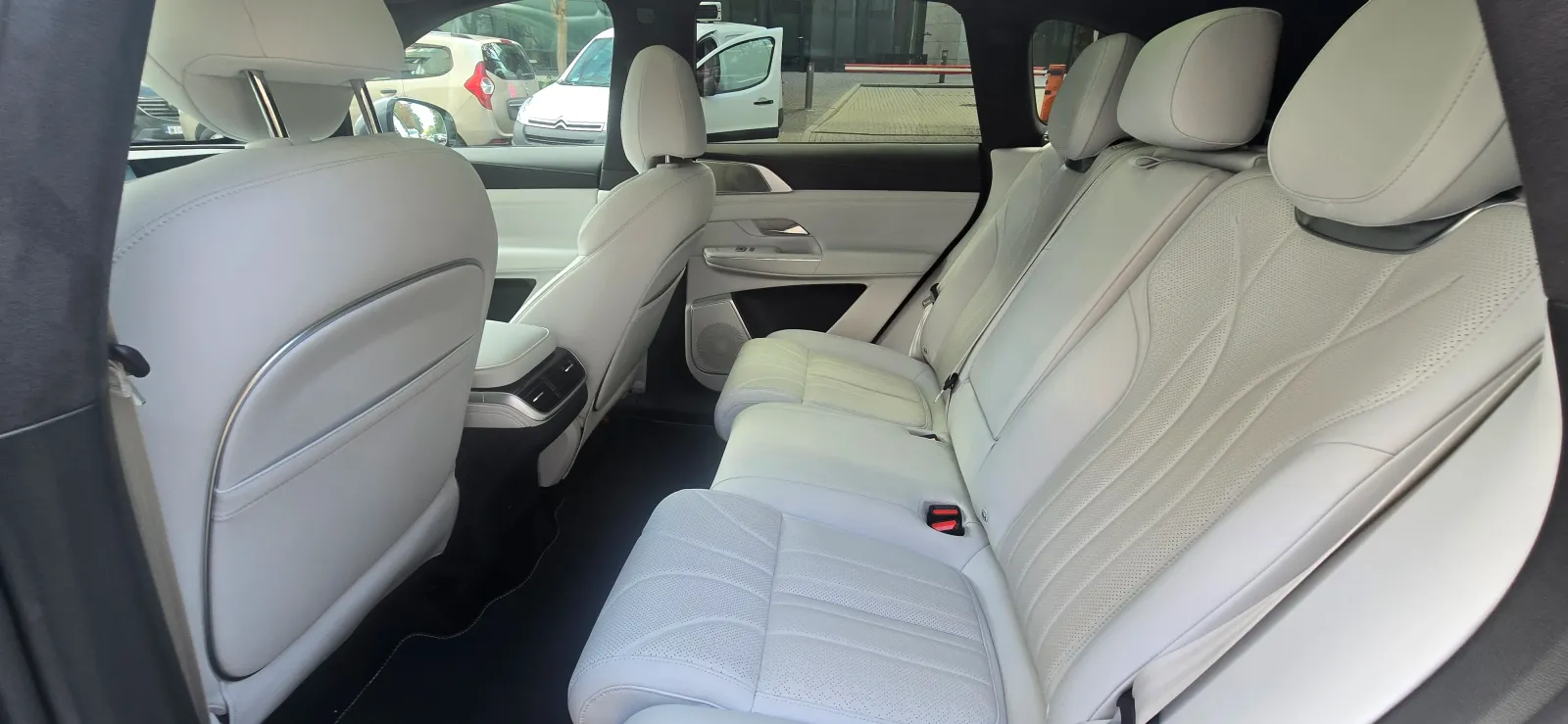
The XPENG G9 is a truly large SUV. It measures almost 4.9 meters in length, with a wheelbase of nearly 3 meters. These figures directly affect the amount of space available inside the cabin.
In our case, it was no problem to install two bases with child seats on the rear sofa. Importantly, an adult could still sit between them. For families with two young children, this is a very practical advantage, as in many cars the middle seat becomes practically unusable after installing two child seats.
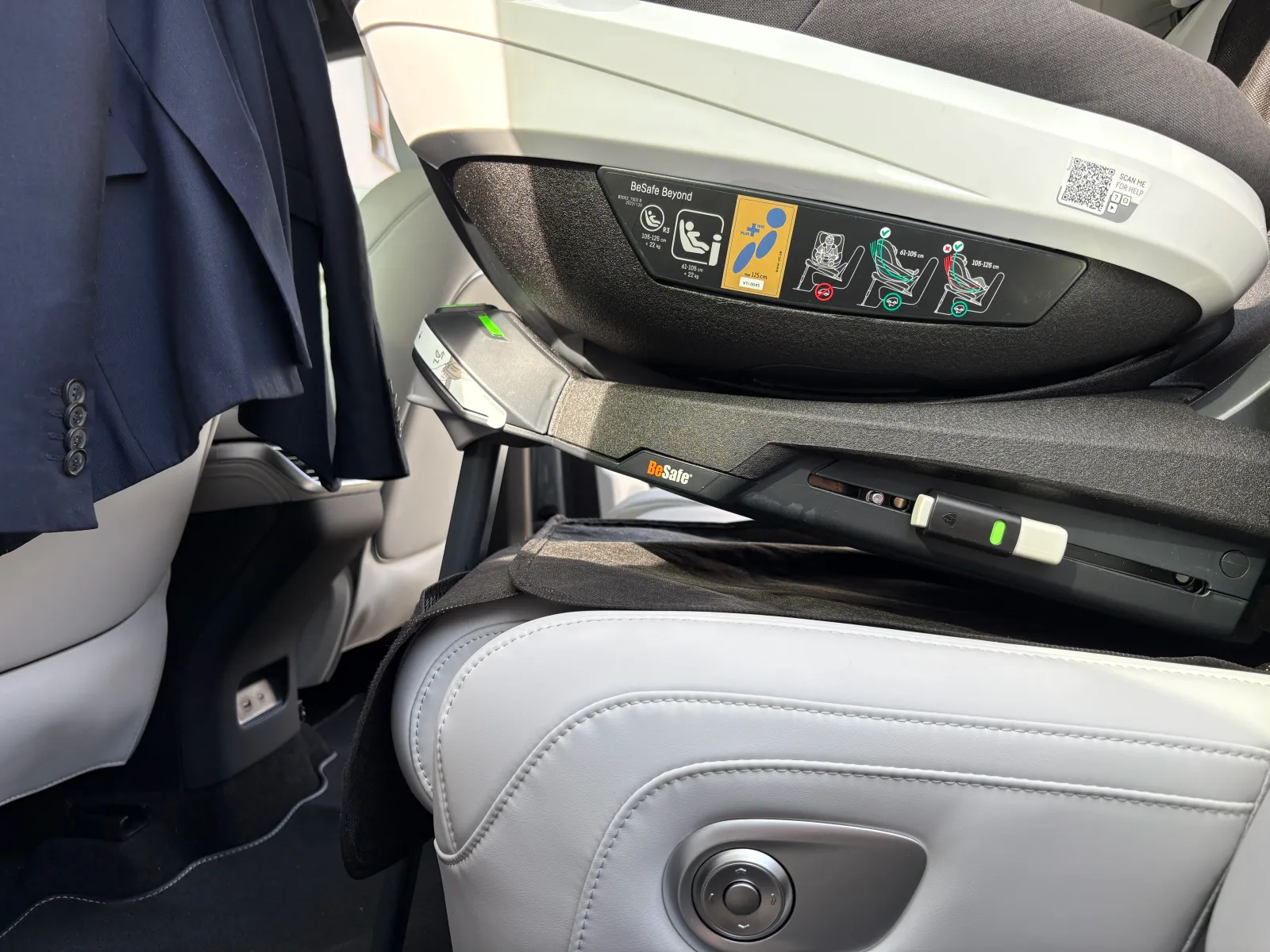
However, she noticed the geometry of the sofa with one of the sets. To keep the base properly level, the difference between its setting and the seat surface was quite large. This doesn’t mean the G9 has issues with car seats, but it’s worth checking the specific base and seat in your own configuration before purchasing.
Multimedia is among the best features of the car
The infotainment system works very quickly and smoothly. The graphics are modern, touch responses are instant, and the whole thing gives the impression of a product designed by a company that understands modern consumer electronics well.
The interior features large screens, and a separate passenger display allows users to access multimedia content independently from the driver. For example, one can watch YouTube while driving, with the screen designed to minimize visibility of the content from the driver’s seat.
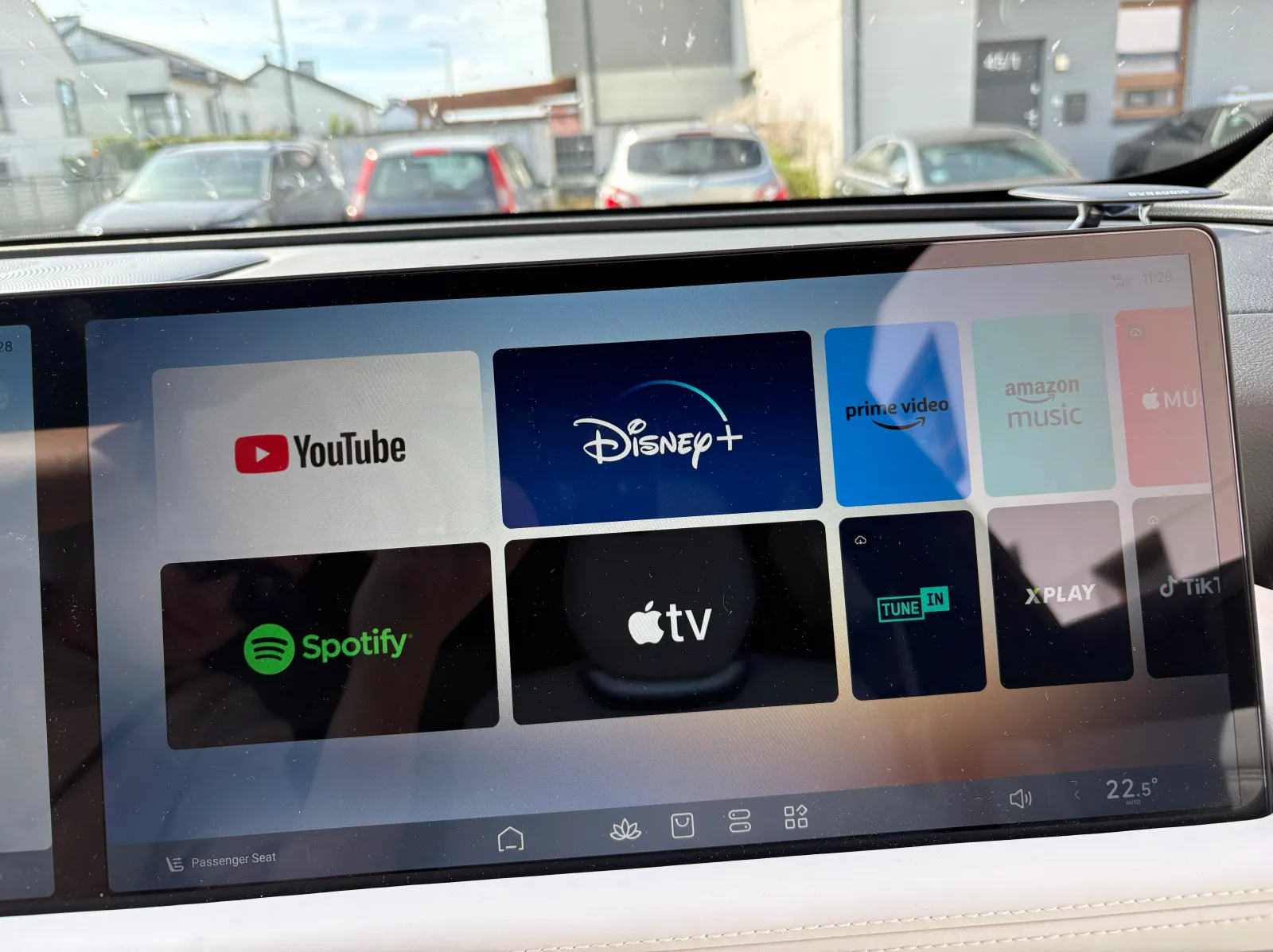
For long trips, this setup proves to be very practical. Passengers can watch movies or use other multimedia functions without taking over the car’s main screen.
Dynaudio fits perfectly with the G9’s character
The Dynaudio audio setup also deserves praise. The sound is spacious, clean, and powerful, with the excellent cabin noise isolation further enabling full utilization of its capabilities.
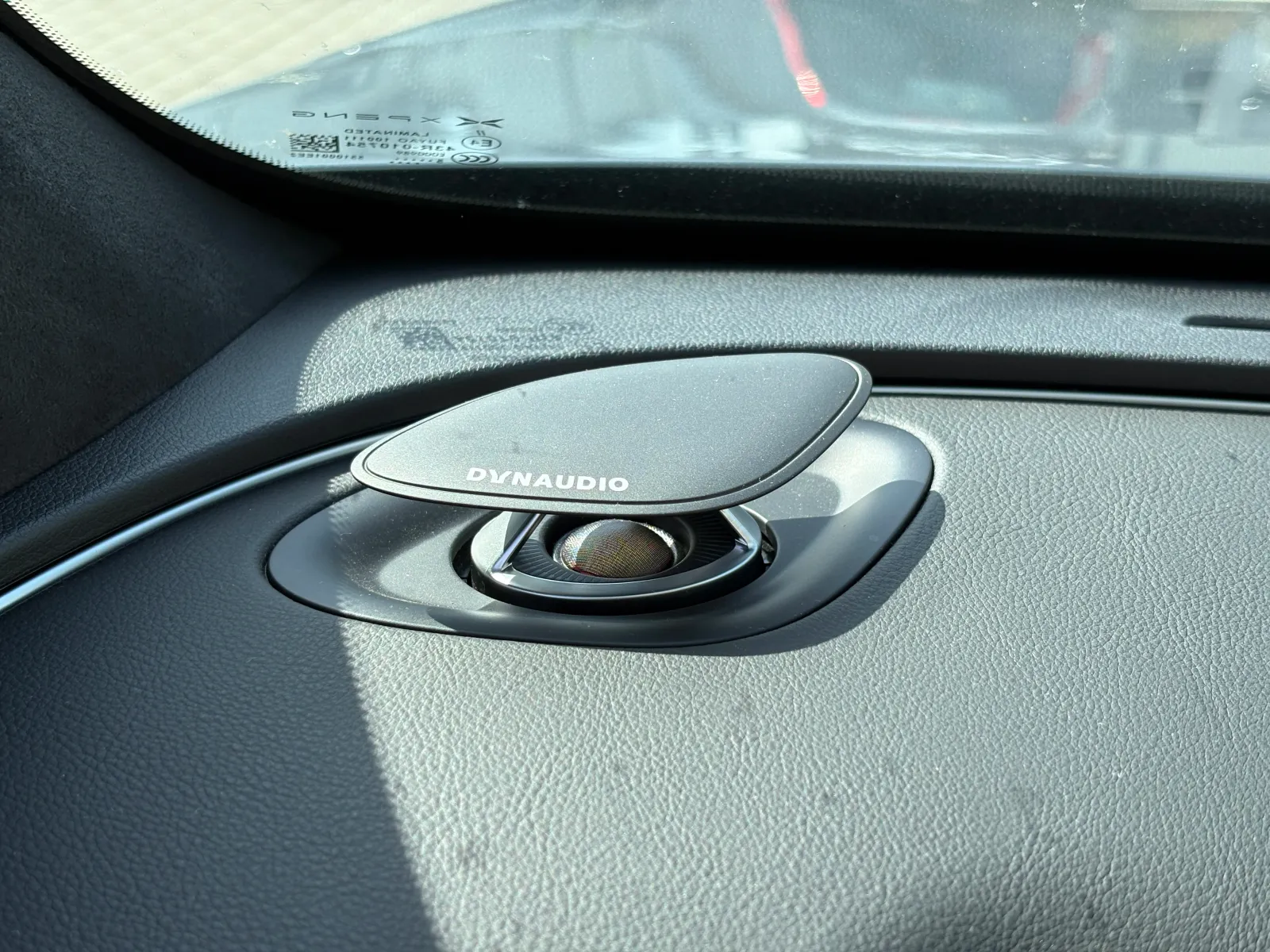
This is one of those features that effectively highlights the G9’s aspirations. The car aims to be a comfortable, modern premium SUV, and the audio system fits well with this identity.
The active cruise control and lane assist work very naturally
The driver-assistance systems also perform well. The active cruise control maintains a good distance from the car ahead, while the lane assist functions smoothly without appearing overly cautious.
The automatic lane change works particularly well. The car performs the maneuver smoothly, without sudden steering movements, and the whole process appears natural and predictable.
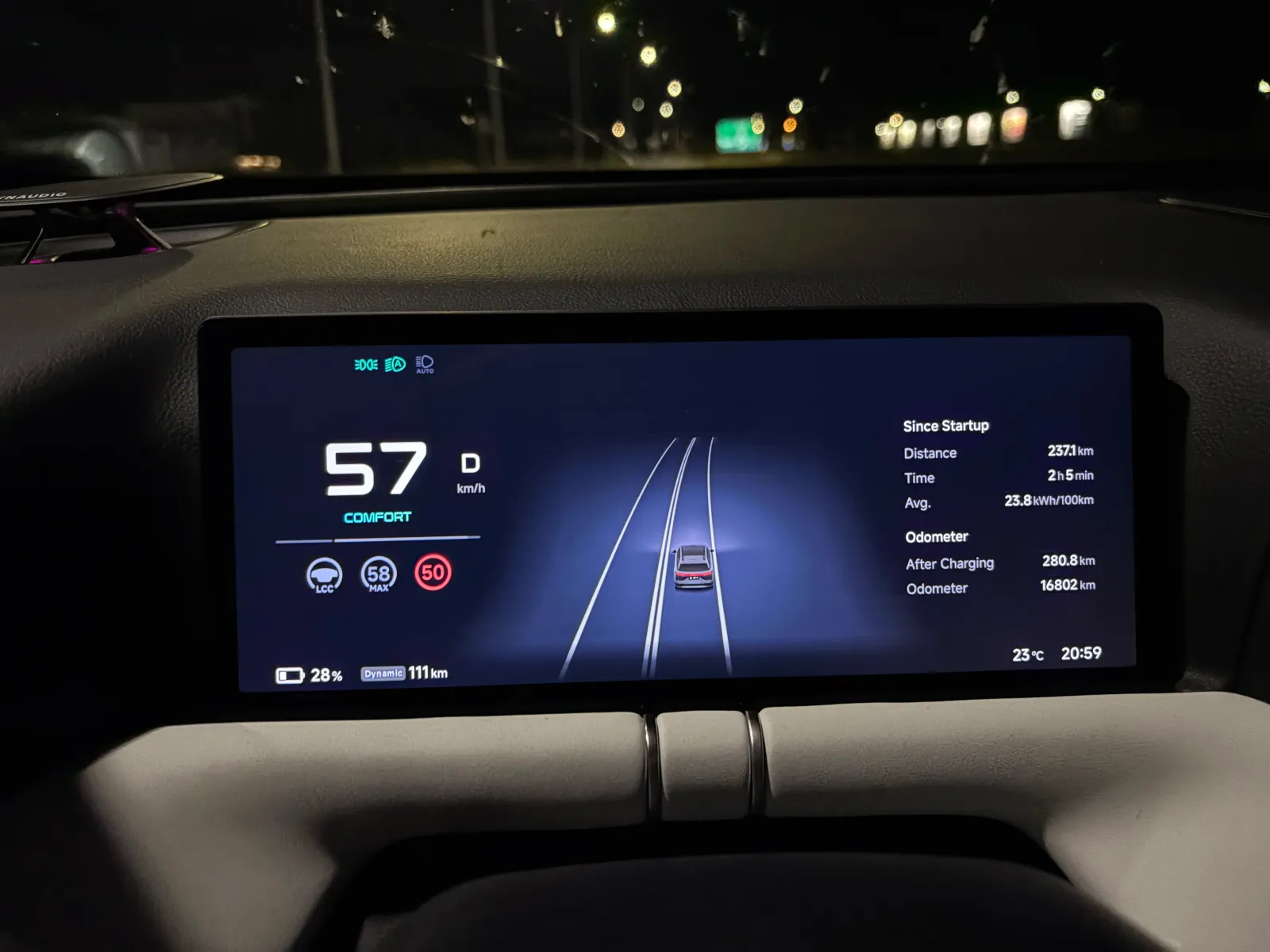
This is important because in many new cars, the number of ADAS systems looks impressive in the specifications, but their operation is so annoying that drivers quickly start turning them off. With the G9, it’s the opposite. These are systems that one really wants to use.
The biggest technological showcase? Charging
Yet the most spectacular feature of the XPENG G9 is its charging speed. Depending on the version, the maximum DC power ranges from 445 kW to as much as 525 kW.
The number alone is impressive, but what’s far more important is how the car performs at a real public charger.
Near Ciechocinek, we connected the G9 to a GreenWay Polska station with a maximum power of 400 kW. The car achieved 391 kW.
This means it was able to utilize almost all the power available at the station.
10% to 80% in about 12 minutes
The overall charging time was even more impressive. It took about 28 minutes for the car to charge from 2% to 100%, with the charger delivering over 98 kWh of energy.
The most important range for travel looks even better. It took the G9 about 12 minutes to go from 10% to 80%.
This is a result that truly changes the way people think about long-distance driving with electric cars. With conventional electric vehicles, stopping at a fast charger often means waiting 25–35 minutes. Here, you can hit the road again after just a few dozen minutes.
The charging curve is what impresses the most
A maximum power output of 525 kW looks great in promotional materials, but what’s even more important is how long the car can maintain high power levels.
In the G9, the charging curve is exceptionally good. Even at around 80 percent battery charge, the car can still accept over 200 kW of power.
This is one of the most crucial parameters for users. In many electric vehicles, once the battery reaches 70–80 percent, the power drops so significantly that further charging becomes pointless (for example, in the Tesla Model Y Long Range at 80 percent charge).
The charging power for the battery is only 50 kW. Even with a high battery level, energy is still replenished very quickly in the XPENG.
This means the driver doesn’t need to obsessively make sure to unplug the car at exactly 80 percent. If they need more range for the rest of the journey, they can stay connected a few minutes longer while still benefiting from very high power.
And now we move on to the road test
To test the G9 in conditions where such a vehicle can actually be used, we chose a route from Warsaw to the area around Ciechocinek. The one-way distance was about 240 km.
At the start of the trip, the battery was charged to 75 percent. Due to heavy traffic, we traveled to Łódź at a speed of around 110–120 km/h. Later, the speed increased, and on faster sections we typically maintained 130–140 km/h.
After traveling 240 km, the onboard computer showed an average consumption of 25.6 kWh/100 km.
Given the car’s size, weight, and highway speeds, this result is not particularly surprising. The G9 is not a lightweight, low-slung sedan designed for maximum efficiency. It is a large and comfortable SUV that can travel about 350 km on a fully charged battery on highways.
The return trip was even better
We set off on the return journey with the battery charged to 91 percent. After traveling the same approximately 240-kilometer route, 28 percent of the battery remained.
The onboard computer showed an average consumption of 23.8 kWh/100 km.
This is a very decent figure for a large SUV that primarily travels on highways. Moreover, the values displayed by the computer align well with the energy consumption indicated by the battery level drop.
With a consumption of 25.6 kWh/100 km, the first 240 km require approximately 61.4 kWh of energy. At 23.8 kWh/100 km on the return trip, it takes about 57.1 kWh.
This is important because it shows that the measured consumption appears reliable.
The actual highway range can be estimated at around 360–390 km
Based on our results, it can be assumed that when driving fast on the highway, the larger battery version of the G9 should be able to cover approximately 360–390 km on a full charge.
Of course, the result will depend on temperature, wind, elevation differences, load, speed, and road conditions. However, at 130–140 km/h, it’s not reasonable to expect values close to the official WLTP figure.
And this is where ultra-fast charging becomes extremely important. The G9 doesn’t need to be the most fuel-efficient electric car on the market, as it can quickly recover the energy it uses.
If the battery can be charged from 10% to 80% in about 12 minutes, a single short charge is enough to restore the energy needed to cover another roughly 250 km on the highway.
But to keep things from sounding too perfect, I also found one weakness in the Xpeng during driving.
It relates to the battery level estimate at the destination.
At the start of the trip from Warsaw, we had 75% battery remaining. The car predicted that after driving about 240 km, we would arrive with 34% left.
The reality was completely different.
We reached the destination with only 7% battery left.
The difference was as much as 27 percentage points.
That’s definitely too much.
Trust in the prediction
In an electric vehicle, the driver must be able to trust the energy forecast at the end of the journey. If the system indicates that more than one-third of the battery remains upon reaching the destination, but in reality only a few percent is left, planning the trip becomes much more difficult.
Importantly, the energy consumption readings themselves appeared correct. This suggests that the problem lies not in the measurement of usage but in the algorithm predicting how much energy the vehicle will need for the rest of the journey.
This is actually good news, as such an issue can potentially be fixed with a software update.
XPENG G9 – Verdict
After a few days and hundreds of kilometers behind the wheel, the G9 leaves a very good impression. It is a comfortable, spacious, and well-built SUV that doesn’t have to be seen as a “cheaper Chinese alternative” to European cars.
The quality of the interior, noise reduction, suspension, multimedia system, audio setup, and performance of the driver assistance features are all excellent. For families, the extra space in the second row and the ability to carry two car seats without completely losing the middle seat are major advantages.
However, its biggest technological advantage remains charging. 391 kW at a public 400 kW station, about 12 minutes to go from 10% to 80%, and over 200 kW when the battery is at around 80%—these numbers truly change the way electric cars are used.
The G9 isn’t the most energy-efficient electric vehicle on the market, and at high speeds on the highway, expect fuel consumption of around 24–26 kWh per 100 km. However, with such short charging stops, this becomes less of an issue.
The most important aspect that still needs improvement is the battery level estimation upon arrival. If XPENG refines this software feature, the G9 will be one of the most comprehensive large electric SUVs in its class.
This is also a good example of how the electric vehicle market is evolving. Not long ago, everyone focused primarily on declared range. The G9 shows that the next step might be something different: not who can drive the farthest without stopping, but who can get ready to continue driving fastest after a short stop.
Łukasz Lewandowski, EV Klub Polska