
Xiaomi SkyNomad: Two range-extender SUVs for China starting at 34,000 euros
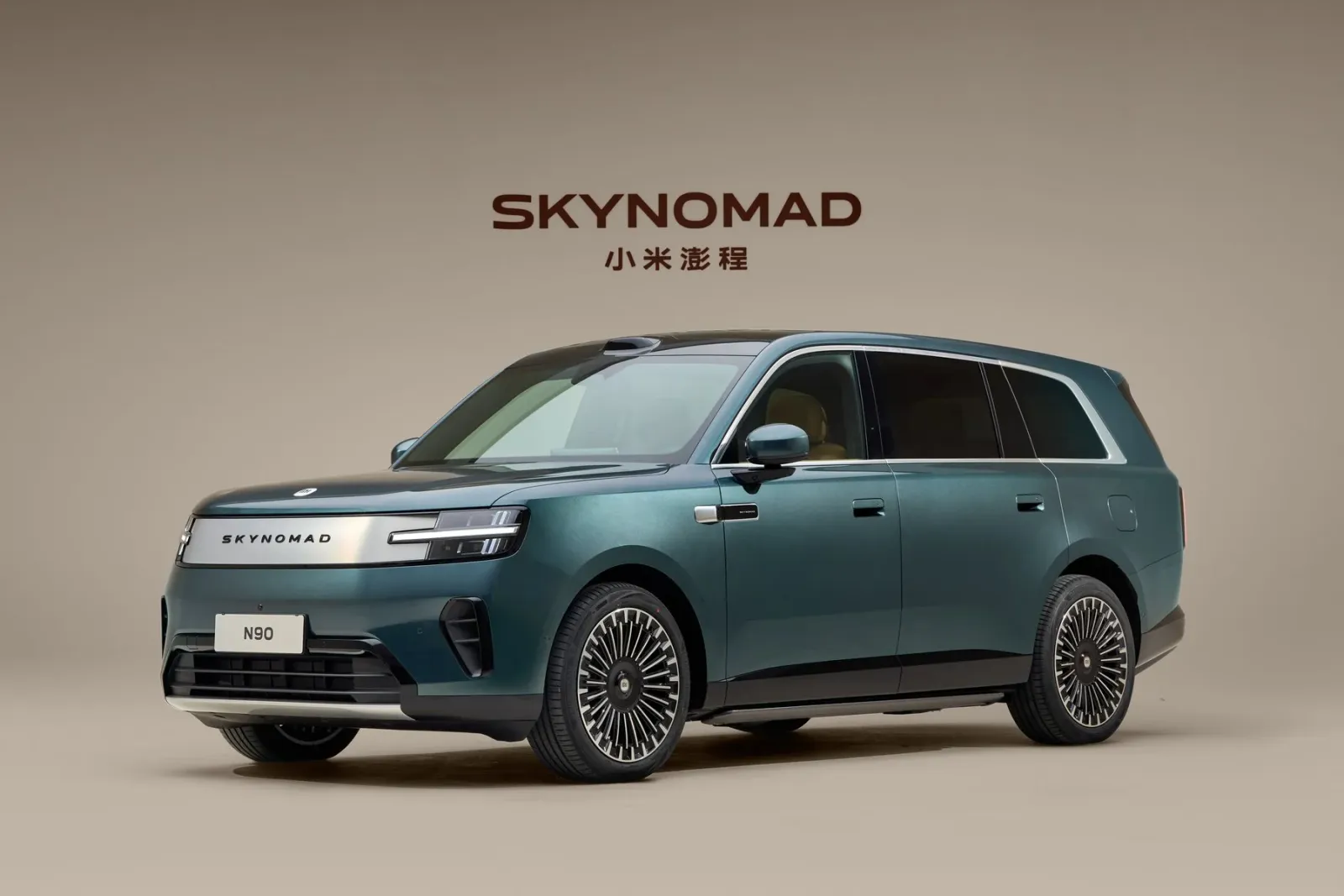
Xiaomi now also has range extenders (EREV) in its portfolio. On July 30, the company unveiled its second vehicle series, SkyNomad, in Beijing. Two large SUVs are available for pre-order now. According to estimates by Chinese media, over 100,000 reservations have already been made.
The seven-seater SkyNomad N90 Max is going on pre-order at 299,900 yuan (around 39,200 euros), while the five-seater N70 Max costs 259,900 yuan (around 34,000 euros). These are both the top versions labeled “Max.” The “Pro” variants and base models are expected to follow at the official market launch in September.
The prices are likely chosen intentionally: In this way, the N90 Max competes with Tesla’s six-seater Model Y L, which costs 339,000 yuan (around 44,300 euros) in China. The N70 Max is positioned near Li Auto’s new Li L6, which has been available since mid-July for 249,800 yuan (around 32,700 euros).
Xiaomi’s decision to take this path became clear early on. As early as May, we reported that Xiaomi was planning a sub-brand with range extenders. At that time, the codename was still Kunlun N3, and there was little information available. The codename remained, but as a technical designation: both SUVs are built on the Kunlun platform, which the company claims it has been developing since early 2023, for three and a half years.
SkyNomads come equipped with an internal combustion engine
To help those unfamiliar with this drivetrain: A car with a range extender always runs electrically. Electric motors are the only ones responsible for propulsion. However, if the battery runs out of power while driving, a compact internal combustion engine kicks in. This engine functions only as a generator to produce electricity, and its power never reaches the wheels.
To overcome the typical weakness of such vehicles—a small battery and thus a constantly running generator—Xiaomi relies on large 52 or 76 kWh batteries. A charged 1.5-liter engine with 112 kW from Harbin Dongan serves as the power generator. The engine, generator, and power electronics are housed in a single unit using silicon carbide semiconductors. Xiaomi reports an electricity consumption of 15.85 kWh per 100 kilometers and an efficiency of 3.66 kWh per liter of fuel. After the first inspection, the generator only needs maintenance every three years or 30,000 kilometers.
The N90 Max: A seven-seater with a total range of 1,705 kilometers
At 5.28 meters in length, 1.99 meters in width, and 1.82 meters in height, the N90 Max is the flagship of the series and comes in a full-size format. Its wheelbase measures 3.08 meters, yet it still requires 5.95 meters to turn. The silhouette is deliberately boxy in design: a flat roof ensures headroom in the second and third rows, while a continuous window line and an ascending rocker panel complete the design. Over 140 aerodynamic details reduce the drag coefficient to 0.255—a good value for its size.
The N90 Max is powered by two engines with a combined system output of 310 kW (416 HP) and all-wheel drive. It accelerates from 0 to 100 km/h in 5.9 seconds, with a top speed of 190 km/h. The 76 kWh large ternary battery from CALB allows for 464 kilometers of pure electric range under China’s CLTC cycle. With a full tank, the Xiaomi N90 Max achieves 1705 kilometers of combined range. When the battery is empty, WLTC estimates indicate 6.26 liters per 100 kilometers are required. Charging is fast: 285 kilometers can be covered in 15 minutes, and the battery reaches 80% charge in 18 minutes. The suspension is borrowed from the SU7 and YU7, featuring double wishbones at the front, a multi-link axle at the rear, and five-stage air suspension.
The interior can accommodate seven people in a 2+2+3 layout. Xiaomi claims up to 1.55 meters of legroom in the second row, with the seat tracks measuring up to 1.93 meters. Four seats can be adjusted into a reclined position, and the front seats rotate electrically backward. When the second and third rows are folded down along with the rear seats, a 2.30-meter-long sleeping area is created. The trunk has a maximum capacity of 1,831 liters, and even with seven passengers it can still hold seven suitcases. In addition, there are 34 storage compartments, a nine-liter refrigerator, and 25 speakers.
In terms of safety, the N90 Max has the longest list: 90.4 percent of its body is made of high-strength steel and aluminum, twelve airbags are standard, and its crash depth rating is 750 millimeters. The Snapdragon 8 Gen 3 is used in the cockpit, along with Nvidia’s Drive Thor assistance system featuring 700 TOPS of performance. In addition to the front lidar, the N90 Max also has a solid-state lidar mounted at the back.
The N70 Max: Shorter, cheaper, and with a longer electric range
At 4.96 meters in length, 1.99 meters in width, and 1.76 meters in height, the N70 Max is over 32 centimeters shorter and has a wheelbase that is 13 centimeters shorter at 2.95 meters. Instead of seven seats, it has five, which results in a price that is 40,000 yuan (around 5,200 euros) lower. The competition in this vehicle class is fierce. The new Li Auto L6 costs almost the same.
Technically, the N70 Max is even more interesting in one regard, as it can travel purely on electricity for a longer distance than its flagship model, the N90. There are two battery options: a 52 kWh version using lithium iron phosphate as the entry-level model, and a 76 kWh version with ternary cells as the higher-end option. This allows it to achieve up to 505 kilometers of pure electric range in the CLTC cycle and 380 kilometers in the WLTC cycle. According to Xiaomi, this is the best range in its class, 41 kilometers higher than that of the N90 Max. The N70 Max also features two motors and all-wheel drive: 210 kW at the front and 100 kW at the rear, totaling 310 kW. With an empty battery, Xiaomi reports a fuel consumption of 5.7 to 6.28 liters per 100 kilometers.
The N70 Max gets everything essential from the platform: a flat floor, long seat rails, and an extendable cabinet in the center console with a cooling compartment. The HAD assistance system and Nvidia’s computing unit are standard features. However, the rear lidar is missing, as is the third row of seats. For those looking for a five-seater with a very large trunk instead of a family bus, this offers a more practical solution.
The Kunlun platform was designed around the interior space
Xiaomi reversed the usual order by building the interior first and then everything else. The front wheelbase measures 1.26 meters because five drive components are combined into one unit. At the back, a flat-mounted electric motor creates 14.5 centimeters more space; the air suspension moves to the control arm, lowering the floor by another 37 millimeters, while the battery pack with its controls positioned inward lowers it further by 18 centimeters.
The result is a completely flat floor from the first row to the trunk: it is just under three meters long and over 4.4 square meters in area. The step between the rows of seats and the loading floor, which typically separates large SUVs, is eliminated. The second and third rows can each be moved 90 centimeters, and the voice assistant can activate eleven interior modes on command.
Full order books, but a shrinking market segment
The customers have responded strongly. In the week after its launch, the Chinese website Cailian visited Xiaomi’s sales outlets in Beijing, Wuhan, Shanghai, and Chengdu, counting 200 to 300 reservations at each location. Extending this to the company’s 499 outlets would result in over 100,000 reservations. It’s important to note that this is an estimate based on a sample, not an official figure from Xiaomi. On August 2 alone, 4,800 reservations are said to have been made in Beijing, with over 30,000 in the Beijing-Tianjin region combined. The larger seven-seater model is particularly in demand.
Xiaomi has set a target of 550,000 deliveries for 2026, but managed only around 220,000 from January to July. The SU7 and YU7 models combined account for about 30,000 vehicles per month. To meet its annual goal, Xiaomi would need to deliver an average of over 60,000 cars in the remaining five months. Yet precisely the market segment the company is now entering is shrinking. According to data from the vehicle manufacturers association CPCA, 450,000 vehicles with range extenders were sold in China in the first half of the year—about 15 percent less than in the same period last year. However, CEO Lei Jun believes the market is far from saturated, citing strong demand for the new Li Auto L6.
The production of the SkyNomad models is already underway in the second phase of the Beijing factory. Sellers promise that the long waiting times seen with the YU7 will not recur, and that the first units will be available immediately after the market launch in September. The N90 will be publicly displayed for the first time starting August 21 at the auto show in Chengdu. Xiaomi cites suppliers such as Harbin Dongan for the range extender, Hesai and RoboSense for the lidar systems, and Bosch for the braking system.