
Xiaomi prepares its entry into France: a sensor-packed SU7 makes an unexpected appearance in Alsace!
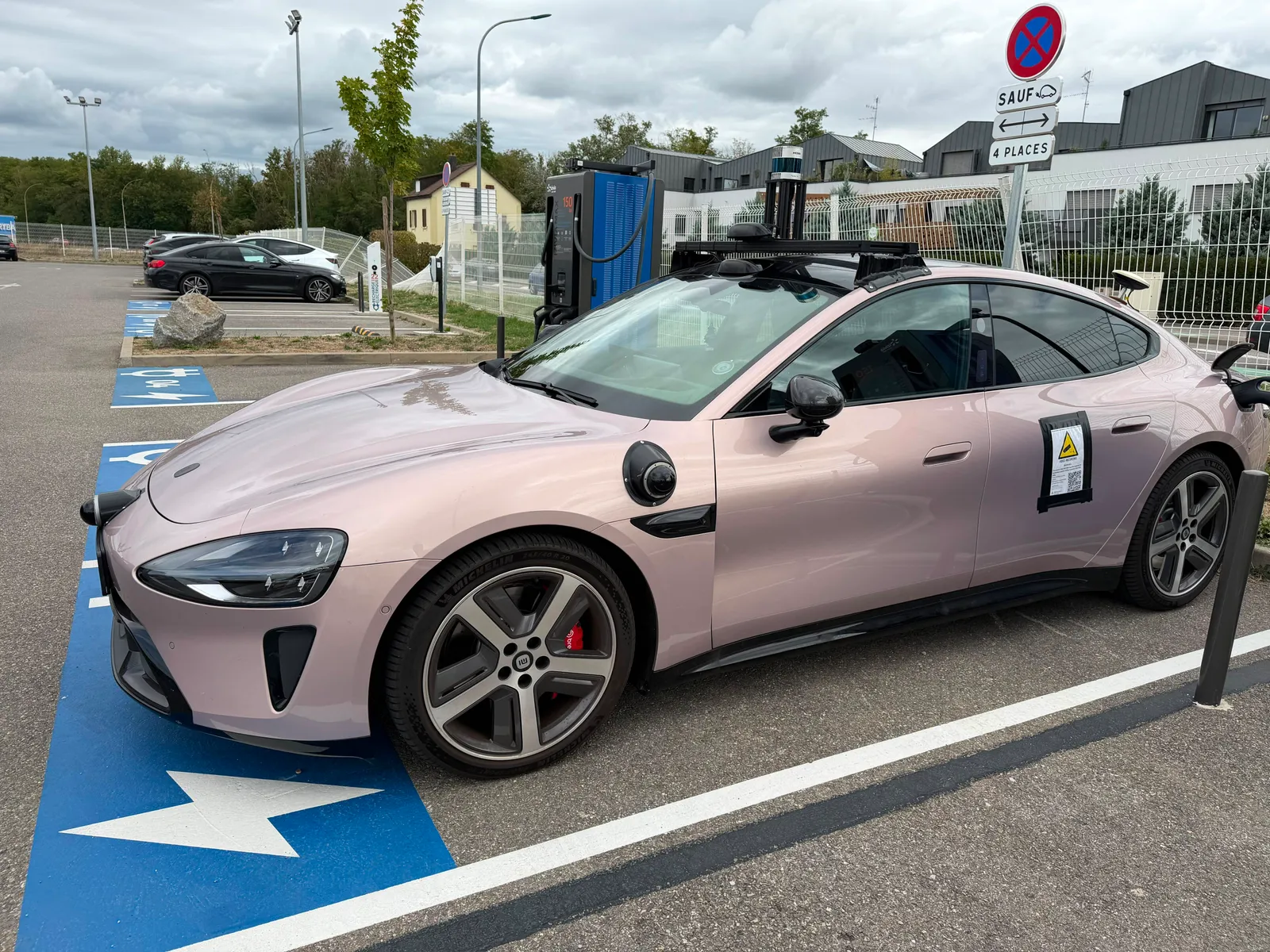
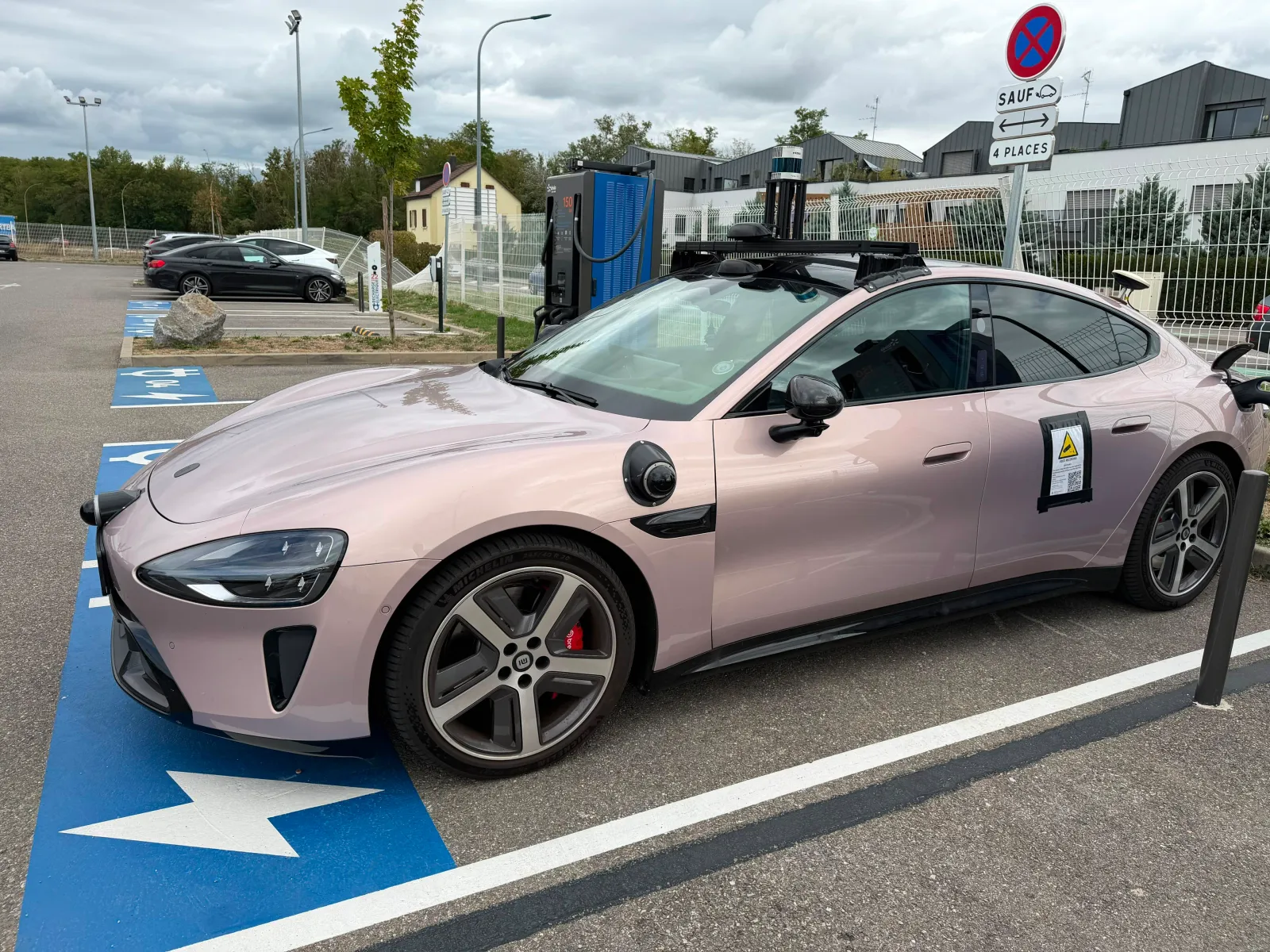
A Xiaomi SU7 equipped with numerous sensors plugged into a fast charging station in Alsace: the scene is quite intriguing. Nathanaël, a loyal reader of Automobile Propre, photographed this development vehicle last night on a parking lot in Saint-Louis (Haut-Rhin), just a few kilometers from Germany and Switzerland. This latest sighting confirms that Xiaomi continues its testing on European roads, with its launch on the continent scheduled for 2027.
A test vehicle caught at a 150 kW charging station
The famous SU7, shown here in a pink color, was caught being charged at an Izivia charger displaying 150 kW. It’s impossible to determine the actual power delivered at the time the photos were taken.
An electric car plugged into a fast charger is certainly nothing unusual. However, this one is much more interesting: Xiaomi has not yet officially launched any cars in Europe, and this SU7 is equipped with numerous measurement devices.
In detail, a custom-made device can be seen on the roof, housing a 360° rotating LiDAR from Hesai brand mounted on a central mast. Two wide-angle cameras have also been added to the front of the car. At the back, a second mast carries a high-precision GPS/GNSS antenna, positioned above the spoiler.
Another detail gives insight into the vehicle’s origin: its German license plate. It begins with M, the code for Munich, and ends with E, the German suffix used for electric vehicles that meet regulatory requirements.
The Munich license plate is likely no coincidence. It is in this Bavarian capital that Xiaomi has established its European R&D and design center, where the company works on adapting its technologies for the European market.
A cockpit transformed into a mobile laboratory
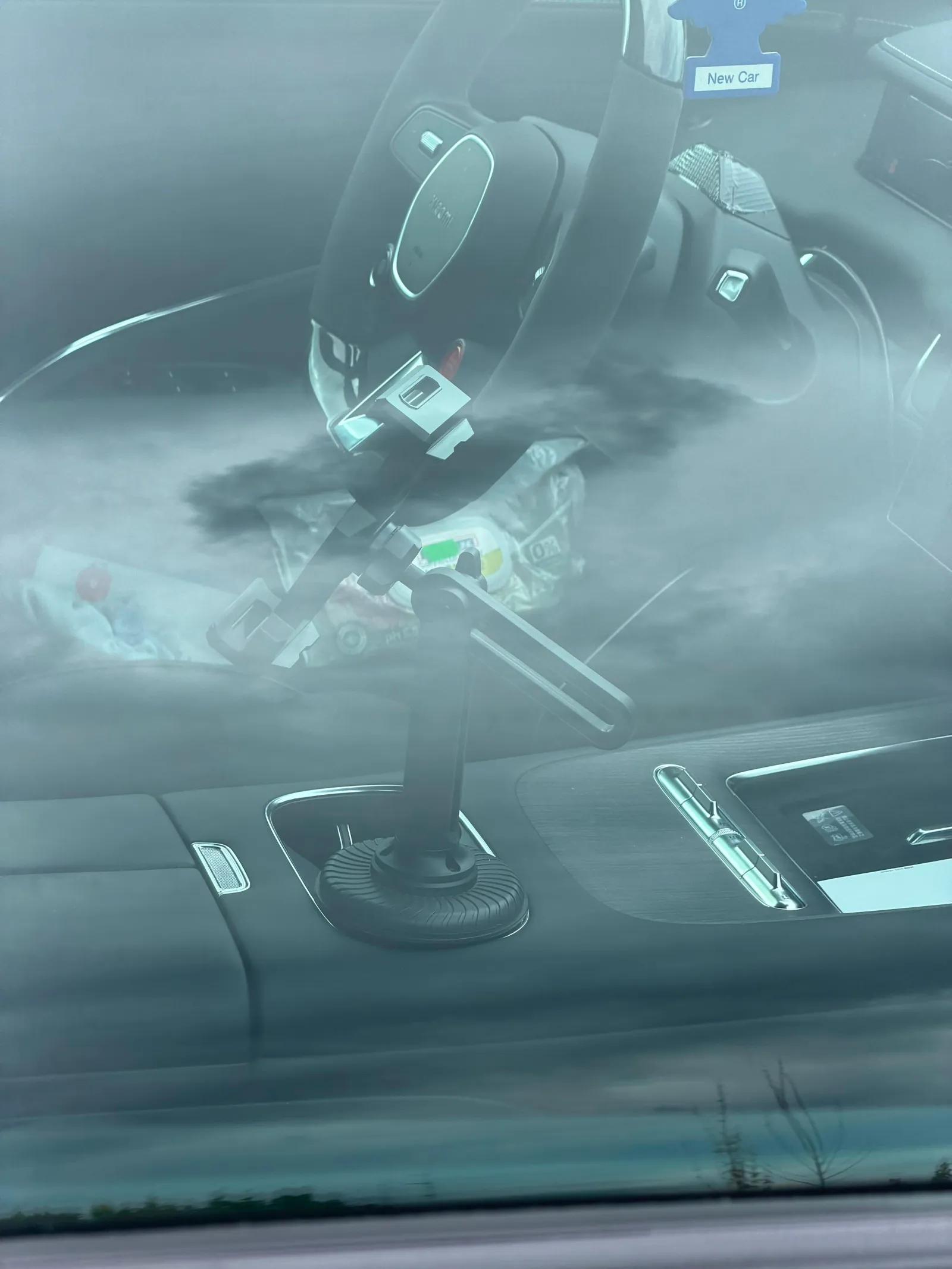
The photo of the cabin confirms that it is indeed a development vehicle. An articulated arm is mounted in the central cup holder, with a gripper facing the driver. Empty at the time of our photographer’s visit, this holder can accommodate a control screen or acquisition equipment. Above the steering column, masking tape also reveals a temporary installation.
Everything suggests that the cockpit is also used to monitor the equipment installed on board during tests.
TÜV Rheinland designated as the data processing authority
A sticker on the door provides additional information about the testing campaign. The text, in both English and Hungarian, states that “the vehicle is equipped with a video recording system for development purposes, aimed at improving road safety.”
An interesting detail: the document designates TÜV Rheinland Kraftfahrt GmbH, headquartered in Cologne, as the responsible party for handling the personal data recorded by the vehicle, such as faces or license plates that may appear in the images.
The specific technical purpose of all the data collected is not indicated. However, its recording can contribute to the development and validation of driving assistance systems for European roads: recognizing traffic signs, detecting other road users, or adapting to local conditions.
This is particularly important for Chinese manufacturers, whose driving assistance systems may sometimes lack relevance when applied directly to European roads, as Éric Dupin highlighted in a recent article.
Xiaomi’s arrival is becoming increasingly certain
This Alsatian SU7 isn’t actually the first Xiaomi development vehicle spotted in France. Automobile Propre reported last March on the appearance of a SU7 equipped with numerous sensors, following another prototype observed in Metz at the end of February. Six months later, this new sighting shows that European testing is continuing.
The timeline is starting to become clearer. As Valentin mentioned just 3 days ago, Xiaomi has confirmed its intention to launch its vehicles in Europe starting in 2027. At IFA in Berlin at the beginning of September, the brand showcased the SU7 and began seeking partners to establish its future European distribution network. However, France has not yet been officially confirmed as one of the initial markets.
While Xiaomi is preparing its commercial network, its technical teams seem to be continuing their work on European roads. It’s highly likely that the SU7 models equipped with numerous sensors won’t be the last Xiaomi vehicles we encounter here before the official launch.
What are your thoughts on this? Eager to see the SU7 and YU7 in dealerships? Share your opinions in the comments or continue the discussion on the Xiaomi SU7 forum.
A big thank you to Nathanaël for his photos. Updates like these are also shared on Automobile Propre thanks to your contributions.