
Xiaomi presented the XRING D100 chip for autonomous driving. A 3 nm process sounds powerful, but its TOPS value remains unknown.
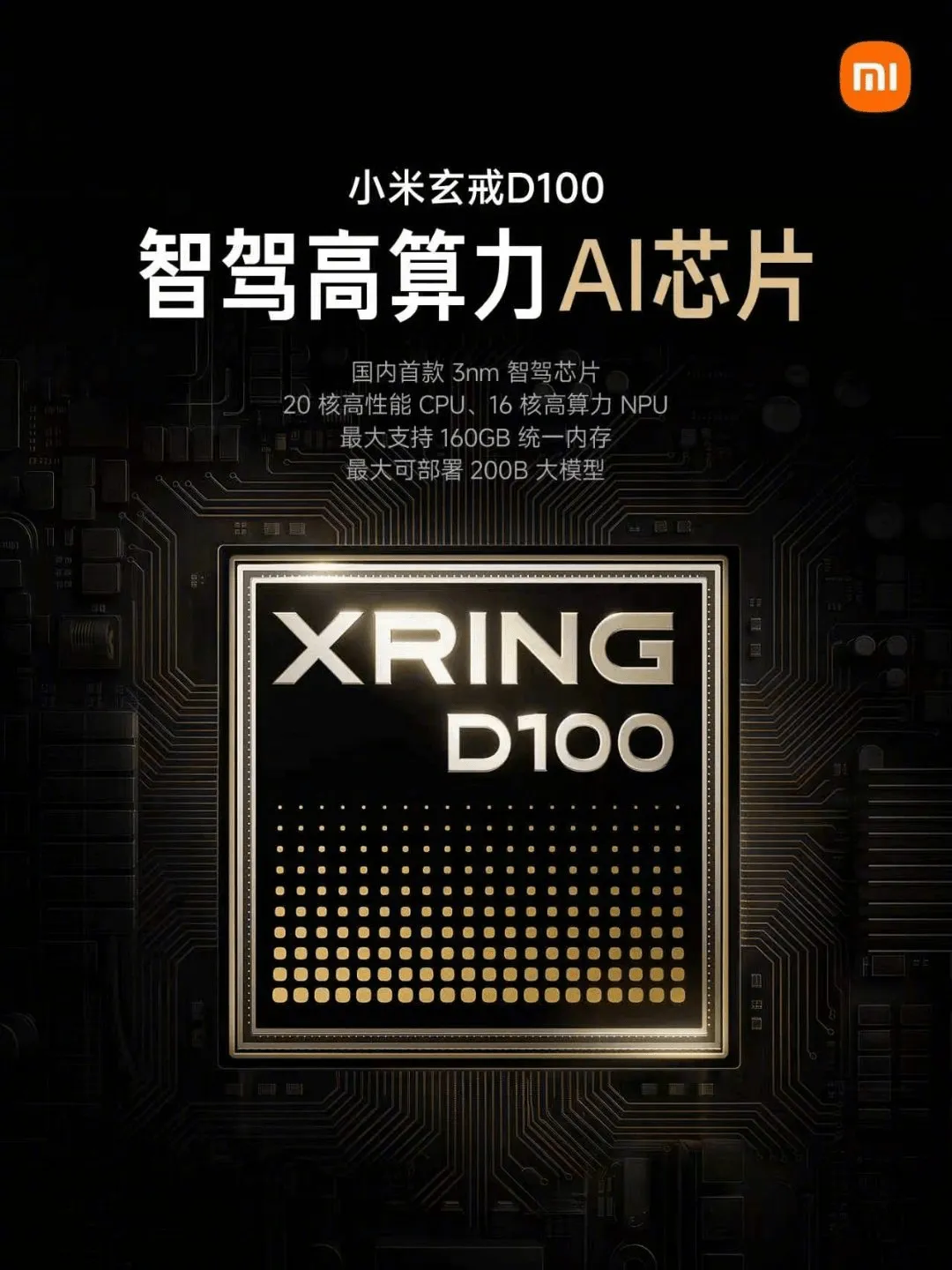
Xiaomi unveiled the XRING D100 on August 24, its first in-house chip for autonomous driving systems. The company mentions a 3 nm manufacturing process, local processing capability for up to 200 billion parameters, and commercial deployment by 2027.
Table of Contents
Show
Hide
This is another step for Xiaomi as it moves from consumer electronics to the automotive industry. However, for now, it appears more like a demonstration unit rather than a ready-to-use product for mass-produced vehicles.
What We Know About XRING D100
The XRING D100 is an AI chip for smart driving, serving as the central computer for assistance and autonomy functions. Xiaomi claims it is the first high-performance autonomy chip in China manufactured using 3 nm technology.
The specifications revealed by the company sound ambitious. It features a 20-core CPU, a 16-core NPU, and support for up to 160 GB of unified memory. Xiaomi also claims to support locally running language models with over 200 billion parameters.
It sounds impressive. The problem is that another parameter needed for industry comparisons, which Xiaomi hasn’t provided, is computing power in TOPS. Without this, it’s difficult to fairly compare the D100 with NIO, Li Auto, BYD, or NVIDIA’s chips.
The company states that the chip has completed its development and validation phases. Commercial use is set to begin in 2027, but Xiaomi hasn’t yet specified any particular car model or production timeline.
Not in cars yet, just in the AI Cube
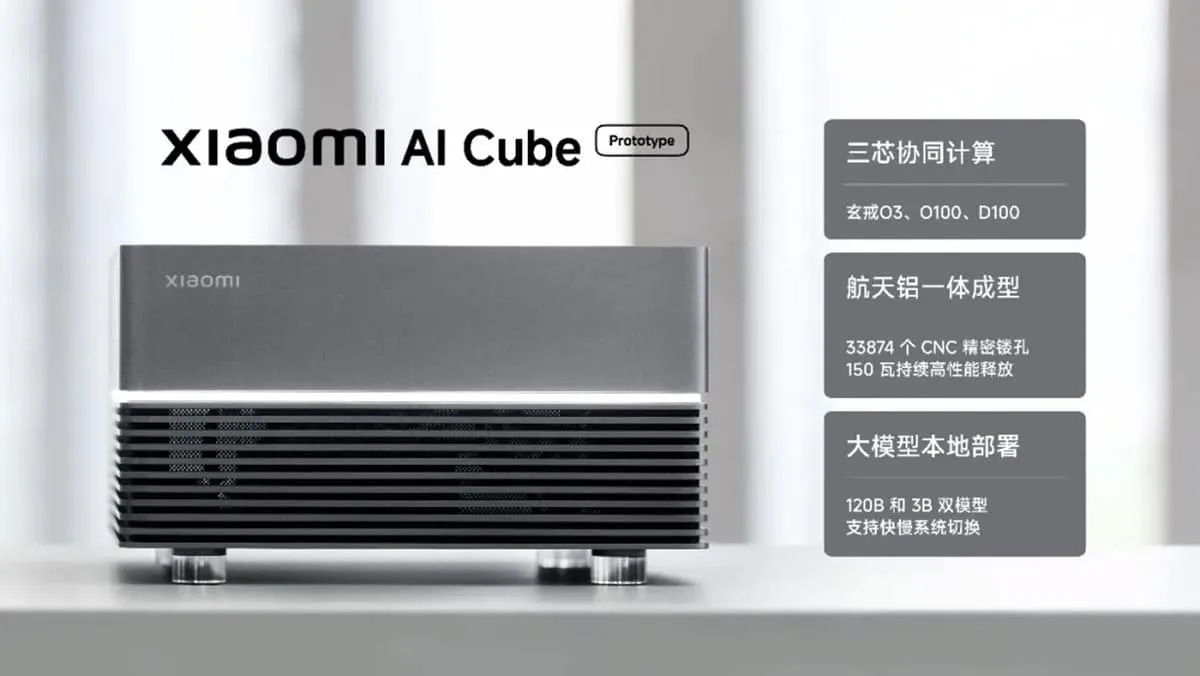
The D100 hasn’t been integrated into a car yet. Xiaomi has installed it in the AI Cube Prototype, which is a high-performance AI demonstration terminal.
This prototype is designed to showcase the local capabilities of the chip. According to the company, it supports 120B and 3B models, and also allows switching between faster and slower modes. In fact, the AI Cube itself contains three chips from the new series: XRING O3, XRING O100, and XRING D100.
This gives us an idea of Xiaomi’s strategy. They aren’t developing a single chip for one car, but rather building their own entire computing portfolio, ranging from smartphones to AI and automotive applications.
However, from the perspective of an EV driver, the most important question remains simple: when will it actually be on the road, rather than just on a demonstration stand?
Xiaomi Moving Away from Complete Dependence on Nvidia
Xiaomi’s current electric vehicles primarily use Nvidia Drive Thor chips, though the company has also used Nvidia Orin in the past. Its own chip is set to offer several advantages at once: lower long-term costs, greater control over software and hardware, and faster customization of algorithms for specific architectures.
This is actually a typical strategy among Chinese manufacturers. First, you use a platform provided by a supplier, then develop software, and finally try to integrate everything with your own chips. Tesla did this in its own way earlier on, and in China, this competition is accelerating rapidly.
Xiaomi stated that since the restart of its major semiconductor program over five years ago, it has invested more than 21 billion yuan, or about 3.1 billion dollars, in this area. The chip team now comprises nearly 3,000 people.
This is no longer a side project. But the costs are also substantial. In its financial results for the second quarter, new initiatives including those in EVs and AI resulted in an operating loss of 2.6 billion yuan. The company cited higher prices for key components, AI-related costs, and a weaker sales mix for the SU7 Ultra as reasons.
China’s race to develop its own chips for autonomy
Xiaomi is entering a segment where competitors are further ahead in commercialization.
NIO has the Shenji NX9031 chip in a 5 nm process. This chip is already being mass-produced in some NIO and ONVO models, with cumulative shipments exceeding 300,000 units. According to previous statements, a single NX9031 chip offers over 1,000 TOPS of performance.
Li Auto has its own Mach M100 chip also built on a 5 nm process. The company claims 1,280 TOPS per chip, and this solution has already been installed in the new generation Li L9, Li L8, and Li L6 models.
XPeng is developing the Turing chip. This chip is used not only in XPeng’s own vehicles but also has an implementation plan with Volkswagen Group in China. The cumulative shipments have exceeded 200,000 units.
BYD unveiled the Xuanji A3 with a 4 nm, automotive-grade chip in May, aiming to support L3 and L4 driving levels. This chip is already in mass production. BYD states that a cluster of three chips delivers over 2,100 TOPS.
Against this backdrop, Xiaomi has one advantage on paper: a more advanced 3 nm process. However, the technology alone doesn’t win the race. Power consumption, integration with sensors, software stability, cost, and production scale also play crucial roles. And of course, whether the vehicle actually drives better matters too.
In short: 3 nm sounds impressive, but without TOPS and a production-ready chip, it remains just a promise.
XRING is no longer just one chip, but an entire platform
At the same event, Xiaomi also unveiled two other chips.
XRING O3 is the flagship mobile SoC focused on AI. It is set to debut in the company’s next foldable smartphone, the Xiaomi 18 Fold.
XRING O100, on the other hand, is an AI accelerator for large models. It too is expected to enter commercial use in 2027.
In May 2025, Xiaomi already introduced its first proprietary flagship SoC, XRING O1 in 3 nm, which was used in the Xiaomi 15S Pro and some top-tier tablets. Thus, D100 represents an extension of this strategy to the automotive industry, rather than a one-off move for media attention.
This may also be important for manufacturers. If a company has its own systems in phones, AI terminals, and cars, it’s easier to create a shared environment for services, updates, and assistants. It sounds logical. But again, in the end, implementation is what matters.
Standards for automotive chips are also emerging
Meanwhile, the Chinese market is establishing rules of the game. In recent days, five certification and accreditation standards for automotive chips were released, approved by China’s market regulation authority.
According to the statements, these are the world’s first evaluation frameworks covering organizations across the entire semiconductor value chain for automotive use. For manufacturers, this signals that having a proprietary chip isn’t enough—they must also go through formal quality, safety, and reproducibility checks.
I'm fine. On the phone, the error causes the app to freeze. In a car, the consequences are more severe.
For Europe and Poland, this topic is important because Chinese brands are increasingly bringing in not only finished cars but also their own systems, software, and entire stacks of technology. If Xiaomi truly enters the mass-market car market with this in 2027, it will take another step toward a model that Tesla, NIO, or BYD are already testing at various levels: full control over a car’s electronics.
For now, the simplest conclusion is this: Xiaomi has shown an ambitious chip and significant funding behind it, but the real test will begin only when the D100 is installed in a car and can be compared to competitors on the road. In your opinion, do manufacturers’ own chips represent a real advantage or mainly an expensive competition of egos?