
World’s largest electric ship enters commercial operation
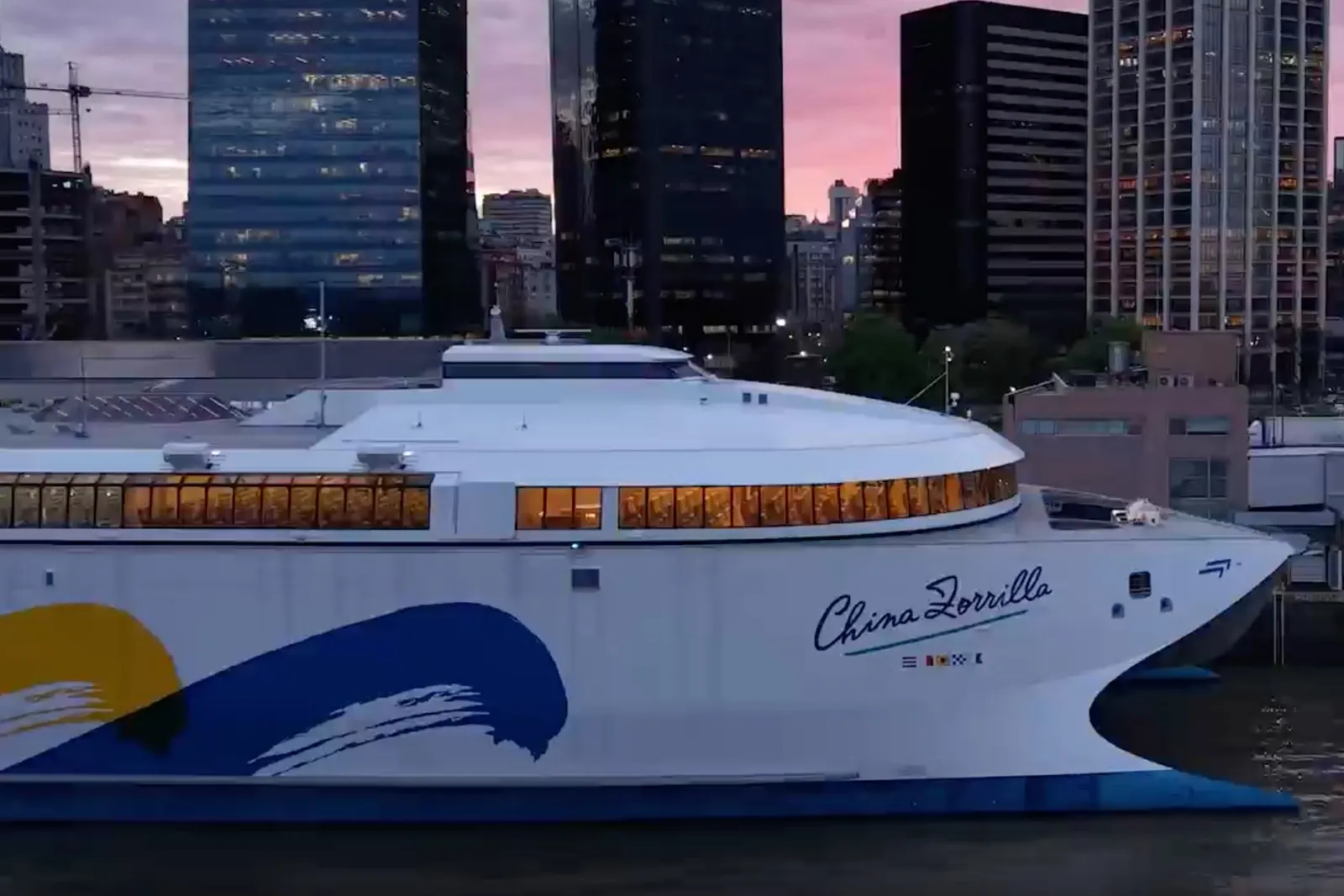
The world's largest electric ship has begun commercial operations in South America. The 130-meter-long 'China Zorrilla' can transport up to 2,100 passengers and 225 vehicles. The electric ferry was built by Australian company Incat Tasmania for the ferry operator Buquebus.
Electric ship "China Zorrilla" in Buenos Aires
Image: Buquebus
The electric ship, which was still known as Hull 096 during its construction and testing phase, has now completed its first commercial voyage between Buenos Aires in Argentina and Colonia in Uruguay. It was named after the popular Uruguayan actress and director Concepción “China” Zorrilla, a figure beloved in both countries – hence the name that may sound unusual to non-Spanish speakers.
The vessel was built by Incat Tasmania for the South American ferry operator Buquebus. The all-electric ferry can transport up to 2,100 passengers and 225 vehicles across the Río de la Plata. Its energy storage system has a capacity of more than 40 MWh, with the batteries weighing a total of over 250 tonnes. Eight electrically powered waterjet propulsion units provide the thrust.
Historic day for the maritime industry
Incat describes the start of operations as an important milestone for the electrification of maritime transport. Company CEO Robert Clifford states: “This is a truly historic day for Incat, for Tasmania, and for the global maritime industry. Over the years, hundreds of talented people at our shipyard in Hobart have worked tirelessly to make this extraordinary vessel a reality. We have overcome immense technical challenges, pushed the boundaries of what was previously thought possible, and created something the world has never seen before.”
He adds that the fact that this ship is now carrying passengers in commercial operation while being fully powered by battery electricity is an incredible achievement and “a moment of great pride for everyone involved in this journey.”
In Incat’s view, the _China Zorrilla_ demonstrates that even large commercial vessels with high transport capacity can be fully electrically powered. Additionally, the battery-electric propulsion is expected to provide passengers with a quieter crossing, free from the engine noise and vibrations typical of diesel propulsion. Naturally, the absence of a combustion engine also means zero direct exhaust emissions on board.
Originally an LNG-powered vessel
Incat received the order for the ship in the summer of 2023. Initially, the ferry was designed with LNG propulsion, but the concept was later changed to a fully battery-electric drive. The ship is constructed as an aluminium catamaran.
Even while the _China Zorrilla_ was still under construction, Incat secured an order for additional electric ships of a similar scale: For the Danish operator Molslinjen, the shipyard in Hobart is currently building three 129-metre-long electric ferries, which are set to operate on the Kattegat route in the future.
_Source: per email_, linkedin.com (Spanish with video)