
World Premiere of the Mercedes GLA: Up to 320 kW of charging power and 657 km of range
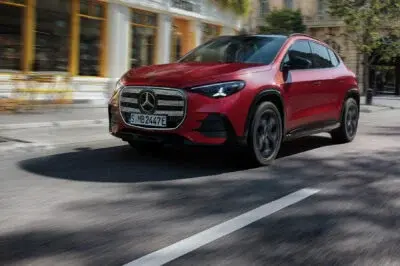
With the new GLA, Mercedes has reversed its usual approach: previously, the carmaker launched the ICE model first, followed later by an electric variant. This time, it will debut three battery-electric models in November, while hybrid versions will not hit the road until early 2027. For the brand’s best-selling compact model, this is a clear statement—and a signal to the industry: electric drive has arrived at Mercedes, even in the volume segment of the A-Class.
The GLA is built on the 800-volt architecture that Mercedes first introduced with the electric CLA and also used in the electric GLB. The entry-level GLA 200 features a 58 kWh LFP battery, while the GLA 250+ and GLA 350 4MATIC models are equipped with an 85 kWh NMC battery. The latter offers a range of up to 657 kilometres (WLTP). Notably, all three variants reach a top speed of 210 km/h. With a starting price of €48,599, the GLA is Mercedes’ most affordable electric SUV.
From 10 to 80% in 22 minutes
Thanks to its 800-volt architecture, the Mercedes GLA delivers impressive charging performance: the GLA 250+ and GLA 350 4MATIC can draw up to 320 kW at an 800-volt charging station, replenishing the battery from 10 to 80 per cent in just 22 minutes.
During this time, nearly 60 kWh of energy is transferred to the vehicle, corresponding to an average charging power of around 162 kW across the entire charging curve. Such average values are more meaningful than peak figures, as high peak power is of little use if it drops after just four minutes. Mercedes states that ten minutes of charging provides up to 270 kilometres of additional WLTP range—a figure that hardly any other electric vehicle in the compact segment can match.
However, the base model lags behind: the GLA 200 uses a lithium iron phosphate (LFP) battery with 58 kWh of usable capacity and charges at a maximum of 200 kW. In ten minutes, it regains 145 to 165 kilometres of range. Due to its smaller battery, it takes just over 20 minutes to charge from 10 to 80 per cent. This makes it nominally faster than the larger models—but with less energy stored. LFP chemistry is cheaper and more durable, tolerates daily full charging better, and is cobalt-free. The trade-off is its lower energy density, which affects range.
One detail that could cause frustration in practice is the DC converter, which enables the GLA to charge at 400-volt charging stations. However, this component is only available as an optional extra. Those who do not order it will be limited to the not yet widely available 800-volt chargers. For alternating current (AC) charging, 11 kW is standard, while 22 kW is available as an option and halves the charging time at home wallboxes or AC charging stations.
GLA 200 electric
GLA 250+ electric
GLA 350 4MATIC electric
Drivetrain
Rear-wheel drive
Rear-wheel drive
All-wheel drive
Power output
165 kW / 224 hp
200 kW / 272 hp
260 kW / 354 hp
Torque
335 Nm
335 Nm
515 Nm
Acceleration
8.1 s
7.3 s
5.4 s
Top speed
210 km/h
210 km/h
210 km/h
Battery (usable)
58 kWh
LFP
85 kWh
NMC
85 kWh
NMC
Range (WLTP)
394 to 447 km
577 to 657 km
555 to 643 km
Consumption (WLTP)
17.0 to 14.8 kWh/100 km
17.3 to 15.1 kWh/100 km
17.6 to 15.1 kWh/100 km
DC charging power
200 kW
320 kW
320 kW
DC charging time
10 to 80 %
20 min
22 min
22 min
AC charging power
(Standard/Option)
11 / 22 kW
11 / 22 kW
11 / 22 kW
AC charging time
(11 kW/22 kW)
6 h 30 min / 3 h 30 min
9 h / 4 h 45 min
9 h / 4 h 45 min
Curb weight
2,145 kg
2,155 kg
2,235 kg
Gross vehicle weight
2,625 kg
2,635 kg
2,715 kg
Payload
480 kg
480 kg
480 kg
Towing capacity
unbraked/braked
750 / 1,500 kg
750 / 1,500 kg
750 / 2,000 kg
Boot space
410 to 1,400 l
410 to 1,400 l
410 to 1,400 l
Frunk
107 l
107 l
107 l
Base price (incl. VAT)
€48,599
€54,978
€58,107
Looking ahead, Mercedes will introduce a fourth variant in early 2027 with a 71 kWh NMC battery, closing the noticeable gap between the 58 and 85 kilowatt-hour options.
Solid consumption, but heavy
At around 15 kWh per 100 kilometres, the 4.57-metre-long SUV, weighing over two tonnes, achieves an excellent efficiency figure. This is primarily due to its aerodynamics: with a drag coefficient (cW) of 0.27, the new GLA is significantly more streamlined than its predecessor. At motorway speeds, air resistance is the biggest factor affecting consumption, and every decimal point in the drag coefficient directly impacts range.
However, the weight is less impressive: 2,145 to 2,235 kilograms is substantial for a compact SUV, and the payload of 480 kilograms is quickly reached with five occupants. That said, it should suffice for most users. Four adults with luggage would theoretically push the GLA to its limit. On the practical side, those who plan to use the all-wheel-drive model as a tow vehicle will benefit from its two-tonne towing capacity, which is remarkable for a battery-electric vehicle of this size. The rear-wheel-drive models offer a braked towing capacity of 1.5 tonnes.
Not everyone will like the illuminated grille
The new GLA measures 4.57 metres in length, 1.87 metres in width, and 1.60 metres in height, making it 20 millimetres lower than its predecessor. Thanks to the electric drivetrain, the wheelbase has grown by 61 millimetres to 2.79 metres, and the rear track has increased by 31 millimetres to 1.62 metres, resulting in a turning circle of 11.53 metres. These dimensions are evident in the car’s stance: it sits more firmly on the road, the shoulders over the rear wheels are prominently flared, and the wheels align flush with the body. The side profile is the most flattering perspective: clean surfaces, minimal lines, and a gently sloping roof.
However, the front is more controversial: the grille, featuring 608 backlit polycarbonate dots, 158 micro-LEDs, and a very large, centrally placed star, marks the first time Mercedes has brought this design element to the compact segment. The bright version appears dominant—even overwhelming—as the star occupies nearly half the surface. In the Night Edition, which includes the AMG Line and Night Package, it blends much better into the overall design, giving the vehicle a more premium appearance.
The rear, on the other hand, is more cohesive. Star-shaped rear lights, a continuous light strip, a neatly integrated roof spoiler, and a black-trimmed lower section give the car optical width without being intrusive. In this respect, the new electric GLA is the more refined and mature vehicle.
Plenty of display, few buttons
Behind a continuous glass surface, the optional MBUX Superscreen features a 10.25-inch driver display, a 14-inch central display, and a 14-inch passenger display. The circular air vents with illuminated rings and the prominently designed centre console are directly adopted from the CLA. This creates a premium feel in this vehicle class but results in a lack of physical controls. Those who regularly drive long distances will appreciate the volume dial on the steering wheel—one of the few remaining rotary controls.
The longer wheelbase enhances interior space: there are 38 millimetres more legroom in the rear, 24 millimetres more headroom, and a boot capacity of 410 litres—70 litres more than the predecessor. With the rear seats folded down, the boot expands to 1,400 litres. Additionally, the 107-litre frunk is large enough for charging cables and even a carry-on suitcase. A standard panoramic roof further enhances the sense of space in the interior. The switchable SKY CONTROL panoramic roof with 172 integrated stars, as well as the announced streaming services DAZN and AirPlay video function, will not be available at launch but will be added later.
The ambient lighting system offers 64 colours, ten colour worlds, 20 brightness levels, and three brightness zones, allowing the interior lighting atmosphere to be customised individually. As an optional extra, a new Burmester 3D surround sound system with Dolby Atmos is available. The system features four additional speakers and more power than before, with a total of 16 speakers and an 850-watt amplifier.
AI assistants, software, and CO₂ footprint
Eight cameras, five radar sensors, and twelve ultrasonic sensors feed a water-cooled control unit with a computing power of 254 tera-operations per second. This impressive processing power is dedicated to driver assistance functions, which will be delivered via over-the-air updates. The MB.DRIVE ASSIST operates at SAE Level 2; the Plus version can even change lanes autonomously on motorways when all conditions are met.
The MBUX Virtual Assistant, powered by generative AI, can conduct complex, multi-part conversations and remember details. It combines models from ChatGPT, Microsoft Bing, and Google Gemini, allowing it to switch between them during a conversation. The navigation system is based on Google Maps and is enhanced by Google Cloud’s Automotive AI Agent. This can, for example, search for charging points with a specific charging power, parking spaces, or points of interest in dialogue with the navigation function.
Across the entire value chain, the electric GLA reduces its CO₂ footprint by around 40 per cent compared to the current ICE model. The new battery generation contributes approximately 30 per cent less CO₂ per cell, and around 40 per cent of the aluminium is sourced from electrolysis using renewable electricity. Together, this amounts to around 400 kilograms of CO₂ savings per vehicle. The proportion of recycled materials is four times higher than in the predecessor, and the carpets are made entirely from recycled Econyl yarn.
Price and positioning
At €48,599, the GLA 200 is the “entry-level” model in the trio but offers the lowest range—up to 447 kilometres—and a charging power of 200 kW. The €6,378 premium for the GLA 250+ buys an additional 210 kilometres of range and the full 320 kW charging power. The GLA 350 4MATIC costs another €3,130 more, provides all-wheel drive, accelerates to 100 km/h in 5.4 seconds, and has a towing capacity of two tonnes but loses 14 kilometres of range. The variant with a 71 kWh battery, set to arrive in early 2027, will be particularly interesting, as it is likely to hit the sweet spot for most buyers.
Technically, the electric GLA and its big brother, the electric GLB, are twins. They share the MMA platform, the 800-volt architecture, the 320 kW charging power, and the 58 kWh LFP or 85 kWh NMC batteries. The GLB 250+ delivers the same 200 kW power output as the GLA 250+ and accelerates to 100 km/h in a similar 7.4 seconds.
The differences lie in the body — and that comes at a price. At 4.73 metres, the GLB is 16 centimetres longer, the wheelbase extends to 2.89 metres, the boot capacity increases to 540 litres (from 410 litres), and the frunk holds 127 litres (up from 107 litres). For an additional €1,309, a third row of seats is available, which is not an option in the GLA.
The GLB 250+ starts at €59,048, around €4,070 more than the GLA 250+. For Mercedes, this makes the decision unusually clear: those who prioritise range and efficiency should choose the GLA. Those who need more space or seven seats will pay nearly €4,000 more for the GLB, gaining 130 litres of boot space but losing around 26 kilometres of range. Compared to the CLA 250+ Shooting Brake, the GLA 250+ is around €2,110 cheaper, while the 350 4MATIC is €3,550 less expensive than its GLA counterpart.
Source: Mercedes Press Release