
“How Vehicle to Grid Can Scale” – Christoph Fuchs, Octopus Energy
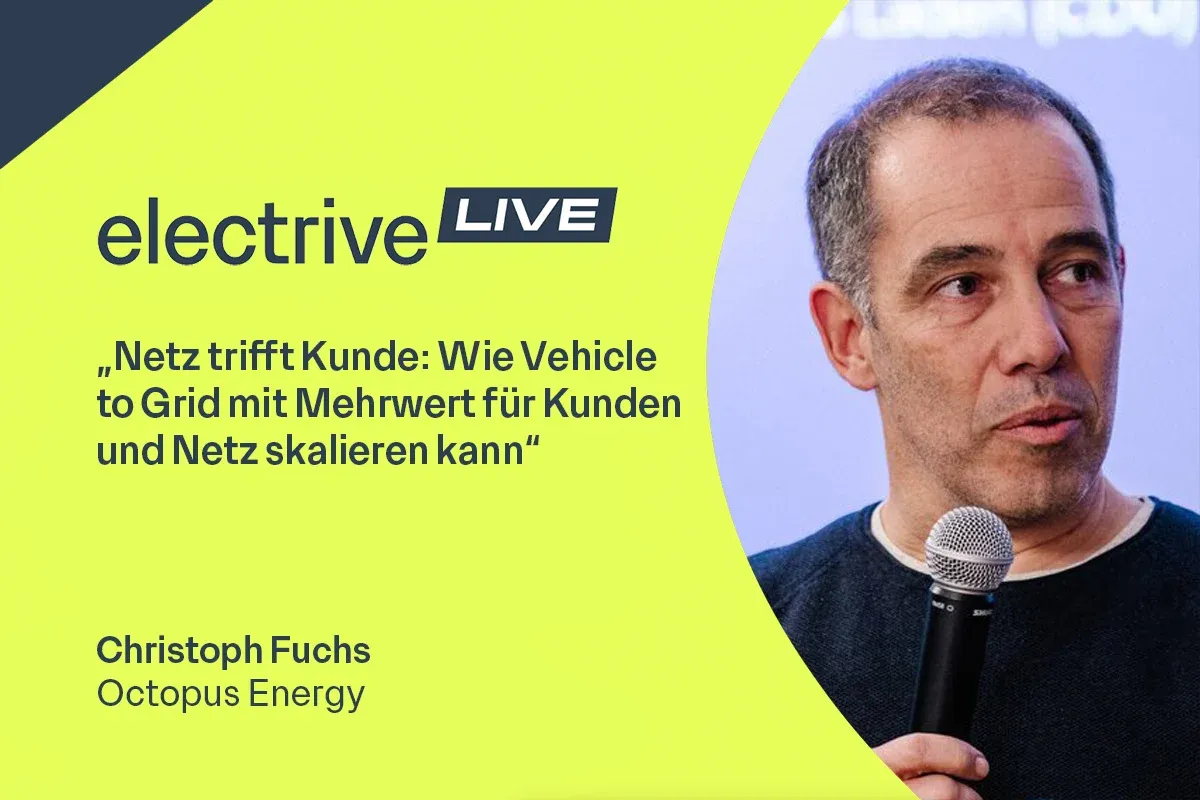
At electrive LIVE, Christoph Fuchs, Global Director of EV Ecosystem at Octopus Energy, demonstrated how Vehicle to Grid (V2G) can be scaled up significantly. If electric cars are charged uncontrolled during peak evening hours in the future, it could lead to grid overload, Fuchs warned at the start. Therefore, the development of intelligent control systems must be accelerated.
In Christoph Fuchs’ view, the real potential to relieve grid strain already exists at many households: Since the average driving distance for a car in Germany is only 15.5 kilometers per day, and vehicles remain idle for most of the time, modern electric cars possess enormous storage capacity.
Considering the technical aspects, it becomes clear that one can “power their house or apartment with an average electric car for about a week” using rough estimates, according to Fuchs. Vehicle to Home (V2H) or Vehicle to Grid (V2G) is the key term here, referring to a two-way charging technology that allows electric cars not only to draw power from the grid but also, when needed, to intelligently feed excess energy from their batteries back into the home network (V2H) or, for grid use, into the public power grid (V2G).
Nevertheless, the technology is still in its infancy, as it currently reaches only a small niche of customers with their own driveways. To enter the mass market, Vehicle to Grid needs its own “iPhone moment” — a time when the various technical components are seamlessly integrated and made widely available to consumers.
Vehicle to Grid needs “people who get involved”
For Octopus Energy, beyond pure technology, it is people who are at the core of everything, as the energy transition absolutely requires “people who get involved.” To build the necessary trust in a market plagued by skepticism toward energy providers, the company focuses on close customer engagement without automated chatbots and offers transparent, easy-to-understand solutions.
Fuchs cited a comprehensive package in the UK as a successful model, where leasing, a Wallbox, a smart meter, maintenance, and electricity are bundled into a single monthly fee of 299 pounds. In Germany as well, the energy provider is working through partnerships with manufacturers such as Ford and Audi on similar models that offer a bonus of 18 cents per kilowatt hour for charging connected to the grid, and even allow zero-cost charging with sufficient charging time.
V2G currently only appeals to early adopters
In regards to current marketing efforts, Fuchs admitted that despite strong demand, the company is still in a transitional phase. “Of course, it must be said clearly that we are still at a point where we’re dealing with early adopters rather than reaching a majority audience,” he explained, referring to the necessary initial investments in hardware.
To overcome this situation and achieve true scale effects, Octopus Energy relies on what is known as the Mobility Energy Flywheel. This economic cycle combines excellent customer experiences, a growing number of electric vehicle owners participating, and larger virtual power plants, which in turn enable higher standards and lower prices. In closing, Fuchs called on the entire industry: “Let’s work together to bring better, cheaper solutions to market faster that our customers will love.”
To watch the full presentation by Christoph Fuchs, please use the video player above the article or go to YouTube.
