
Plant logistics with 25-meter tractor-trailers: Fendt relies on electric long trucks
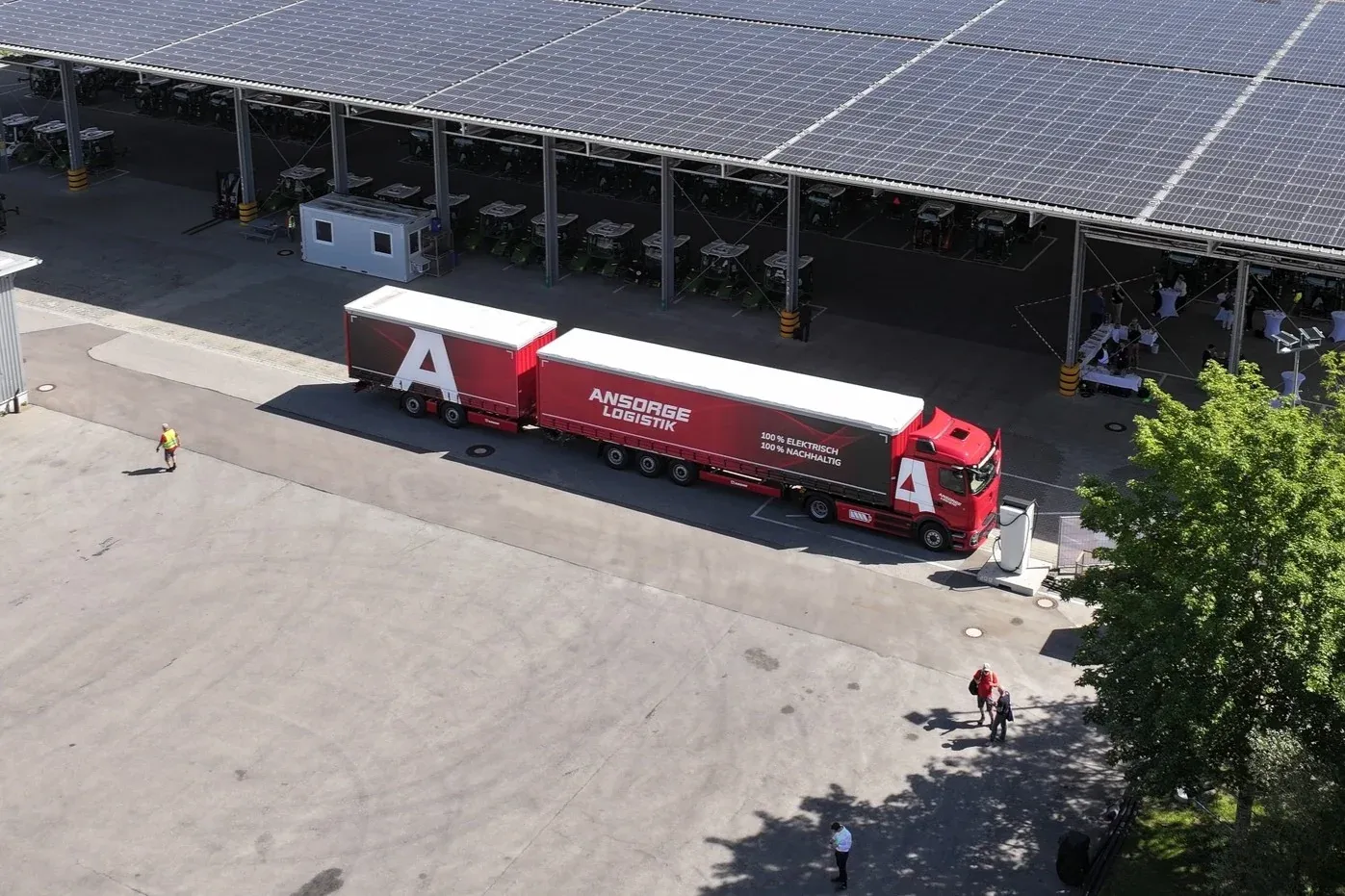
The brand Fendt, founded as early as 1930 in Marktoberdorf, Bavaria, is electrifying the transportation of tractor cabs between its factories in Asbach-Bäumenheim and Marktoberdorf. And it’s doing so in an extraordinary way: while most vehicle manufacturers rely in their factory logistics on semi-trucks in lowliner configuration paired with a particularly spacious megatrailer as a trailer, Fendt’s solution lies in fully electric long trucks. Together with the Allgäu-based logistics provider Ansorge Logistik, Fendt has replaced its previous diesel trucks with modern electric trucks of the Mercedes-Benz eActros 600 model — specifically, extra-long tractor-trailer combinations.
The eight electric long trucks of type 2 (which in official German terminology refers to “trucks with a central-axle trailer with a total length of up to 25.25 meters”) have been operating on the round 120-kilometer route between the two locations in Bavaria since September. Fendt expects annual savings of around 280,000 liters of diesel and approximately 740 tons of CO2 from this project. Fendt’s decision to electrify its factory logistics aligns with the company’s product lineup: back in 2017, Fendt, now part of the U.S.-based AGCO corporation, introduced its first battery-electric tractor. To date, two electric tractors have been launched on the market: the Fendt e100 Vario and the narrow-gauge model Fendt e100 V Vario.
Fendt customers feel the impacts of climate change
"Sustainability is currently receiving less public attention, but our customers in agriculture feel the impacts of climate change directly. Increased extreme weather events, such as droughts, heavy rainfall, or local storms, affect their operations directly," said Dr. Jan Cachay, Head of Production at Fendt. "Sustainability remains a core component of our corporate strategy. By using electric cab transport, we reduce emissions in our production logistics and take another important step toward resource-efficient manufacturing."
The eight eActros-600 tractor units used by Ansorge Logistik pull trailers with a total length of 25.25 meters and seven axles. An additional trailer 7.70 meters long behind the 13.60-meter-long semi-trailer provides space for more cargo volume: Depending on size, seven to eight tractor cabs can fit on such a long truck, while a conventional semi-trailer can only accommodate four to five cabs. Electric long trucks are extremely rare to date — with the use of eight units, Ansorge’s fleet is likely the largest of its kind in Germany.
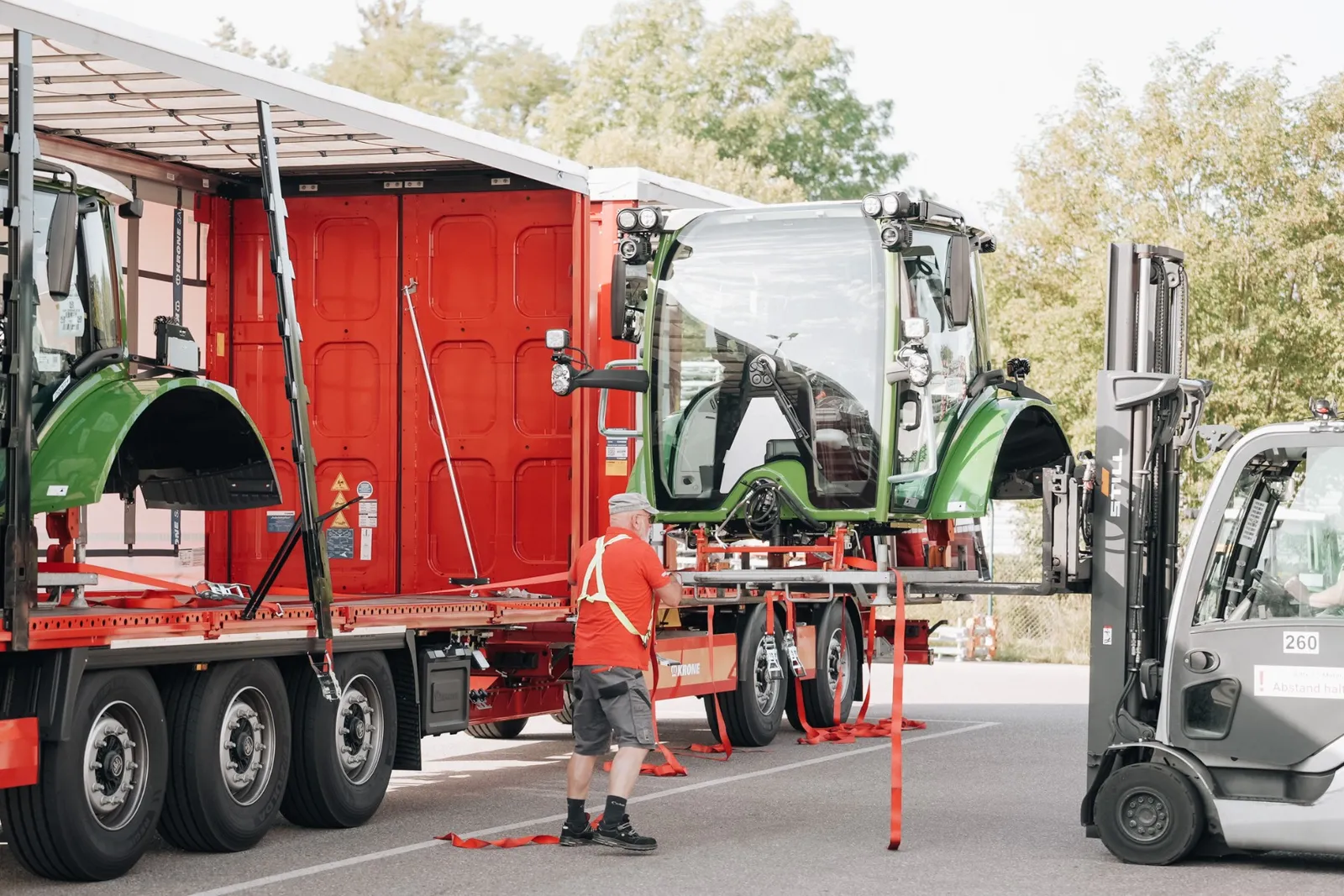
The additional transport capacity is intended to reduce the number of trips required. Fendt specifies an allowable total weight of 40 tons for these vehicles. After traveling about 240 kilometers, the electric long trucks are charged at the depot in Biessenhofen. According to Fendt, the charging time takes around 45 minutes. Ansorge uses electricity from its own photovoltaic systems and battery storage for this purpose.
Interim Summary After Two Months
Approximately two months after the launch, we asked Benedikt Roßmann, the manager at Ansorge, about the initial practical experience with the electric long trucks. “Especially for planned internal factory transportation, it’s clear that electromobility already works very well in heavy road freight transport today,” explains Roßmann.
A round trip covers approximately 240 kilometers. According to Roßmann, this means the range of the eActros 600, at over 500 kilometers, is more than sufficiently sized. The necessary charging sessions can be integrated into regular driver breaks. The energy consumption figures also show a positive outlook: these electric long-haul trucks have only a few percentage points higher consumption than an electric truck with a standard trailer. Even in low temperatures or bad weather, there is sufficient range reserve.
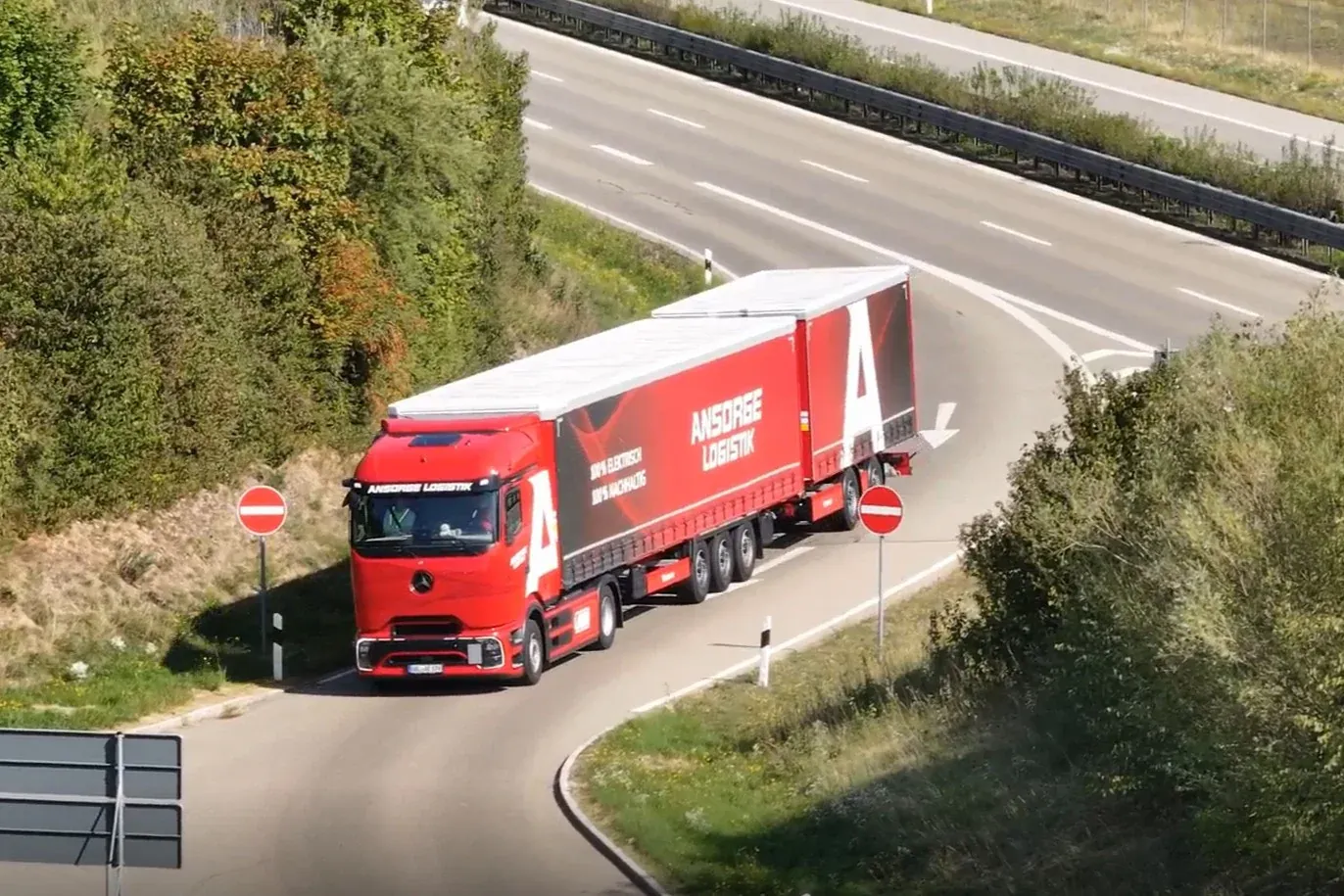
Roßmann also sees advantages from an economic perspective. While both electric trucks and specialized long-truck equipment along with the necessary charging infrastructure require significant investments, the electric truck currently has a lower total cost of ownership (TCO) thanks to toll exemptions and self-produced green electricity — especially given high daily mileage and current diesel prices. Additionally, there is the higher transport capacity: “The fact that we can also save up to 30 percent on trips with the long-truck is another advantage. Every kilometer we don’t have to drive due to the higher transport capacity is still the best kilometer from an environmental standpoint.”
According to Roßmann, regulatory barriers are primarily hindering broader adoption among other customers. The long trucks of type 2 used can only operate on the designated routes within the Positivnetz network. Additionally, the allowable load weight is limited to 18 tons, which means the concept is best suited for light and bulky goods. Nevertheless, Ansorge is already exploring other possible routes, with regular shuttle services in the industrial and automotive sectors being particularly interesting. “We can easily imagine expanding this concept to other customers,” said Roßmann.
Long Trucks: More Length, But Not More Weight
In Germany, conventional truck trains are allowed to be a maximum of 18.75 meters long. After a five-year trial period starting in 2012, during which Ansorge was also involved with a diesel-powered vehicle, long trucks are now generally permitted to reach up to 25.25 meters in length since 2017. However, the allowable total weight does not increase as a result: it remains at 40 tons for regular traffic (or 42 tons for electric trucks) and at 44 tons for combined traffic involving transfer to ships or railways. There are five different types of long trucks:
| Type | Vehicle Combination | Maximum Length |
| --- | --- | --- |
| 1 | Tractor unit with extended trailer | 17.88 m |
| 2 | Tractor unit with center-axle trailer | 25.25 m |
| 3 | Truck with dolly and trailer | 25.25 m |
| 4 | Tractor unit with an additional trailer | 25.25 m |
| 5 | Truck with trailer | 24.00 m |
Important to know: Types 2 through 5 may only be used on the designated routes within the so-called Positive Network. Freight companies can apply for additional routes, but the process often takes one to two years. Type 1, however, has a special status: it can generally be used throughout the approved federal states, but not in Berlin. The authorization for Type 1 is currently valid until December 31, 2026, but it is likely to be extended.
Generally speaking, due to the strictly limited maximum allowable weight, the long trucks licensed here cannot be compared to the 60-ton Gigaliner concepts used in some parts of Scandinavia.
Elflein Uses E-Lang Trucks for Two Customers
Elflein, a logistics company based in Bamberg that has been using electric trucks for some time, also put its first electric long-haul truck into operation recently. According to the logistics company, since September 1, a fully electric vehicle from Swiss manufacturer Designwerk has been operating as a long-haul truck on the route from Gera to an automobile factory in Zwickau. With two shifts, up to four round trips per day are planned. The distance of the route is 39 kilometers.
According to Elflein, the tandem truck can carry about one-third more cargo than a conventional truck. Over four round trips, the company estimates that the direct CO2 emissions avoided amount to roughly 226 kilograms per operating day. The deployment, initially planned until the end of 2026, is intended to provide insights into how electric long-haul trucks can be integrated into existing transportation processes.
In fact, this deployment is not the only project of this kind at Elflein. As Marco Schubert, the logistics company’s E-Mobility Manager, explained in an interview with electrive, a total of four electric long-haul trucks are now in regular operation. The other three vehicles have been in use for a car parts supplier for about half a year to three-quarters of a year. They transport goods from the supplier’s location in Schierling near Regensburg to an automobile factory in Leipzig. The distance between the two locations is roughly 360 kilometers. Power supply for these electric long-haul trucks is ensured through a charging station in Hermsdorf, where Elflein operates its own charging infrastructure, as well as an additional charging post at the supplier’s site. The three MAN eTGX trucks complete three round trips per day at fixed timeslots.
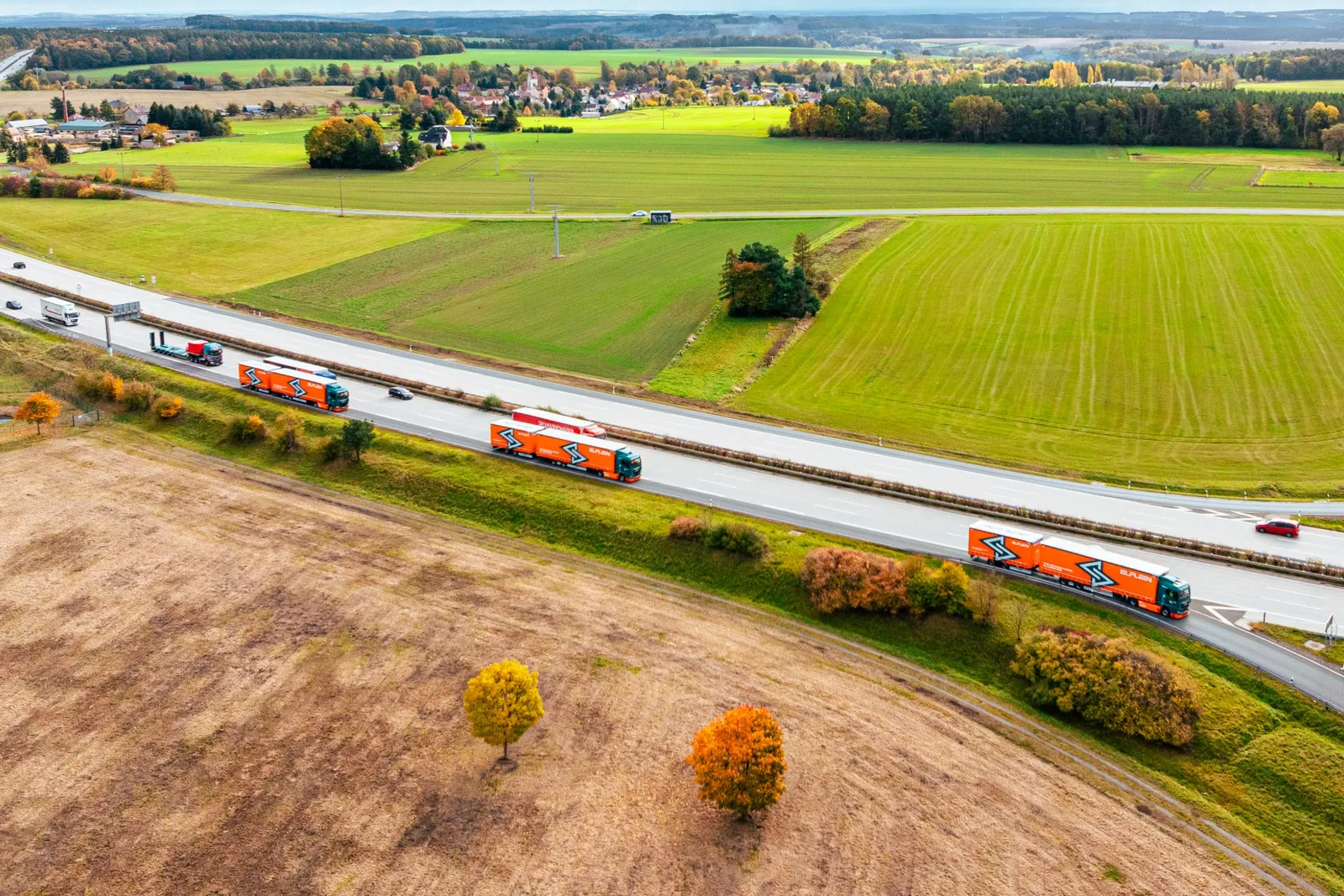
According to Marco Schubert, the experiences with these vehicles have been consistently positive. In particular, the energy consumption is noteworthy: “It’s by no means the case that an electric long-haul truck has double the energy consumption. The additional usage remains truly limited,” says Elflein’s e-Mobility manager. While a regular electric tractor-trailer requires about 1.0 to 1.1 kWh per kilometer, the energy consumption of an electric long-haul truck is around 1.2 to 1.3 kWh, according to him. This figure can be higher depending on loading, road conditions, and weather. The additional length therefore has a less significant impact than initially assumed. Moreover, these vehicles can recover some of their energy through regenerative braking on downhill sections.
Charging: On long routes at own HPC stations
Elflein has also found practical solutions for charging. On the OEM route to Zwickau, the entire tractor-trailer unit cannot reach the Aral Pulse public charging station in Gera. Therefore, the trailer is left at the supplier, while the electric tractor drives alone to the charging column. After about an hour of charging, the driver reconnects the trailer. “We use the driver’s regular break time for this. It works flawlessly,” reports Schubert. On the second route, as mentioned earlier, specially installed charging points at the supplier and at the swap point enable an even better integration of charging processes into the transportation workflow.
Transport to the automobile factory in Leipzig is quite challenging: the goods are needed to support automobile production, so safety stock levels are correspondingly low. “The parts don’t have to go directly into production. But the on-site buffer only lasts for about six hours. This is naturally a very tight schedule where nothing can go wrong,” explains Schubert. He views the electric long-haul trucks functioning reliably under such conditions as a positive sign for further use. To date, Elflein has 19 electric trucks in operation, with two to three more set to be added by the end of the year.
Electric Long-Haul Trucks Also at DHL in Sweden
Another example comes from Sweden. There, WLX WeLink Express uses a Mercedes-Benz eActros 600 for DHL. According to Daimler Truck, the tractor-trailer unit is 25.25 meters long, has seven axles, and weighs 36 tons in total. It operates five days a week on two routes between Malmö, Jönköping, and Emmaboda, covering more than 1,000 kilometers per day. Operations are carried out on a two-shift system, with driver breaks used for refueling. This Swedish deployment shows that electric trucks can also be used for long daily distances when route planning and charging opportunities are coordinated properly.