
VW unveils the concept electric car “Mission Efficiency” with a cW value of 0.158
Images: VW
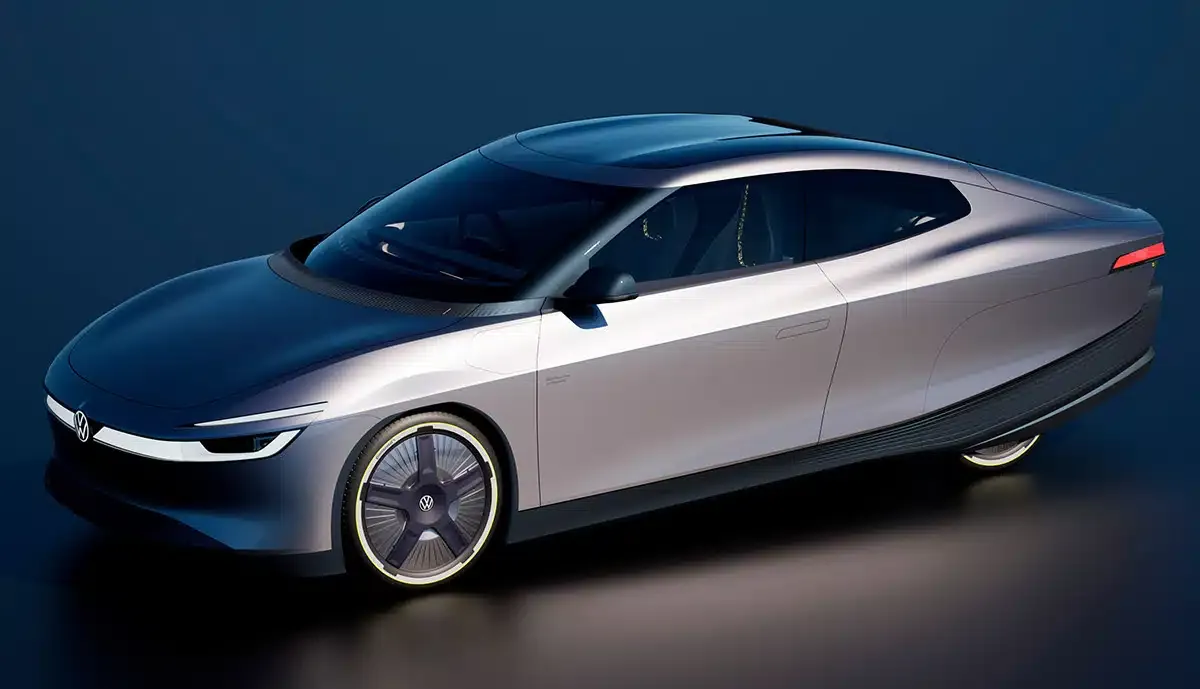
VW has fully unveiled the “Mission Efficiency” and released images along with technical details of the electric concept vehicle. Developed in Wolfsburg, this study is not intended for sale but reportedly has EU road approval. VW claims three world records with this electric car, which resembles the 2014 plug-in hybrid compact model XL1: a cW value of 0.158, an energy consumption of 6.48 kWh/100 km during a test drive labeled as an “ideal driving condition,” and the status of being the most efficient production-ready electric car.
For another documented trip, the Mission Efficiency covered 1,278.36 kilometers from Wolfsburg via Poznań and Olmütz to Vienna. VW reports an energy consumption of 7.51 kWh/100 km including charging losses, or 6.89 kWh/100 km without such losses. The average speed was 67.72 km/h, with a maximum speed of 138 km/h reached. According to the specifications, the battery’s net energy capacity is 54.9 kWh. The vehicle was charged once during the trip, and upon arrival it still had a remaining range of 164 kilometers indicated.
Technically, the study relies on components from the new generation of the MEB+ electric vehicle platform with front-wheel drive. VW specifies an electric motor with 99 kW/135 hp, a maximum DC charging capacity of 105 kW, and a WLTP fuel consumption of 8.4 kWh/100 km. According to the manufacturer, the powertrain, front axle including steering, and the basic structure of the rear axle are similar to those of the electric compact car ID. Polo. The ID. Polo is also based on MEB+ and is available with a 99-kW powertrain option among others.
A key focus for improving efficiency is aerodynamics. The Mission Efficiency is 4,775 meters long, 1,744 meters wide, and 1,392 meters high, with a frontal area of 2.08 square meters. It is 722 millimeters longer than the ID. Polo. Fully covered rear wheels, a closed underbody, a body shape that tapers toward the rear, and three active cooling air flaps are designed to reduce drag. VW reports a cW value of 0.158. The increased wheelbase by 100 millimeters and the long rear overhang serve the purpose of creating a teardrop-shaped body design, according to the manufacturer.
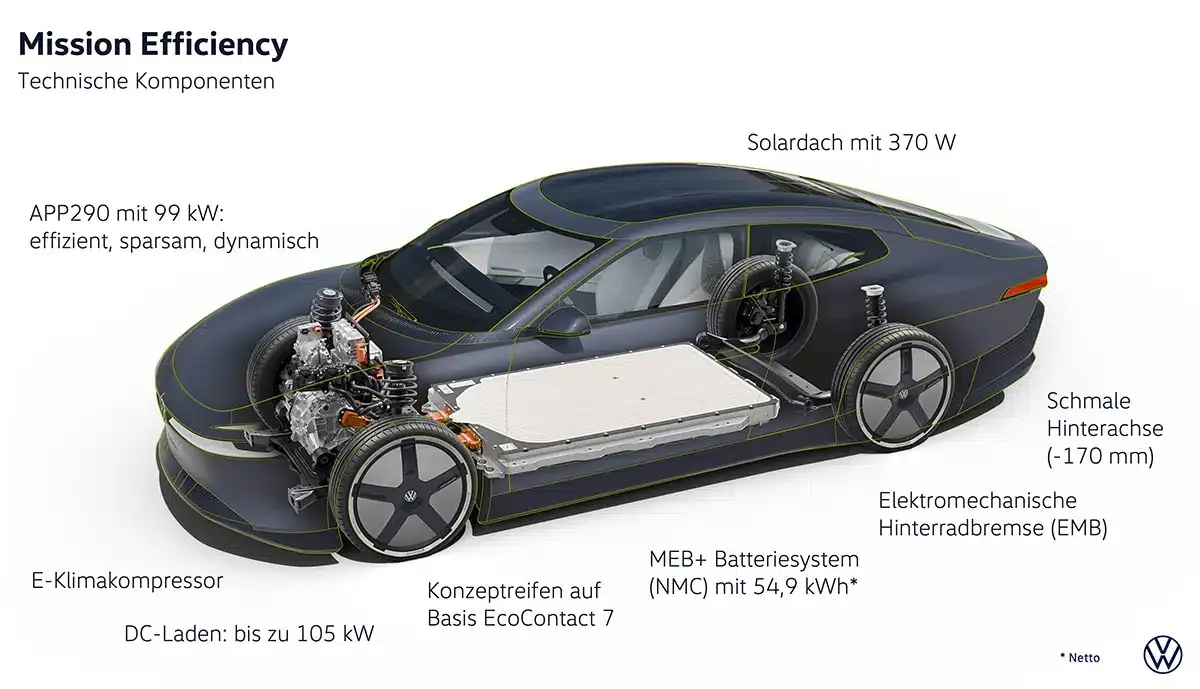
Additional measures relate to friction losses, auxiliary consumers, and weight. At the rear, VW uses a new electromechanical brake, while a hydraulic brake operates at the front; this is intended to eliminate friction losses in the rear axle almost entirely, according to the manufacturer. A photovoltaic system integrated into the glass roof and trunk lid generates 370 watts to power onboard electrical devices. VW estimates that the potential additional range improvement varies by region, season, and weather conditions, up to 30 kilometers per day. A fixed infotainment display and conventional speakers are omitted in favor of mobile devices and a Bluetooth speaker box.
For regular customers, no new model will result from this project initially: VW explicitly labels the Mission Efficiency as a concept vehicle not available for sale and has not announced any mass production. The Wolfsburg-based company cites factors such as aerodynamics, reduced friction losses, and weight reduction as key to its high efficiency. According to the manufacturer, the fuel savings over the ID. Polo exceed 30 percent at speeds of 80 km/h and above.
You are currently viewing placeholder content from YouTube. To access the actual content, click the “Unlock content” button. Please note that data will be transmitted to third parties in this process.
More information
"Mission Efficiency is the best answer to the question of what sets Volkswagen apart in the electric age: technology for everyone — not just a few," says brand chief Thomas Schäfer. "The vehicle achieved these three world records not through advanced specialized technology, but through affordable series-production technology from the ID. Polo and ID. Cross based on MEB+ with front-wheel drive. This shows the efficiency potential we bring to our latest generation of electric cars. Developed in Wolfsburg and built by our team led by Kai Grünitz, Mission Efficiency represents German engineering with clear customer benefits."
Also interesting
About the author
Thomas Langenbucher is an expert in electromobility with professional experience in the automotive industry and finance sector. Since 2011, he has been covering electric vehicles, sustainable technologies, and mobility solutions for ecomento.de. Learn more.
Reader interactions