
VW Commercial Vehicles: E-Transporter operates at “half capacity” in service
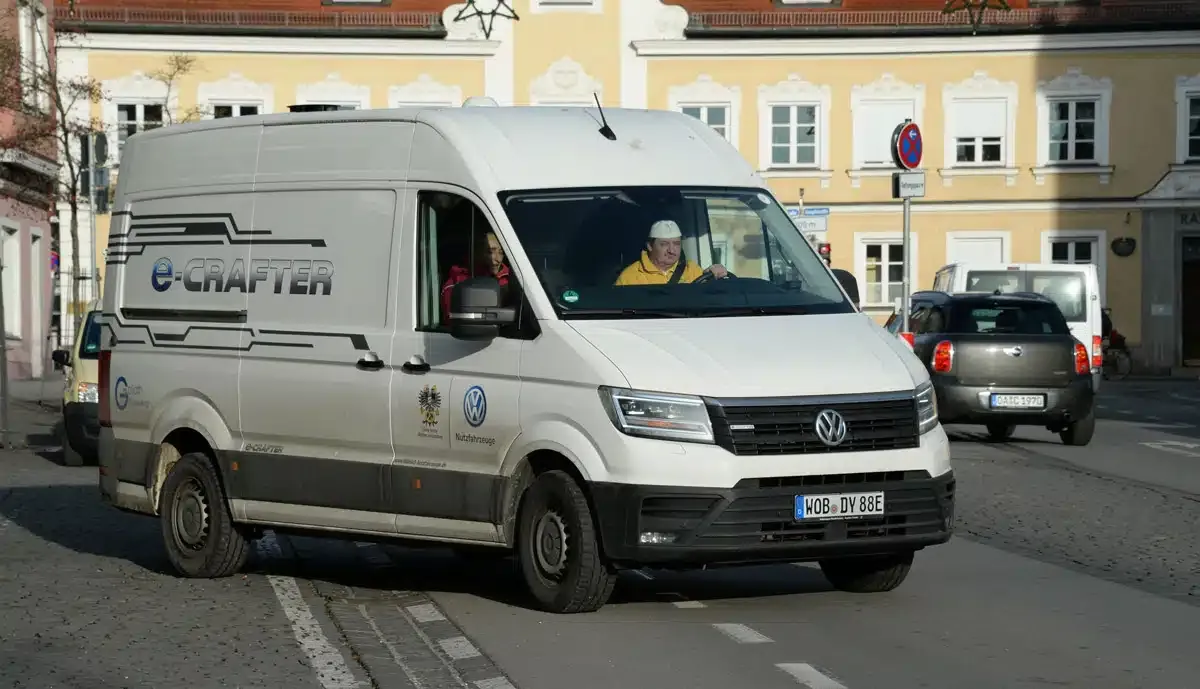
Image: VW
Volkswagen Nutzfahrzeuge (VWN) sees significant cost advantages in using electric trucks and an electrification process progressing faster than expected. Electric commercial vehicles now cost “half as much” to operate, said VWN CEO Stefan Mecha during the E4 Testival networking event, according to Elektroauto-News.Net. The key factor is the total cost of ownership. Battery and electricity prices have developed relative to fuel prices in a way that will further accelerate electrification.
About 30 percent of the VWN vehicles sold are already electric, according to the manager, while battery-electric vans account for 70 to 80 percent of new registrations in Norway and the Netherlands. Just a year ago, Mecha expected a longer transition period. However, for very large commercial vehicles and certain applications, such as the Crafter, he still assumes a prolonged transition phase.
In autonomous driving as well, the cost efficiency of electric drives plays a crucial role. Christian Senger, who is in charge of autonomous driving at VWN and also CEO of ADMT and Moia, pointed out the lower failure risks of electric drives and expected service lives of 500,000 kilometers or more with high availability. Full autonomous mobility could thus become cheaper than owning a car, and it might even undercut traditional ride-hailing services in the next decade. The ridepooling service offered in Hamburg using the ID. Buzz AD has already gained significant acceptance, but it is not economically viable when operated by human drivers.
For the European market, Senger identifies technology, business model, and societal acceptance as key challenges. Particularly important are safety certifications for every software and hardware version to ensure at least human-level driving performance, as well as resolving data protection issues and determining responsibility for remote support centers. At the same time, Senger expects a fundamental shift in manufacturers’ roles: “The traditional automobile manufacturer will become a supplier of digital driver systems.” Professor Dr. Schuh added that increasing vehicle utilization from the current 4% to 20–25% could undermine the traditional business model of automakers.
VWN’s CEO Mecha sees the need to reshape the company’s business model and create equal competitive conditions. China and the U.S. are ahead of Europe in autonomous driving, where development is characterized by fragmentation according to his assessment. VWN also views its long-standing presence in China as a model for competing with Chinese manufacturers who are increasingly focusing on exports. Mecha emphasized that challenges cannot be resolved through bans and regulations.
In the future, Mecha expects both Level 4 autonomous driving functions in private and corporate vehicles as well as ridepooling to emerge as distinct market segments. Lowering technology costs is seen as a prerequisite for implementing such functions in private and corporate cars, while individual transportation will remain crucial in Europe. Senger also noted that artificial intelligence will become tangible through autonomous driving, allowing the automotive industry to leverage its strengths in scaling and partnerships.
Also interesting
About the author
Thomas Langenbucher is an expert in electromobility with experience in the automotive and financial industries. Since 2011, he has been covering electric vehicles, sustainable technologies, and mobility solutions for ecomento.de. Learn more.
Reader interactions