
Volvo will unveil a new design language in spring 2027. And it will bring back physical buttons.
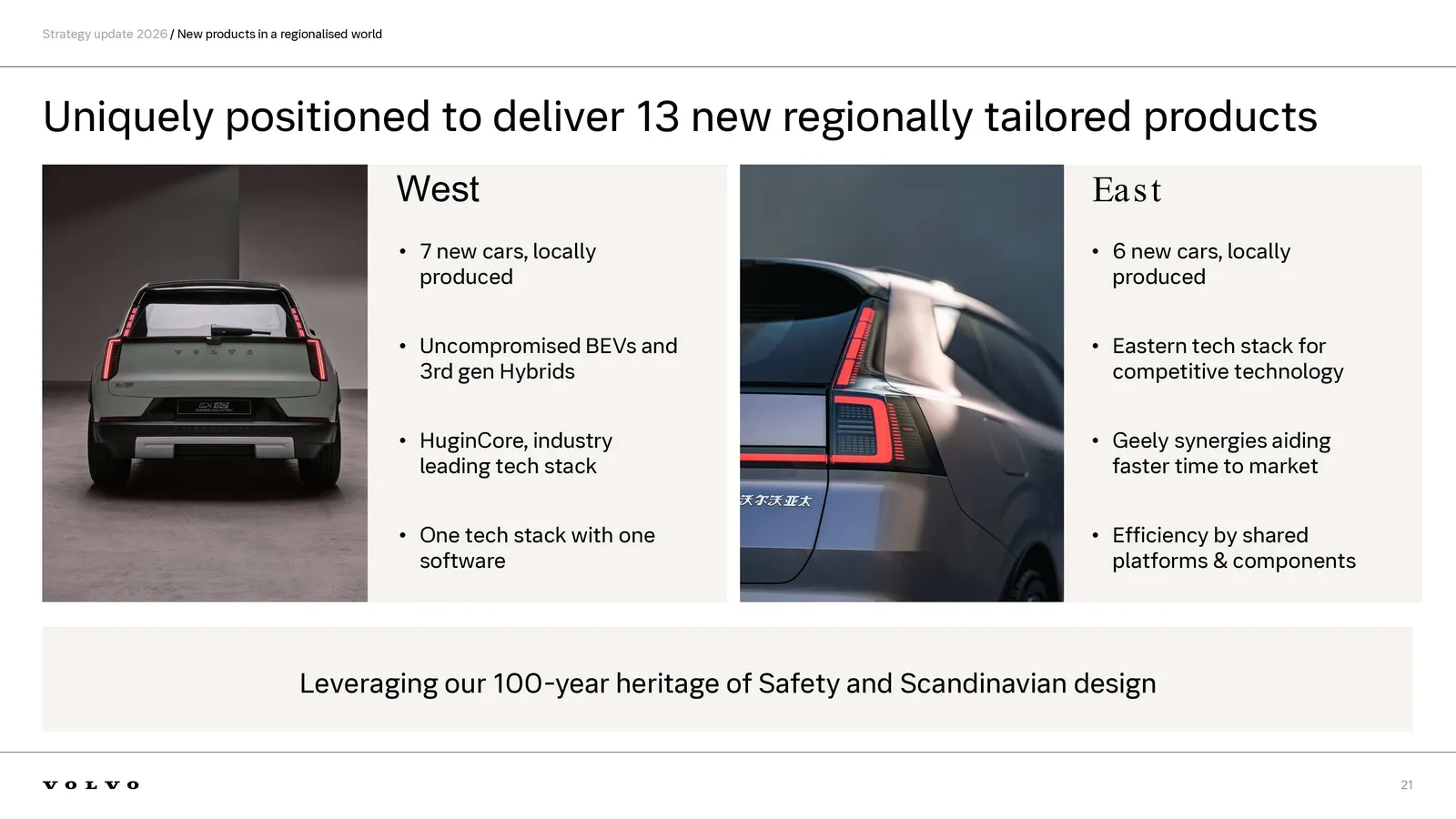
During the Strategy Update 2026, Volvo announced 13 new EV and PHEV vehicles by 2030, along with a new design direction that will first be seen in a concept car in spring 2027. For drivers, something other than styling might be more important: the company confirmed the return of physical buttons inside the vehicle.
The Swedes want their showrooms to look completely different by the end of the decade. Ambitious goals indeed. The question is whether much of this will translate into actual changes or remain just on paper.
13 New Models and Two Different Worlds
Volvo’s plan calls for 13 new models by 2030. Of these, 7 vehicles are intended for Western markets, namely Europe and the US, while 6 are targeted at China. The company also explicitly mentions two separate technology stacks.
In Europe and the US, Volvo will rely on the SPA2 and SPA3 platforms along with the HuginCore computer architecture. In China, it will make greater use of Geely’s solutions and local technological capabilities. This is a pretty clear signal that the global Volvo as we know it is coming to an end—at least in terms of technology.
The powertrains are also set to be a mix. The brand is focusing on both electric vehicles and third-generation plug-in hybrids. The goal is simple: double its market share by 2030. On paper, this makes sense because Volvo isn’t sticking to just one option, but relying on PHEVs as a growth driver in the second half of the decade remains a rather cautious approach.
Buttons are returning, and the EX60 introduces a new platform
Design chief Thomas Ingenlath said the new Volvos are meant to be more desirable and premium. Comparisons were even drawn to Louis Vuitton and Rolex. Marketing likes such comparisons, but users are interested in something else.
Volvo confirmed it will return to physical buttons. However, it’s not about a “row after row” of keys. Each one is supposed to have its own shape and interaction method. If the company executes this well, it could be one of the most practical changes in premium interiors. The screen obsession has gone too far.
We will see the new stylistic language in a concept car in spring 2027, as part of preparations for the brand’s 100th anniversary. It is meant to build on Volvo’s Scandinavian identity rather than creating it from scratch like many startups.
Meanwhile, Volvo is launching a new product offensive. Production of the new long-range PHEV models XC60 and XC90 is set to begin in fall 2026, with deliveries to customers planned for early 2027. Both models will be sold alongside the Volvo EX60, the brand’s first electric vehicle based on the SPA3 platform. The manufacturer promises longer range, faster charging, and more body style options, including wagons and sedans.
There’s another development. According to Automotive News, by the end of 2027, Volvo plans to replace the EX40 model in the U.S. with a new base electric SUV, likely the EX50, priced at around $50,000. If this model makes its way to Europe later, it could enter the market below the EX60 and help streamline the lineup.
Volvo is finally saying outright that a large screen alone isn’t enough. Here’s a question for you: in a premium car, would you prefer more physical buttons or have everything still on a tablet?
LovEV Newsletter
Want more content like this?
Sign up — we’ll send you a weekly summary once the newsletter starts.