
Volvo EX40 Facelift: Matrix-LEDs as standard, larger touchscreen, and more
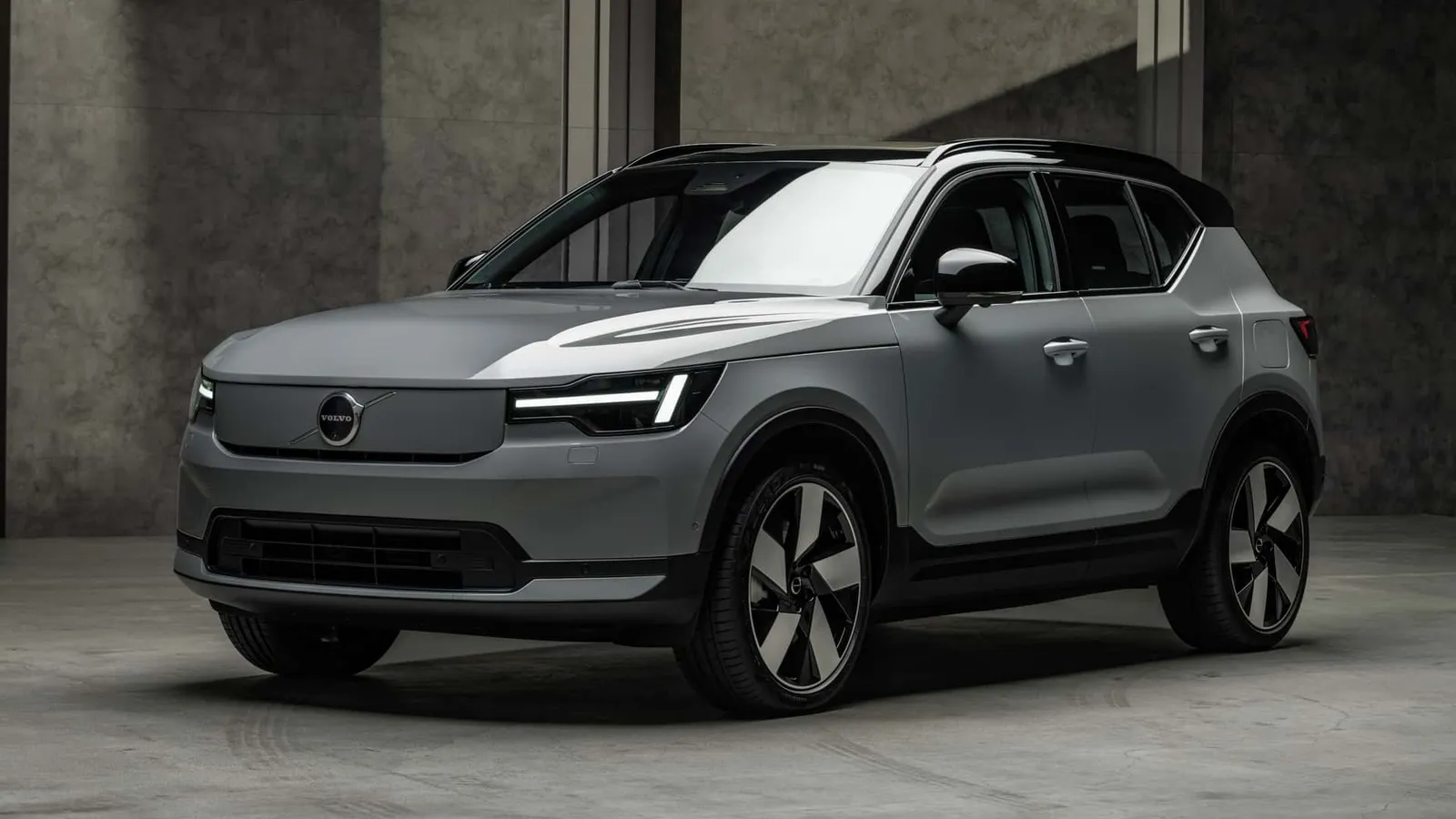
The Volvo EX40 recently received a facelift. The new version is labeled as the 2027.5 model year. In addition to the updated design, it offers more features, including a larger touchscreen and standard matrix LED headlights.
The powertrains and batteries remain unchanged but now use the new P-nomenclature: For example, the base version is no longer called EX40 Single Motor but rather EX40 P5 electric. Additionally, the coupe-style EC40 version was discontinued in Germany. We introduce this series in an overview.
Volvo’s first production electric vehicle has been on the market in Germany since 2020. It launched as the XC40 Recharge Pure Electric. Technically, this is accurate since it is based on the Compact Modular Architecture (CMA), which is also the platform of the XC40. However, since February 2024, the model is simply called EX40.
Exterior | Interior | Powertrains/Batteries | Prices
Gallery: Volvo EX40 (2027)
Exterior
The EX40 is 4.44 meters long and boasts a height of 1.65 meters. It has similar dimensions to the Hyundai Kona Electric or the Mini Countryman Electric, while the BMW iX1 (4.50 meters), the electric Mercedes GLA (4.57 meters), and the Audi Q4 e-tron (4.59 meters) are slightly larger. Here are the exterior dimensions of the EX40 compared to Germany’s currently best-selling competitor, the BMW iX1:
Length
Width
Height
Wheelbase
Volvo EX40
4,440 mm
1,863 mm
1,647 mm
2,702 mm
BMW iX1
4,500 mm
1,845 mm
1,616 mm
2,692 mm
The exterior design of the Volvo EX40 received a subtle refresh with the facelift. It retains the brand’s signature “Thor’s Hammer” lighting design, but the headlights now have a distinctly different shape. For the first time, matrix LED headlights are standard equipment. The front bumper also looks significantly different now, with the black elements on the outside removed:
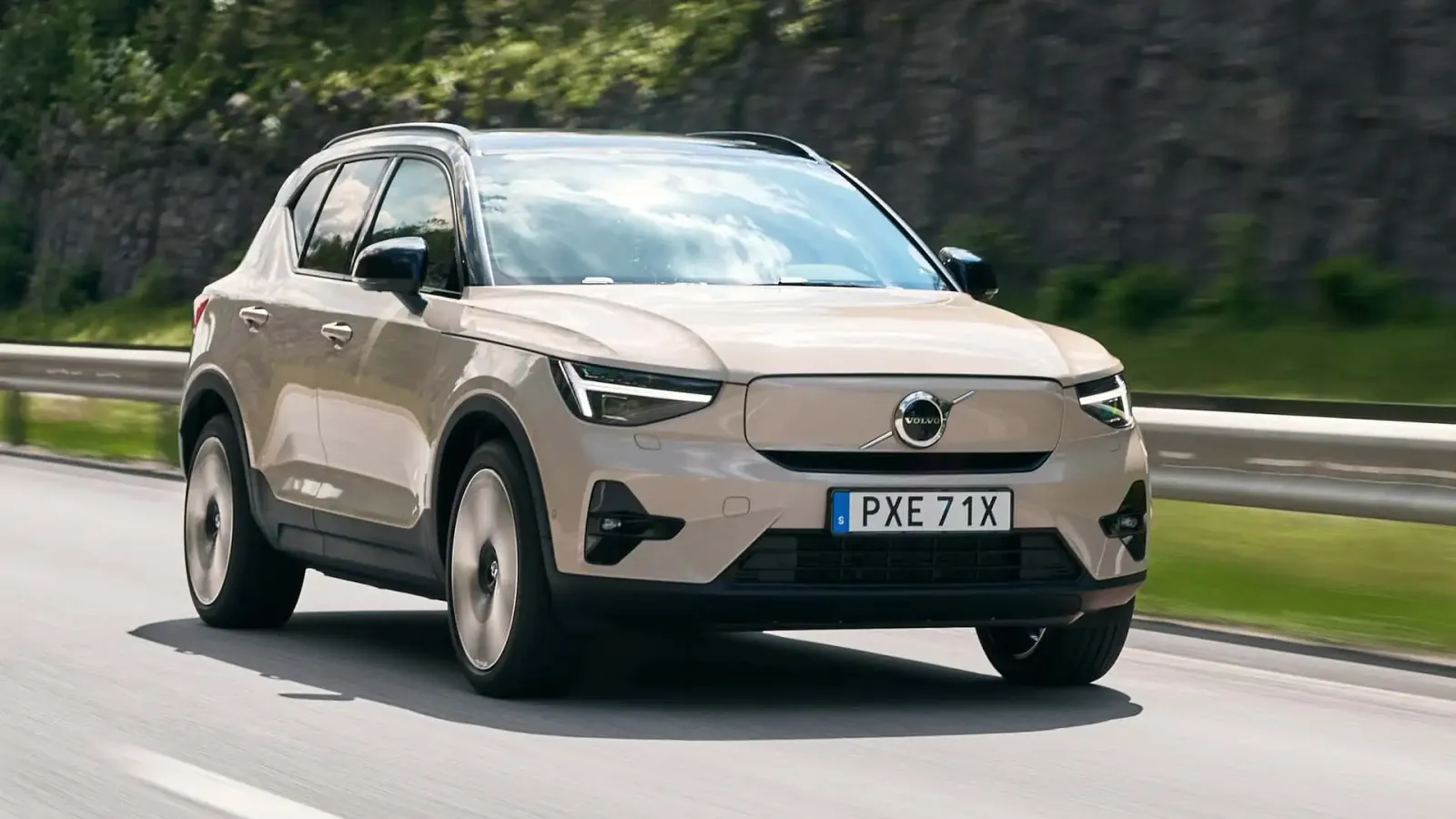
Volvo EX40 (2024)
Images by: Volvo
Volvo EX40 (2027)
Images by: Volvo
At the rear, the Volvo EX40 features more delicate tail lights. The trunk lid has new contours, while the rear bumper boasts lower-mounted taillights that are less noticeable now. Additionally, new wheels in 19 and 20 inch sizes are available. The 18-inch wheels mentioned in the press release are not listed in the price table. According to this, even the base version continues to use 19-inch wheels (as before). The handle design remains unchanged as well—the extravagant WingGrip handles from the EX60 will not be adopted.
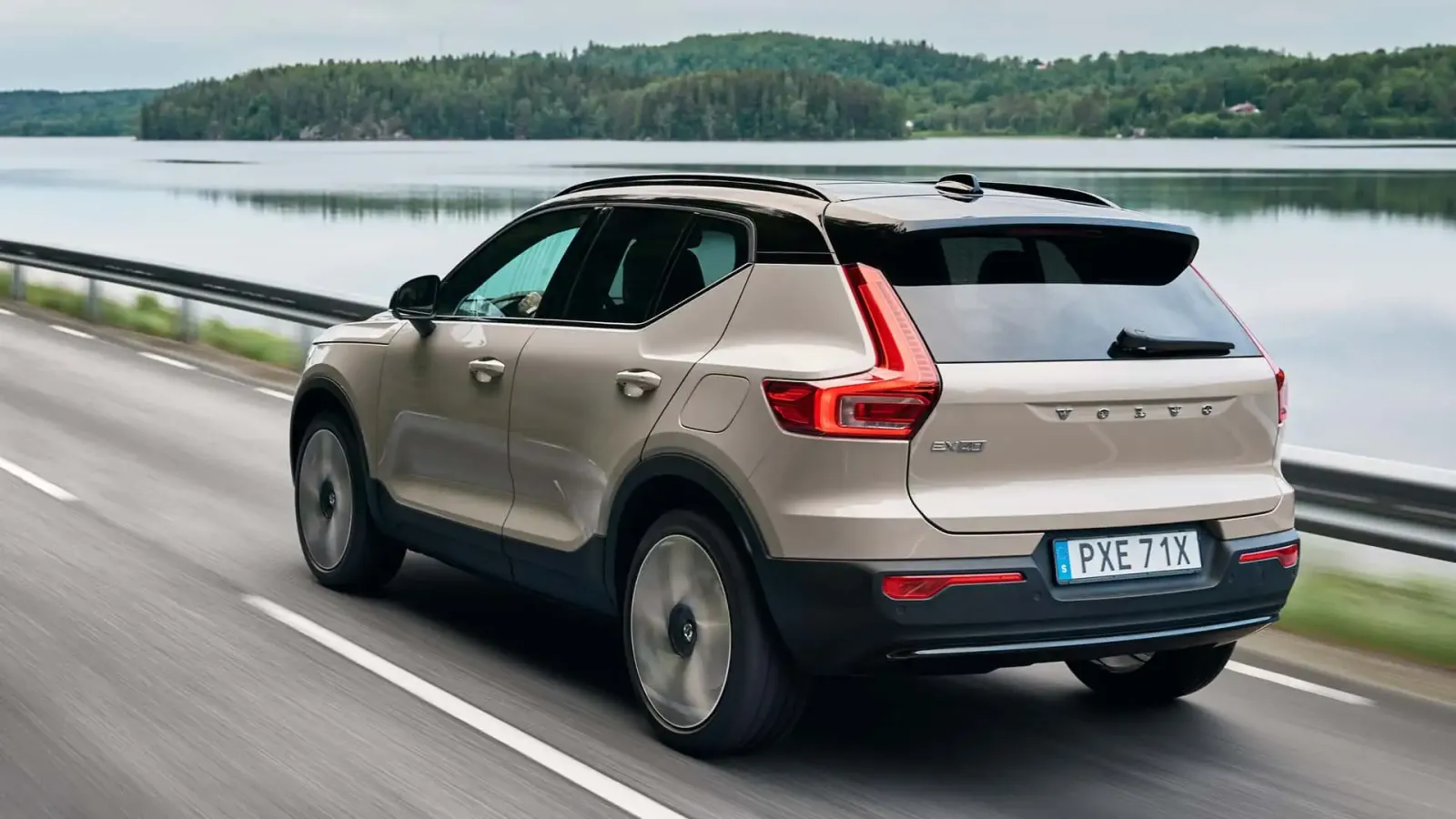
Volvo EX40 (2024)
Images by: Volvo
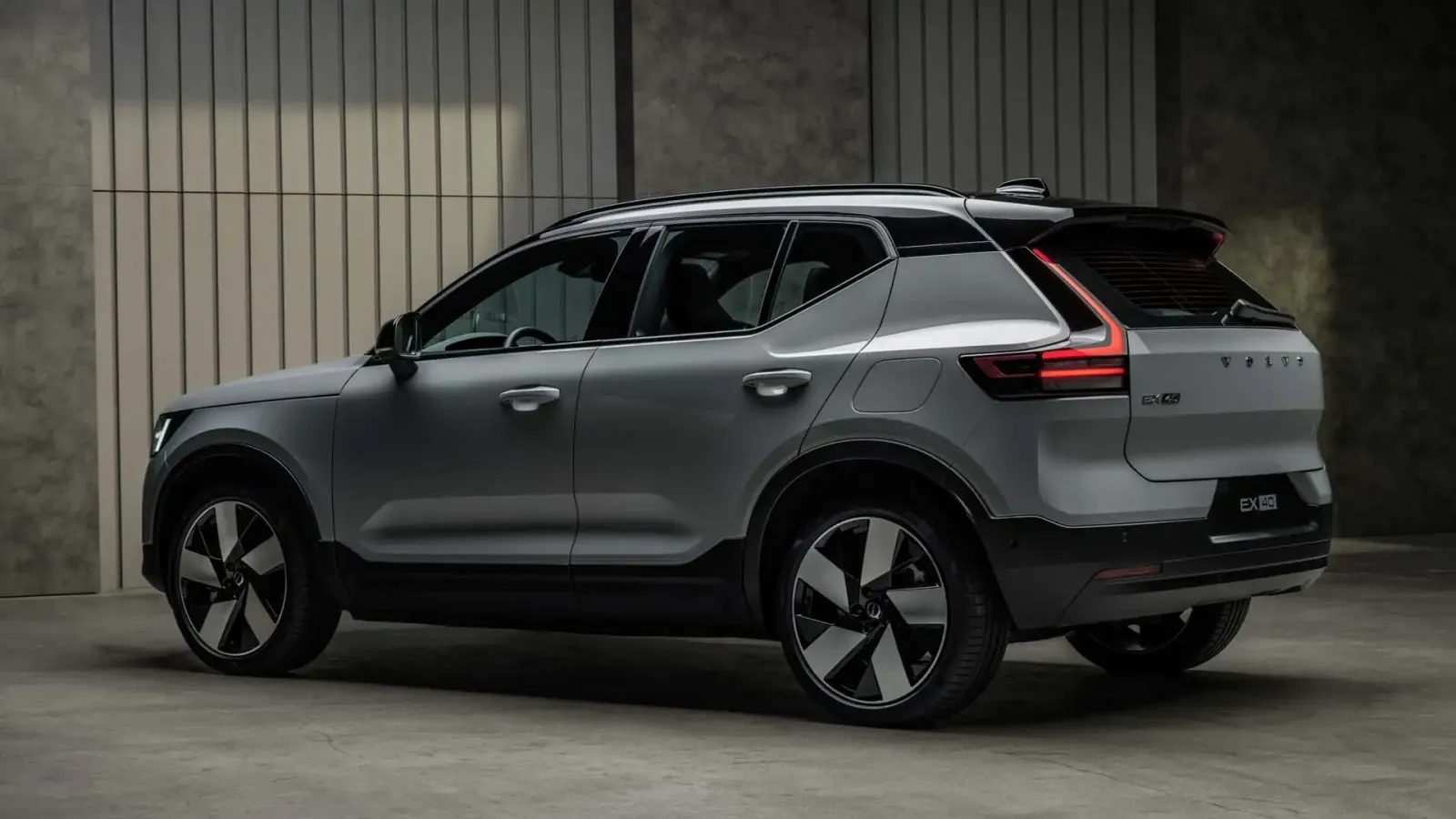
Volvo EX40 (2027)
Images by: Volvo
The base Essential version offers only four muted paint colors to choose from (two white variants, gray, and black). Starting with the Core version, users can select eight paint colors, including the new Heather Bronze and Denim Blue. With the third trim level, Plus, it is also possible to order a roof in a black contrasting color.
Interior
Inside, the EX40 features a larger touchscreen: it now measures 11.2 inches instead of 9 inches, while the instrument display remains at 12.3 inches, making it larger than the touchscreen. This layout gives a much more modern appearance, as the infotainment monitor is now clearly vertically oriented; previously it appeared almost square and quite outdated.
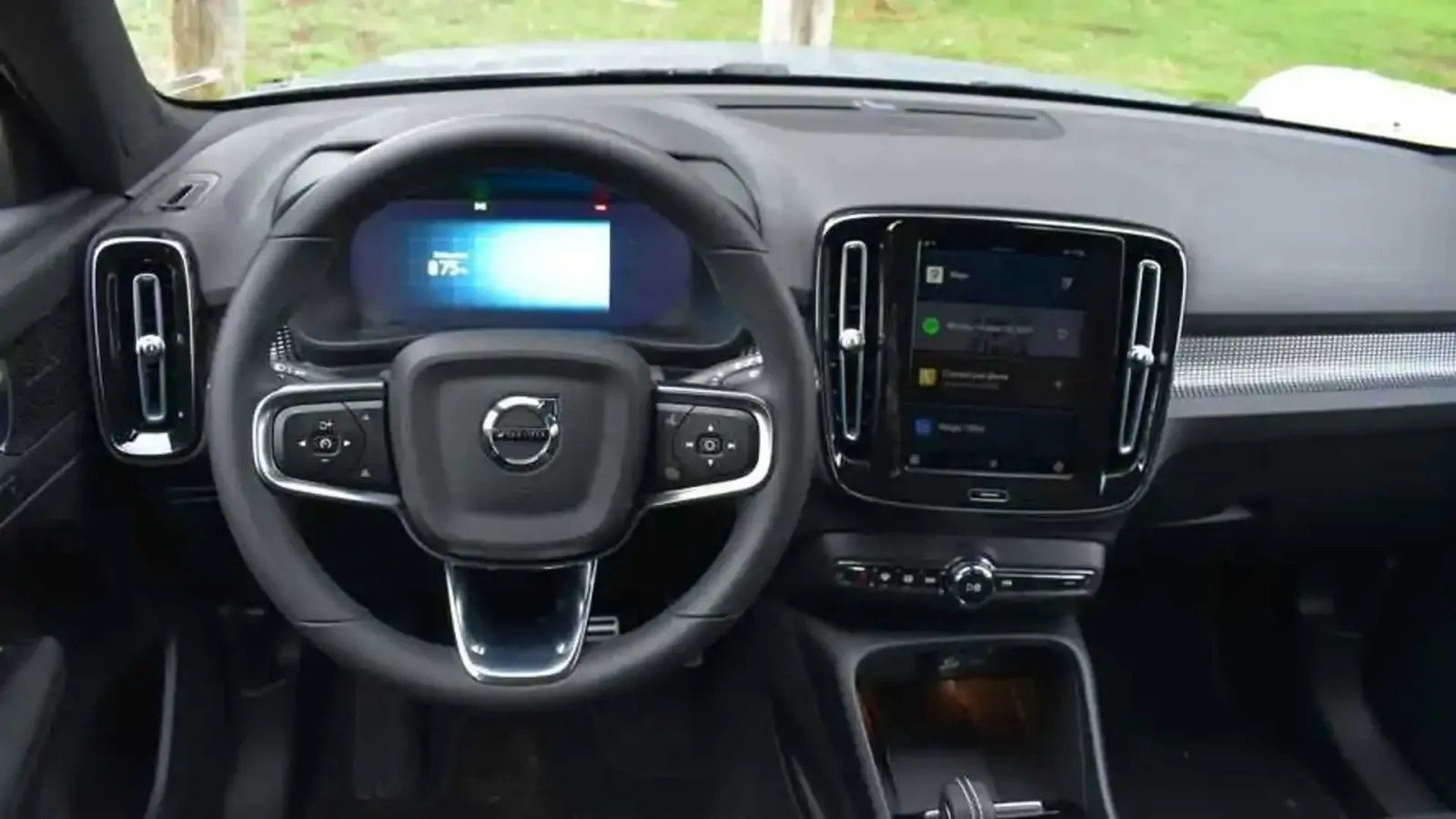
Volvo EX40 (2024)
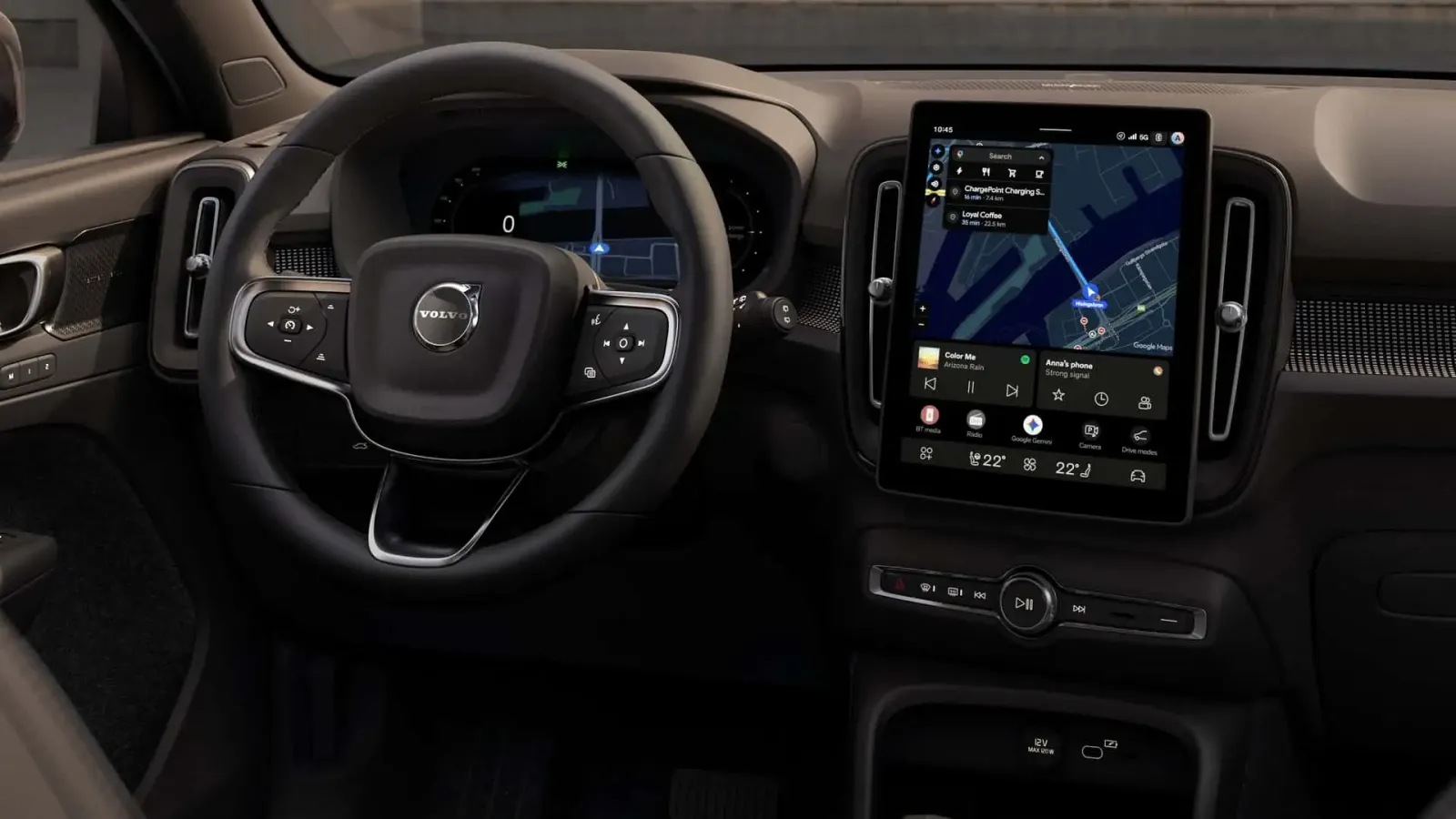
Volvo EX40 (2027)
The instrument display is still housed in a cover, which resembles internal combustion engine models. It features two configurable circular instruments and an information display (for example, for a map view). Since navigation is based on Google Maps, the navigation maps can also be displayed as satellite images, which is useful in many situations.
The system starts as before without any button press: simply activate forward or reverse gear (D or R) while the brake pedal is pressed. The latter is done via a bulky lever in the center console, as usual, with a button next to it for P mode. The characteristic vertical air vents also remain unchanged.
A new feature is Google Gemini: after its debut in the EX60, this artificial intelligence is now being gradually integrated into other models. One advantage is that it enables natural conversation.
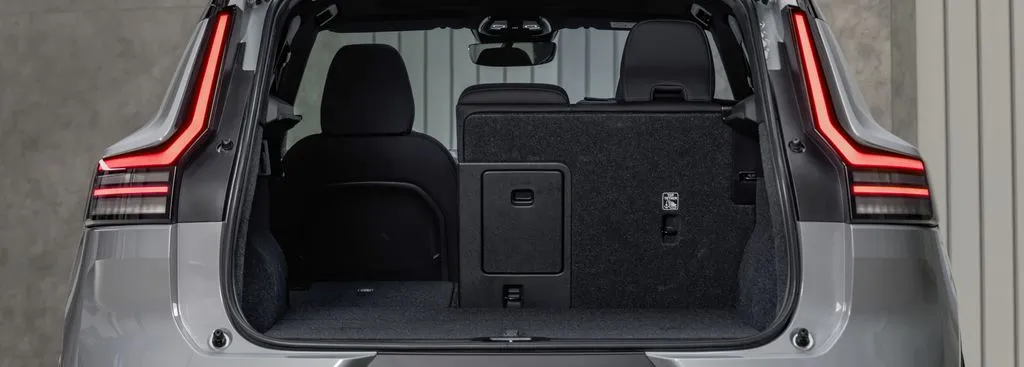
Volvo EX40: The Trunk
Image by: Volvo
The trunk capacity remains unchanged at 410 to 1,295 liters. In addition, there is a 31-liter frunk. For comparison, the BMW iX1 offers significantly more at 490 to 1,495 liters, but it lacks a frunk. The Mercedes GLA provides 410 to 1,400 liters plus a 110-liter frunk, while the Audi Q4 e-tron has a capacity of 515 to 1,460 liters (according to ADAC). Based at least on the manufacturer’s data, Audi and BMW thus offer the largest trunk volumes.
Powertrains and Batteries
Even when the electric compact SUV was launched in 2020, its powertrains had designations like P8 AWD. These P-designations are returning now, simplifying the naming scheme somewhat. The two battery options with 70 and 79 kWh of net capacity remain in the lineup, but the all-wheel-drive version with 300 kW has been removed. This leaves three variants whose specifications have remained almost unchanged:
EX40 P5 electric
EX40 P5 Long Range electric
EX40 P8 Performance AWD electric
Drive Type
RWD 175 kW
RWD 185 kW
AWD 325 kW
(135+190 kW)
Torque
420 Nm
420 Nm
670 Nm
(250+420 Nm)
0–100 km/h / Top Speed
7.3 seconds / 180 km/h
7.3 seconds / 180 km/h
4.6 seconds / 180 km/h
WLTP Fuel Consumption
17.2–18.7 kWh/100 km
16.6–18.4 kWh/100 km
17.6–19.4 kWh/100 km
Battery Capacity (net / gross)
67 / 70 kWh
79 / 82 kWh
79 / 82 kWh
WLTP Range
435–477 km
520–576 km
485–538 km
Max. Towing Capacity
1,500 kg
1,500 kg
1,800 kg
A permanent magnet synchronous motor (PSM) is used at the rear, apparently always the same one. The all-wheel-drive version adds an asynchronous motor (ASM) in the front as well. When full power isn’t required, this motor can be simply switched off.
The drivetrains differ quite significantly: while the rear-wheel-drive models, like the front-wheel-drive BMW iX1, have a relatively modest power output, the all-wheel-drive version, with its 4.6-second acceleration time, is almost on par with a sports model. Their ranges can compete with those of the BMW iX1 and Q4 e-tron, while the electric GLA can achieve up to 655 km of range. Regeneration can be adjusted, but only via the touchscreen. At the time of our test in 2023, there was only a choice between one-pedal driving and coasting mode. An adaptive mode has since been added, according to a Volvo support page.
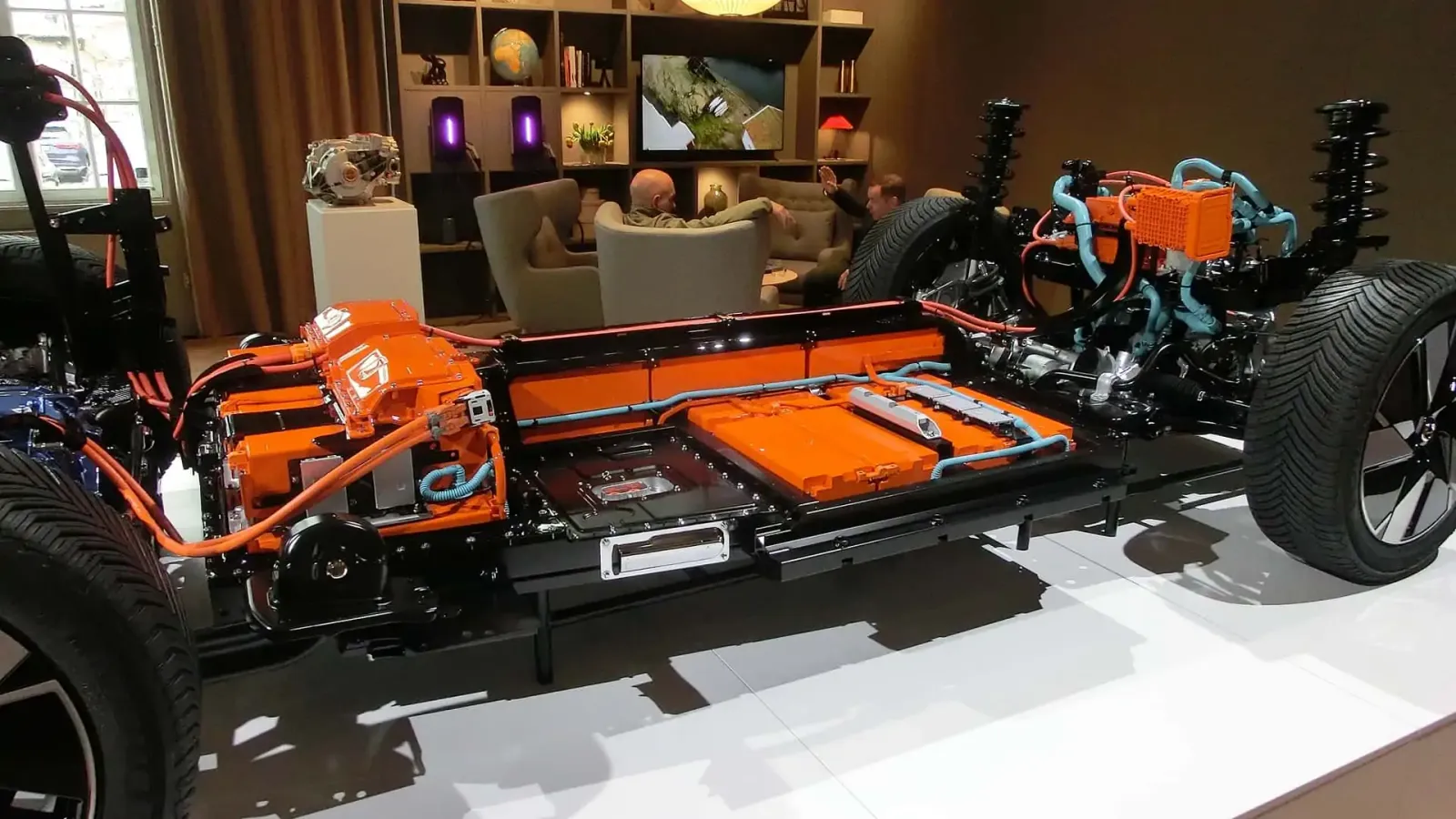
The 79-kWh battery of the rear-wheel-drive model: The highly segmented battery design shows that the Common Modular Architecture used is a combustion engine platform (showcased in 2023)
Nothing has changed regarding charging options. AC charging always provides up to 11 kW, while DC charging offers 180 kW for the smaller battery and even 205 kW for the larger one. These are impressive figures for a 400-volt model. The same applies to the average charging speed of up to 2.0 kWh per minute (calculation for the larger battery: 67 kWh × 0.7 / 28 minutes).
EX40 P5 electric
EX40 P5
Long Range electric
EX40 P8 Performance AWD electric
Max. charging capacity
AC / DC
11 / 180 kW
11 / 205 kW
11 / 205 kW
DC charging time
10–80%
26 min
28 min
28 min
DC charging speed
10–80 %
1,8 kWh/min
2,0 kWh/min
2,0 kWh/min
Average charging capacity
10–80 %
108 kW
119 kW
119 kW
Top speed after charging
up to 12.8 km/min
up to 14.4 km/min
up to 13.5 km/min
The average charging capacity in the 10 to 80 percent range is calculated by multiplying the charging speed in kWh/min by 60 min/h, while the values for range extension come from the WLTP range (calculation for the Long-Range model: 576 km × 0.7 / 28 min). Even here, the Long-Range version performs well, though it doesn’t make it into the top ten of 400-volt vehicles. Plug & Charge is supported, but not reverse charging (V2L).
Prices and Features
The prices start at 47,490 euros as before, while the Long Range version is now available from 53,090 euros, representing a moderate price increase compared to the previous 52,990 euros. The all-wheel-drive model with 325 kW of power is available from 60,590 euros; this comes with the Plus version, which was not offered for the highest-powered configuration before. The Ultra variant remains priced at 64,090 euros. Here are all the prices for the Volvo EX40:
EX40 P5 electric
EX40 P5
Long Range electric
EX40 P8 Performance AWD electric
Essential
47,490 euros
—
—
Core
50,290 euros
53,090 euros
—
Plus
52,990 euros
55,790 euros
60,590 euros
Black Edition Plus
54,290 euros
57,090 euros
61,890 euros
Ultra
—
59,290 euros
64,090 euros
Black Edition Ultra
—
60,590 Euros
65,390 Euros
For a model that recorded only about 2,600 new registrations from January to September 2026, the range is quite extensive. The prices seem fairly high at first, but premium competitors are hardly any cheaper. The 150-kW base version of the BMW iX1 starts at 49,400 Euros (the 230-kW all-wheel-drive version at 56,600 Euros), the Audi Q4 e-tron with 150 kW also costs at least 47,500 Euros, while the electric Mercedes GLA with a consumer discount is only slightly cheaper (starting at 46,170 Euros, the long-range 250+ version at 52,290 Euros).
The base Essential version already comes equipped with 19-inch aluminum wheels, a roof rack, LED headlights with high-beam assist, a rain sensor, electrically adjustable, heated, and foldable exterior mirrors, a two-zone automatic climate control system, seat and steering wheel heating, and a heat pump. Front and rear parking sensors, a rearview camera, adaptive cruise control, lane-keeping assist, and blind spot monitoring are also standard features.
The lack of seat and steering wheel heating, as well as a heat pump, cannot be ordered at an additional cost either. For this reason, along with the limited paint options, the Core version seems more advisable. In addition to seat and steering wheel heating and a heat pump, it also features inductive smartphone charging, a sensor-controlled trunk lid, and Keyless Drive (automatic unlocking with the key in your pocket, locking via a button on the door handle). Other features include a premium audio system, the partially autonomous Pilot Assist driving system, larger wheels (20 inches), electrically adjustable seats, and a glass sunroof.
The car is manufactured in Ghent, Belgium, where the EX30 is also produced.
Rivals, Tests, and Evaluation
We have tested the Volvo EX40 several times already:
Volvo XC40 Recharge P8 AWD in Test (2021)
Volvo XC40 and C40 after the facelift tested (2022)
Volvo XC40 Single Motor Extended Range and Twin Motor tested (5/2023)
Volvo XC40 Recharge Pure Electric Single Extended Range (12/2023)
Volvo EX40 Twin Motor Performance (1/2025)
More compact SUVs:
In summary
Were you already aware of the facelift to the Volvo EX40? Not so fast. The new version offers more than the press release promised. It only mentions the new look of the matrix-LED headlights, without noting that they are now standard for the first time. It also omits the fact that the 300-kW all-wheel-drive version is no longer available.
On the other hand, the high-end heat pump was already standard on the previous model from the Core trim level. Ultimately, it is the price list that matters most, not the press release — and comparing it to older versions also provides useful insights.