
Volvo begins manufacturing its 80-ton electric truck: up to 420 km of range with a 680 kW charge
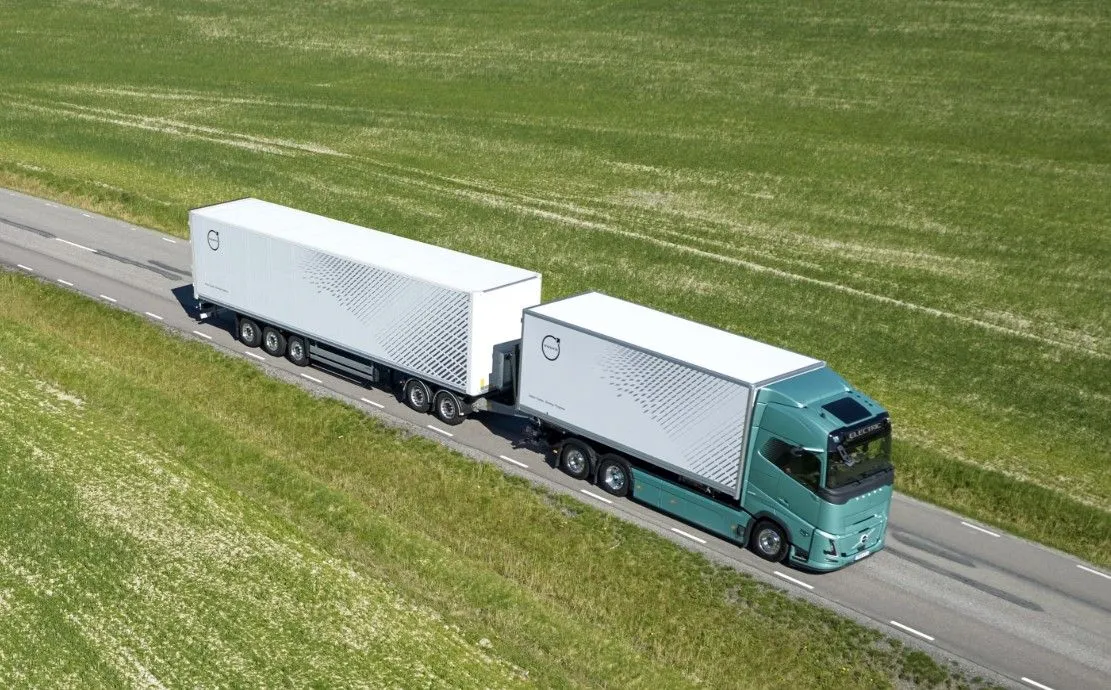
Volvo Trucks has begun mass production in Sweden of its new generation of heavy electric trucks, a range that includes the Volvo FH Electric and the Volvo FH Aero Electric. Manufacturing started at the Tuve plant in Gothenburg, marking the production start for models that the company unveiled in the first half of 2026.
Among them is a particularly interesting version for heavy transport. The new Volvo FH Electric can be configured with a maximum weight of up to 80 tons, designed for markets where heavier vehicle combinations are permitted than in Europe. Volvo will begin introducing this version gradually starting in early 2027 in Sweden, Norway, Finland, Denmark, the Netherlands, and Switzerland.
The proposal is primarily aimed at long-distance operations and regional transportation with heavy loads. In this case, Volvo has chosen a configuration consisting of a tractor truck and a trailer, equipped with reduction axles that enable better handling of heavy loads and improved pulling capacity, especially in tasks requiring greater traction.
Here, it’s important to clarify the initial reports regarding this model. The 80-ton version is not the same truck as the Volvo FH Aero Electric capable of traveling up to 700 kilometers; rather, it is a different variant of the new generation. The extended-range FH Aero Electric can go up to 700 kilometers but is rated for payloads of up to 48 tons. The 80-ton version has a shorter range precisely due to the heavier loads it must carry.

Specifically, Volvo claims up to 450 kilometers with a total weight of 64 tons, while at 74 tons—the allowable limit in Sweden—the range drops to 420 kilometers. In Finland, where the weight can reach 76 tons, the claimed range is also up to 420 kilometers. As with such vehicles, these figures depend on factors like weight, weather conditions, wind, and road characteristics.
The propulsion system belongs to Volvo’s new generation of electric systems and uses an eight-speed transmission developed specifically for use with electric motors. The company aims to achieve smoother power delivery and greater control when the truck is carrying heavy loads. In its new generation lineup, Volvo offers power outputs of up to 540 kW, equivalent to around 731 horsepower, depending on the selected configuration.
The most notable aspect is the energy storage system. For this generation, Volvo has developed new batteries with a longer lifespan and improved thermal management, along with an upgraded monitoring system. In the case of the 80-ton version, the announced usable capacity reaches 640 kWh, a figure that ensures considerable range even when the unit operates with very high weights.
Rapid charging also gains special importance in a truck with these specifications. The new Volvo FH Electric can use both the CCS2 system and the MCS high-power charging system. For the 80-ton configuration, Volvo claims up to 680 kW via MCS, allowing a 20% to 80% charge in approximately 36 minutes. With CCS2, offering up to 360 kW, the same process takes around 70 minutes.

This rapid charging capability is especially important in professional transportation, where downtime has a direct impact on vehicle utilization. The MCS technology allows for the recovery of a significant amount of energy during drivers’ regular breaks, enabling electric trucks to be used on routes that are much more demanding than those that earlier generations could handle.
Above this version is the Volvo FH Aero Electric with extended range, which is the model behind Volvo’s claimed range of up to 700 kilometers. Its e-axle system integrates the electric motors and transmission in the rear axle, freeing up space in the chassis to accommodate up to eight battery packs. In its highest capacity configuration, it has 780 kWh of storage, of which up to 725 kWh is usable, and it can be charged from 20% to 80% in about 50 minutes using a 700 kW MCS charger.
This long-range version can deliver up to 460 kW, or about 625 horsepower, and is designed to cover over 700 kilometers on a single charge stop. It offers a different approach compared to the 80-ton FH Electric, as Volvo prioritizes range and long-distance capability here rather than the ability to handle maximum payloads like in the heavier variant.
As for the 780 kWh battery in the FH Aero Electric, it consists of eight packs of 97.5 kWh each and uses NCA cells supplied by Samsung SDI. The same source states that Volvo guarantees a battery health level of at least 80% for six years or 720,000 kilometers.
Volvo has also explored the possibility of using these trucks in refrigeration applications. The electric power system allows for powering cooling equipment without the need for a separate diesel generator, which is particularly important for long-distance freight transport.
With the start of mass production in Gothenburg, Volvo moves from prototypes and initial demonstration units to a much more significant commercial phase. The combination of up to 80 tons of total weight, 420 kilometers of range with heavy loads, and a power output of up to 680 kW demonstrates the progress of heavy electric truck technology, though its widespread adoption will still depend on the availability of high-power charging infrastructure.
Source | Volvo