
Volta Via examines electrification of road construction sites
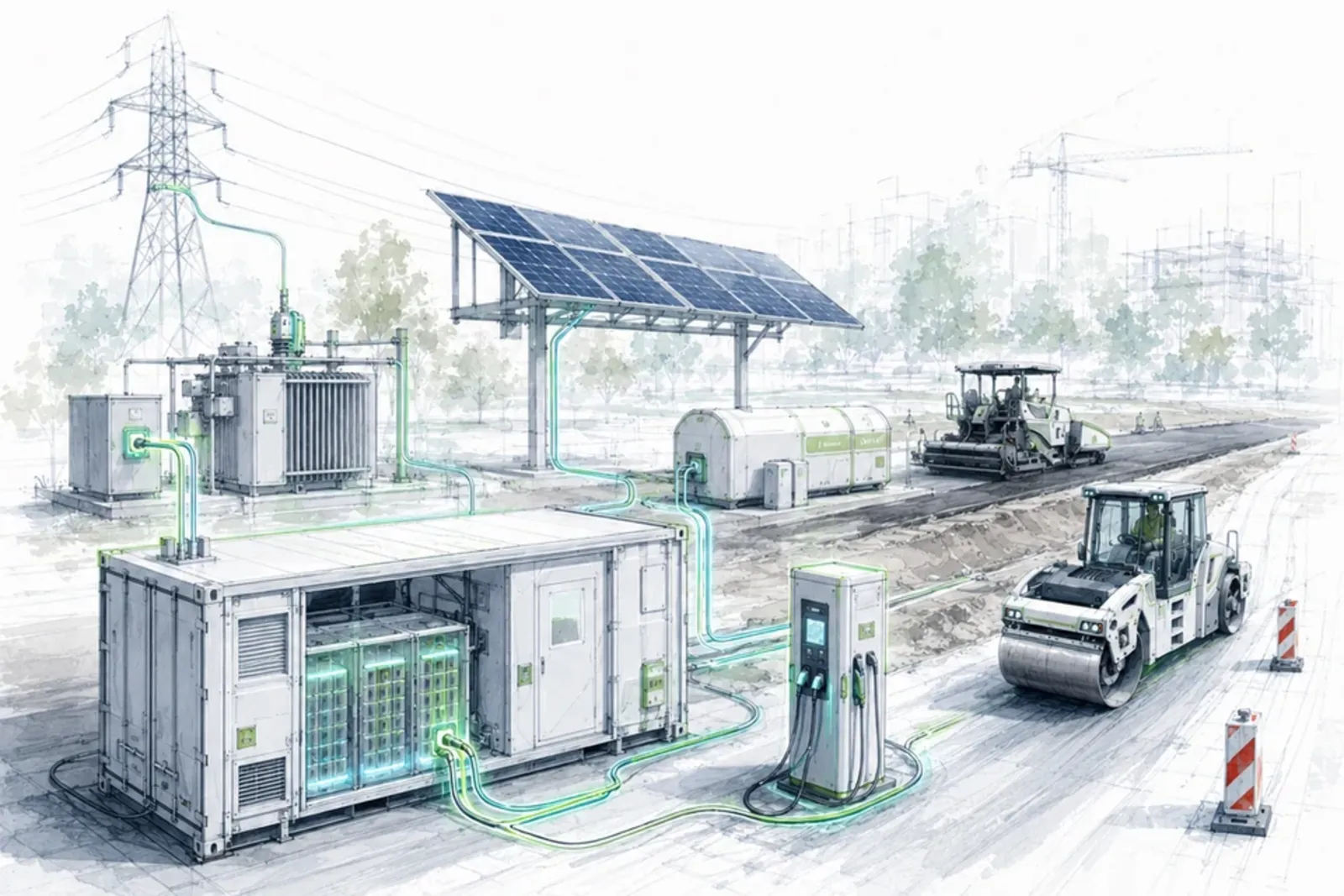
The Volta Via research project has investigated how large construction sites in road building can be electrified and what energy infrastructure is required. Electrified models are already available for up to 86 per cent of the machine classes considered.
A recharging demand of 378 kW was calculated for intensive construction phases.
Bilde: Volta Via
The project was conducted by Zeppelin Rental in collaboration with the Chair of Production Engineering of E-Mobility Components (PEM) at RWTH Aachen. Participants included, among others, Autobahn GmbH, the Federal Highway Research Institute (BASt), the Austrian ASFINAG, and the Swiss Federal Roads Office (ASTRA).
The study examined major renovations and surface repairs of asphalt and concrete roadways, among other aspects. For the years 2027, 2040, and 2050, the project partners developed reference scenarios for machinery requirements, energy supply, and charging infrastructure. According to the final report, these must be adapted to construction methods, machinery configurations, construction time, and local conditions.
The results show that electrified models are already commercially available for up to 86 per cent of the required machinery classes. However, this does not imply full technical equivalence with diesel machines. Limitations remain, particularly in continuous power output, operating duration, charging requirements, and deployment flexibility. The authors identify supply gaps primarily in feeders and slipform pavers.
Energy supply becomes the critical factor
A model calculation for the electrification of motorway renovations illustrates the potential additional electricity demand. Assuming a renovation rate of four per cent, Germany would require approximately 34.7 GWh of additional electricity per year, equivalent to about 0.0066 per cent of the country’s total electricity consumption. For the entire D-A-CH region, Volta Via calculates around 44 GWh annually.
However, according to the report, local availability of the power required is more critical than the total energy volume. For the most power-intensive construction phase in the reference scenario, a recharging power demand of 378 kW arises. Factors such as grid connections, charging windows, storage systems, load management, and potential simultaneous charging processes must be considered.
Not all vehicles would need to charge directly on the construction site. Road-legal tipper trucks, articulated lorries, concrete mixers, and other material transport vehicles could, according to the study, also use operational yards, production and logistics sites, or public truck charging points.
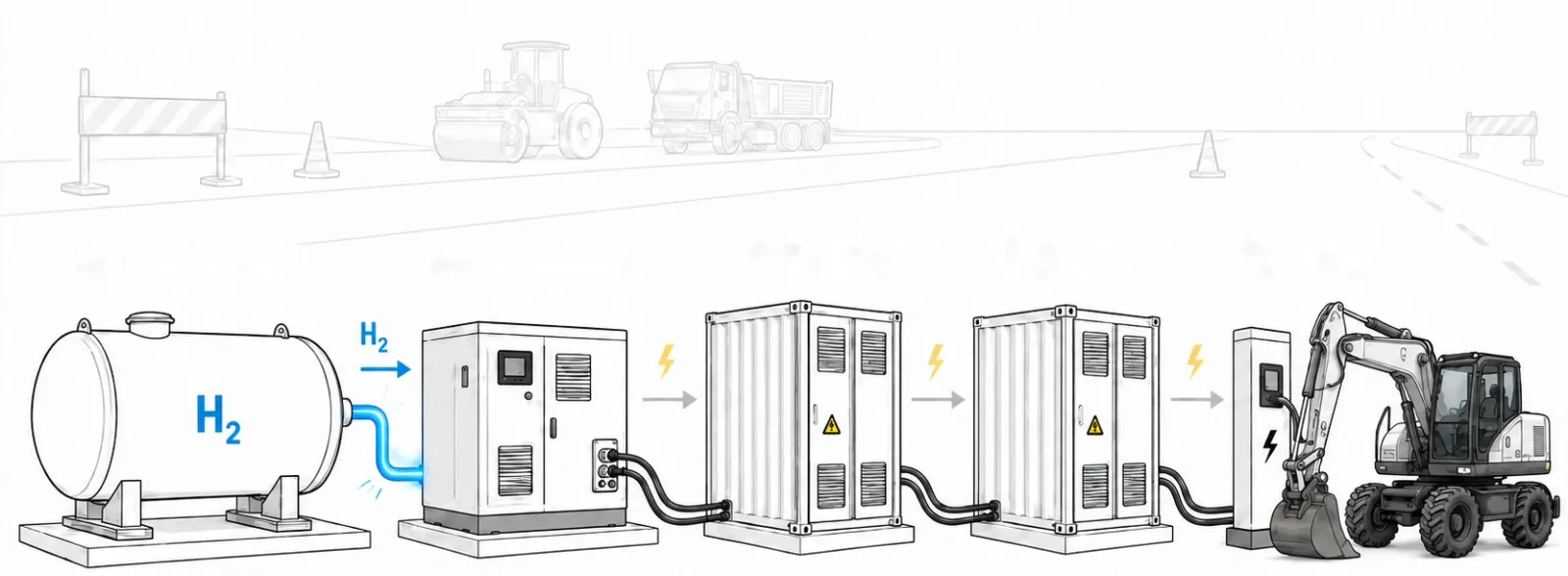
For construction-site-bound machinery, other supply solutions are necessary. For multi-year large-scale projects, a project-specific medium-voltage connection may be an option. For shorter or spatially mobile construction sites, the report envisages temporary and mobile supply systems. Cable-bound machines could also be practical for stationary applications. This could partially eliminate the need for large battery storage systems in the machinery, provided a sufficiently powerful electricity connection is available.
An example of how such an approach can work in practice was demonstrated by Strabag in summer 2026 in Oberhausen. During the conversion of a soil treatment plant, eleven fully electric construction machines were deployed, including a 25-tonne excavator, a wheel loader, a mobile crane, and a road paver. A mobile battery storage system with 153 kWh was used to supply the machines and absorb peak loads. However, the site was not fully electric: for non-electrifiable applications and logistics transport, Strabag additionally used HVO100.
Operating costs could decrease
Volta Via also examined the operating costs of the various scenarios. Assuming that available electrified machinery is consistently used, operating costs could be reduced by slightly more than half by 2027 compared to conventional execution. By 2050, the model projects a reduction to as little as one-eighth of today’s levels.
However, the calculation does not account for the procurement costs of the machinery. It also assumes a constant industrial electricity price at 2025 levels. According to the report, the cost-efficacy of electric construction machinery depends on factors such as utilisation, operating hours, energy prices, infrastructure costs, residual values, and potential impacts on productivity and construction time.
The emissions figures are also modelled potentials. Under the assumed optimal conditions, Volta Via calculates approximately 80 per cent fewer greenhouse gas emissions in 2027 compared to the conventional reference case. By 2050, the reduction potential increases to around 97 per cent. The actual values depend, among other things, on the source of electricity, machinery availability, and the specific construction site.
The project also focused on the way in which public construction contracts are awarded. To this end, it deployed an electrification index that takes into account drive technology, the number of machines, and their significance for the construction process. This is intended to prevent a large number of small electric devices from disproportionately improving the result while central process steps continue to be carried out conventionally.
The index is included as a bonus criterion rather than an exclusion criterion. Bidders without a fully electrified machinery fleet should not be fundamentally excluded, but lower-emission machinery and supply concepts should receive an evaluation advantage. As market availability increases, the index could later be given greater weight or underpinned with minimum values.
Volta Via was funded as part of the D-A-CH Cooperation on Traffic Infrastructure Research 2024. The sponsors are the German Federal Ministry of Transport, the Austrian Federal Ministry of Innovation, Mobility and Infrastructure, and the Swiss Federal Roads Office.