
Volkswagen is considering using Xpeng’s CEA architecture in Europe. It will apply to 75% of the models.
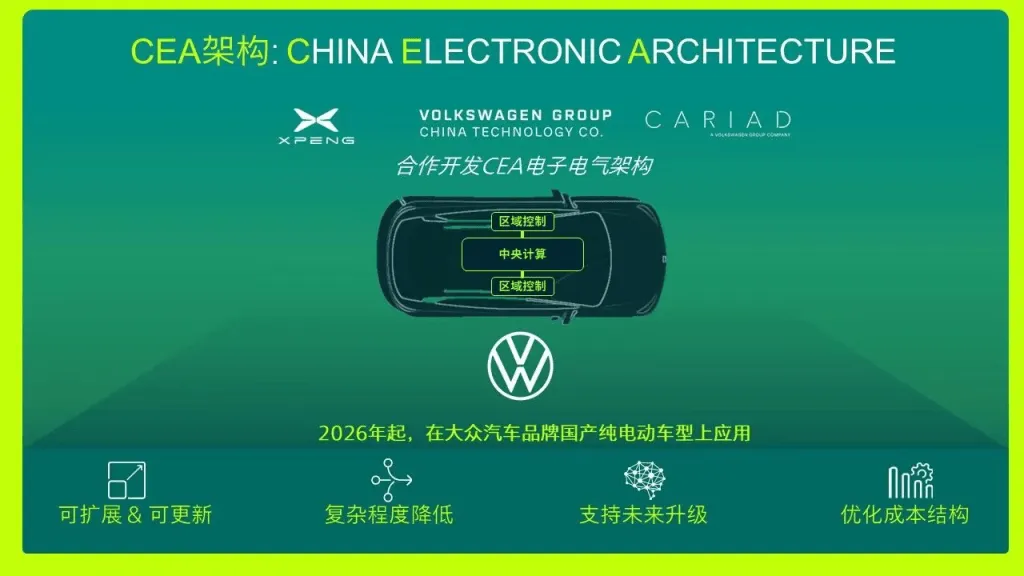
Volkswagen is considering adopting the CEA (China Electronic Architecture) electric and electronic system design in Europe, which it developed jointly with Xpeng. According to German Manager Magazin, this proposal would apply to around 75% of the next generation of Volkswagen, Skoda, and Cupra models. Volkswagen brand head Thomas Schäfer is set to present it to the group’s management on October 27.
This is currently just a proposal for evaluation, not a decision. If approved, European VW vehicles would use electronics developed in China, while Rivian would lose some of its role in the group’s plans.
Two strategies, one to remain
To date, Volkswagen has pursued separate paths. In China, it uses CEA with Xpeng, while for western markets it develops technology with Rivian. The group invested up to $5.8 billion in this American partner in 2024. This is one of the pillars of the software repair program led by the company’s chief Oliver Blume.
Manager Magazin lists future ID. Golf, ID. Passata, and Skoda Enyaq as candidates for CEA. These are segments where every euro spent on development translates into a price increase at the dealership.
What CEA Offers
The main argument is cost savings. Schäfer’s team estimates that switching to the Chinese architecture could save 4-5 billion euros, or 4.6-5.8 billion dollars.
CEA is a modular architecture that combines distributed controllers into fewer units, resulting in about 30% fewer controllers in a vehicle. According to the cited figures, this also improves development efficiency by up to 30%. Development costs for selected new models could drop by as much as 50%, and the development cycle could be reduced to around 18 months. These are figures from proponents of the project, so I would consider them as a forecast rather than an actual result.
The strongest advantage is actually quite straightforward: CEA is already in operation. Volkswagen and Xpeng signed an agreement for a shared architecture in April 2024. The first model based on CEA, the ID. UNYX 07, went into production at Volkswagen’s Anhui factory in January 2026. Plans call for CEA to be integrated into VW’s electric vehicles manufactured in China by 2026. Starting in 2027, it is intended to support all types of powertrains.
Supporters also argue that Chinese software and electronics can function on the group’s existing European platforms.
Conflict within the group
Not everyone at Volkswagen is convinced. Some managers doubt that adapting CEA to European regulations will be as simple and inexpensive as the proposal’s proponents claim. Further development also entails technical risks.
Advocates of the Rivian partnership are concerned about cost sharing. As Volkswagen relies much less on this technology, the collaboration may become unprofitable under current terms.
Software has long been the biggest challenge in Volkswagen’s transformation. Its extensive lineup, ranging from popular models to Audi and Porsche, made it difficult to standardize a single solution—a problem Cariad also faced.
The Road to Europe
The partnership with Xpeng began in July 2023. Volkswagen invested $700 million at that time and announced two joint electric vehicles for China. In August 2025, the companies expanded it to include internal combustion and plug-in hybrid platforms in China. Xpeng argued that a single architecture across different powertrains would accelerate OTA updates, shorten vehicle development time, and improve production scale.
Now VW is testing whether the same electronics can succeed in the European market. If so, the first European cars with Chinese “brains” could become regular, popular models rather than an exotic niche.
LovEV Newsletter
Want more content like this?
Sign up — we’ll send you a weekly roundup once the newsletter starts.