
Volkswagen pauses Indian EV investments pending likely JSW deal
Volkswagen is apparently holding back further investments in a planned electric car program for India for the time being. The group is reportedly awaiting the outcome of joint venture talks with the Indian JSW Group. However, basic development work for a low-cost electric car is already complete.
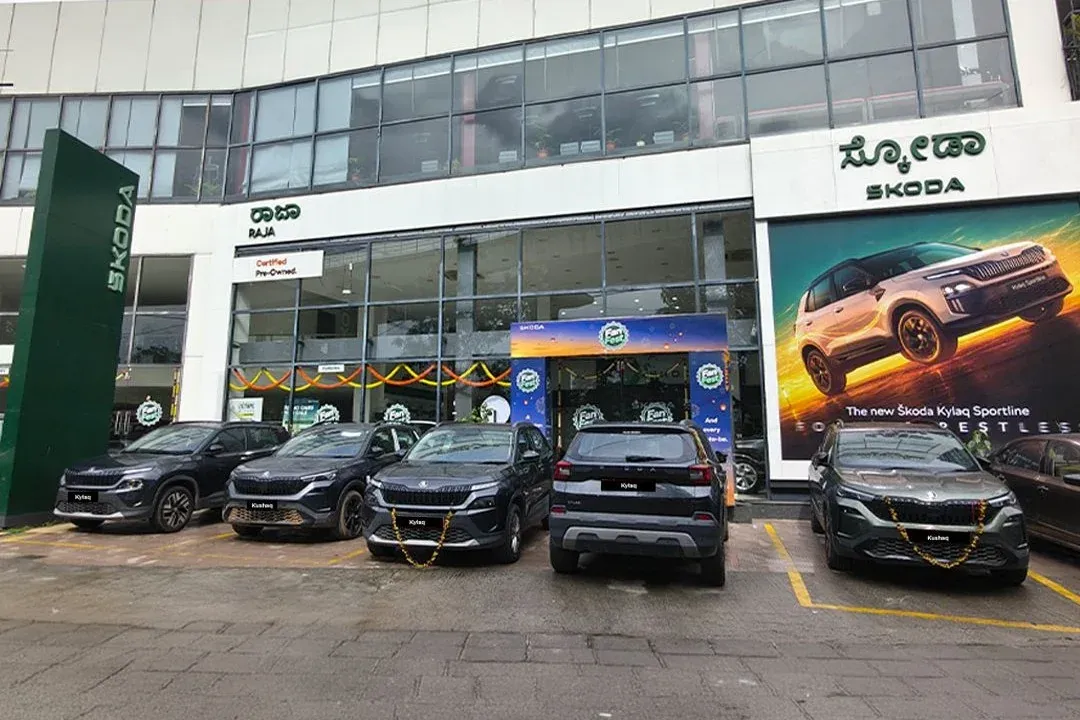
Skoda dealer in Bengaluru, India
Image: Skoda
Volkswagen has reportedly put further investments into its planned EV programme for India on hold. According to _Bloomberg_, citing sources familiar with the matter, the group wants to gain clearer insight into its potential partnership with Indian conglomerate JSW Group before committing additional funds to the project. Development work is said to be so advanced that the project could be accelerated rapidly once an agreement with the potential partner is reached.
There has been no official confirmation of the investment pause so far. Last year, it was already reported that Volkswagen – or its most important brand in India, Škoda – might not invest as much of its own money as originally planned in the platform. Currently, neither Škoda nor Volkswagen offers EVs on the Indian market; only internal combustion engine models are available. This is set to change in 2028; however, Volkswagen and JSW declined to comment on the new _Bloomberg_ report.
Reducing costs with a local partner
At the beginning of September, Volkswagen and Škoda announced they were exploring a strategic partnership with JSW. The companies signed a memorandum of understanding (MoU) to this effect. The goal is a potential joint venture that could develop, produce, and market passenger cars for both the Indian market and for export. In addition to EVs, the collaboration also looks set to include vehicles with other powertrains.
For Volkswagen, the search for a local partner is primarily a cost issue. The group wants to expand its position in India but currently holds only a relatively small market share there. Within the group, Škoda bears the main responsibility for the India business. Together, both brands increased their sales in 2025 by 36 per cent to 117,000 vehicles, according to statements from outgoing Škoda CEO Klaus Zellmer. Significant investments would be required to enable further growth, Zellmer explained in September. A partner could contribute capital and simultaneously improve access to local suppliers, production capacities, and market expertise.
Volkswagen’s talks with JSW must also be viewed against the backdrop of earlier attempts in India: after failed negotiations with Indian automaker Mahindra, Volkswagen has been looking for almost two years for a way to share the costs and risks of its expansion with a domestic company. According to _Bloomberg_, the group had already decided last year to reduce development costs for electric vehicles in India by one-third.
Cost-effective EV platform from China
Technically, Volkswagen has long planned to adapt its Chinese electric vehicle architecture, CMP 21, for India, under the working title India Main Platform (IMP). To achieve a competitive presence in India, Volkswagen is likely to rely heavily on local components and manufacture the vehicles on-site. Only this approach would allow costs to be reduced sufficiently to compete with offerings from domestic manufacturers.
As _Bloomberg_ reports, Volkswagen has already completed the design work for the project. This could indicate that the group could advance the project relatively quickly if an agreement with JSW is reached.