
The Volkswagen Mission Efficiency covered 1278 km on a single charge. The XL1 returned as an electric vehicle with 6.89 kWh/100 km.
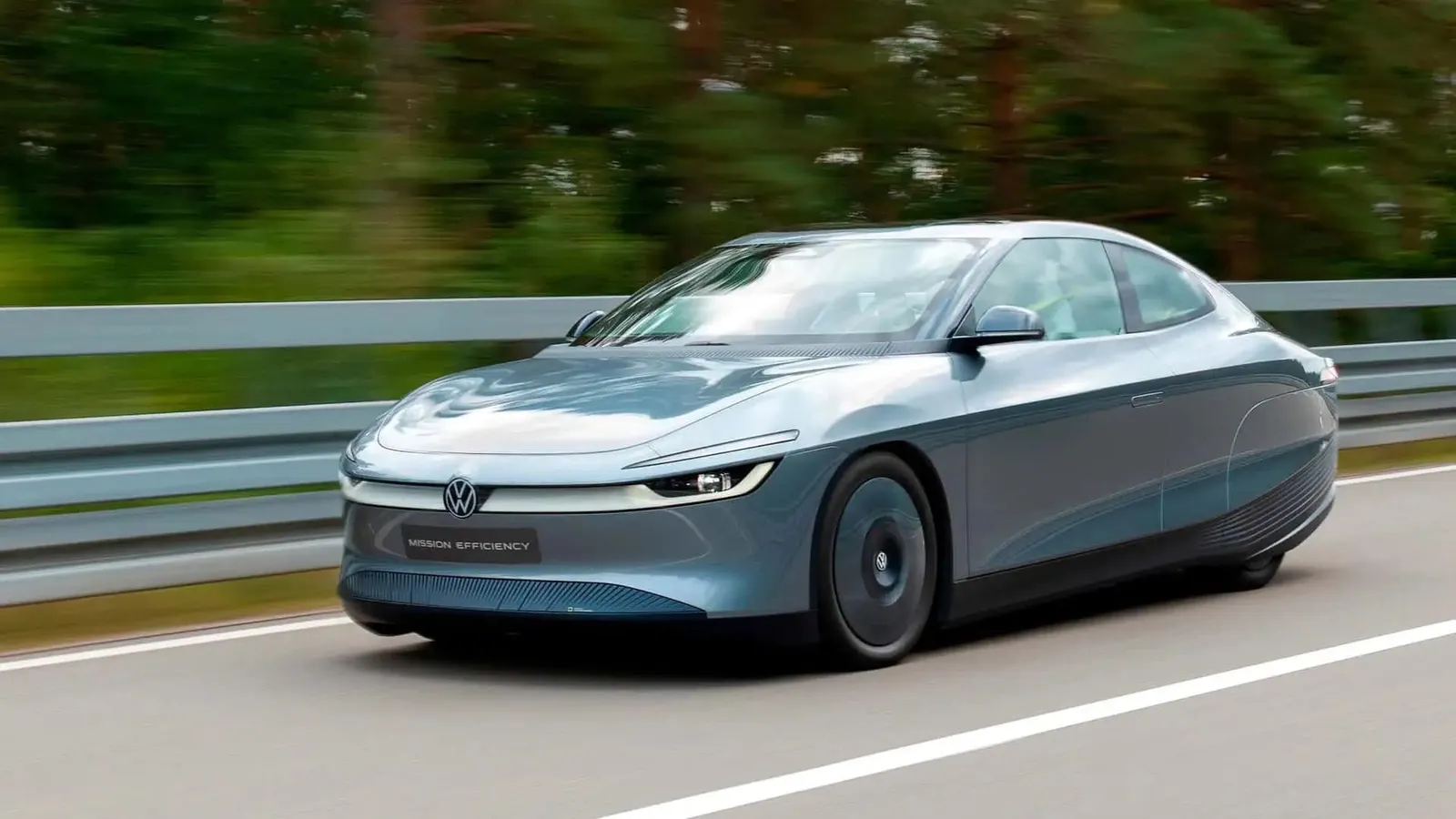
Volkswagen unveiled the Mission Efficiency concept, a production-ready electric vehicle based on the ID. Polo platform. The car set three records, including a Cd value of 0.158 and an actual fuel consumption of 6.89 kWh/100 km on the route from Wolfsburg to Vienna.
Table of Contents
Show
Hide
The most interesting aspect is this: it’s not a demonstration of a massive battery. It shows how far a standard MEB+ platform can take us if people truly strive to optimize every watt.
Mission Efficiency is the spiritual successor to the XL1, just without a diesel engine and an exorbitant price
If the name says nothing to you, its design should. Mission Efficiency looks like a modern interpretation of Volkswagen’s XL1, the famous “one-liter” experiment from 2013-2016. That vehicle was a plug-in hybrid with a two-cylinder diesel engine, weighed 795 kg, and had an impressive Cd value of 0.189 for its time.
The XL1 problem was simple: excellent aerodynamics, terrible scalability. Volkswagen built only about 250 units, at a price of around 111,000 euros. It was a showcase of engineering, not a product for the public.
Mission Efficiency aims to fix exactly this flaw. Instead of an exotic powertrain and niche design, Volkswagen uses standard components from the MEB+ platform—those same ones found in the ID. Polo and also planned for use in the ID. Cross. That sounds more sensible.
The numbers are impressive, but they need to be read carefully
Volkswagen cites three key figures. The first is a Cd value of 0.158, claimed to be a record for road-legal vehicles. The second is 6.48 kWh/100 km under ideal conditions—maintaining a constant speed of around 68 km/h on flat terrain with all onboard devices turned off. The third, much more interesting one, is 6.89 kWh/100 km in real-world driving conditions, without accounting for charging losses.
In the road test, the car traveled from Wolfsburg to Vienna via Poznań and Olomouc. The distance was 1278 km. The vehicle was charged once during the trip, and it still had to show a range of 164 km at the end. This means a theoretical total range of over 1400 km with just one charge along the route.
However, there’s a catch here. This isn’t “1400 km on one charge” in the way most drivers intuitively understand it. It’s the result of very fuel-efficient driving, with one stop to charge, at an average speed of around 67.7 km/h and a top speed of about 138 km/h. Impressive? Yes. Representative for the A2 highway at 140 km/h? No.
Standard drive, exceptional aerodynamics
There’s no magic under the hood. The Mission Efficiency uses a front-mounted APP290 engine with 99 kW of power, or 135 hp, and 264 Nm of torque. The battery has a net capacity of 54.9 kWh and is based on NMC chemistry.
This is important because the engine alone doesn’t determine the performance. The mentioned engine and architecture are similar to what Volkswagen is preparing for its cheaper electric models. In fact, it’s the body that really makes all the difference.
The car has a very small front area of about 2.08 m2, a significantly narrowed rear section, and almost fully enclosed rear wheels. The chassis is completely covered. Additionally, there are three active cooling flaps that can operate in five different configurations. The record-breaking Cd value of 0.158 was achieved with all flaps closed.
Volkswagen claims that above 80 km/h, the Mission Efficiency uses more than 30 percent less energy compared to the standard ID. Polo. There’s also an interesting comparison: at 140 km/h, it requires roughly the same amount of power as the regular model does at 100 km/h. On paper, it sounds great. In practice, I’d really like to see identical tests of the two cars on the same day and along the same route.
Tires, brakes, and weight. Wires also escape here.
Volkswagen didn’t stop at just the car’s design. The Mission Efficiency features special Continental tires with very low rolling resistance, at 4.9 kg/t. This is said to be about 25 percent below the EU Class A efficiency label threshold.
There are also patented deflectors on the wheels and optimized wheel covers. It sounds like a detail, but with such numbers, it’s the details that make a difference.
The rear brakes are more interesting. Instead of a traditional hydraulic system, electric-mechanical rear brakes without wires or brake fluid are used. The goal is to reduce weight and friction losses. This actually seems like a technology that could move beyond the concept stage.
The vehicle’s structure has also been streamlined. It features a self-supporting aluminum frame, with certain components such as the doors, front grille, and trunk lid made from carbon fiber reinforced composites. Thus, it isn’t a cheap car in terms of materials used. It’s the drivetrain and electronics that are intended to be inexpensive, not the entire bodywork.
The interior makes it clear: every kilogram counts
Inside, the Mission Efficiency doesn’t pretend to be luxurious. It’s a basic 2+2 layout with a minimalist cabin, lightweight seats, and no traditional center screen. Instead of an infotainment system, Volkswagen reverted to the concept used in the e-Up: you install your own smartphone or tablet, which serves as the multimedia control center.
Even the audio setup is kept minimal. Instead of built-in speakers, there’s a portable Bluetooth speaker. It’s a bit silly, but fair. The manufacturer doesn’t promise any “premium digital experience” here; instead, they cut costs significantly.
Still, this isn’t a gimmick car. Volkswagen claims it has four seats and a trunk with a capacity of 481 liters. The entire vehicle is about 4.8 meters long, so it’s not a tiny car like the XL1.
Specifications
Volkswagen Mission Efficiency
Platform
MEB+
Powertrain
front-wheel drive, 1 engine
Power
99 kW, 135 HP
Torque
264 Nm
Net battery capacity
54.9 kWh
Battery chemistry
NMC
DC charging
up to 105 kW
AC charging
11 kW
Ideal fuel consumption
6.48 kWh/100 km
Actual fuel consumption
6.89 kWh/100 km
Fuel consumption including charging losses
7.51 kWh/100 km
Resistance coefficient
Cd 0.158
Seats
4
Trunk space
481 l
Solar power
370 W
The solar roof offers a bonus, but let’s not make it into a perpetual motion machine
A 370 W solar power system is integrated into the glass roof and trunk lid. Volkswagen claims it can add up to 30 km per day under favorable conditions.
This can be used to power onboard devices and reduce battery consumption. It’s a nice addition, but still just an addition. With Polish weather conditions, this “free range” will mostly be a marketing gimmick for half a year.
Will it go into production?
For now, the answer is no. Volkswagen clearly refers to Mission Efficiency as a concept and has not announced any plans for sales. It’s meant to be a demonstration of what can be achieved with standard components when efficiency is the focus.
It’s a shame, but not entirely. Even if the entire car doesn’t make it to dealerships, several of these solutions have practical production value. Active aerodynamics, efforts to reduce rolling resistance, weight reduction, and a more uncompromising approach to the vehicle’s shape can be adopted by regular models. And this is exactly what many electric vehicles lack today, as they rely on larger batteries to solve every problem.
For Polish drivers, the conclusion is simple. If manufacturers start focusing truly on energy consumption rather than just battery capacity, small and medium-sized EVs on the road could see the biggest improvement in years. Not in showrooms, but at charging stations.
Mission Efficiency may seem like a concept, but its most valuable aspect isn’t the XL1-inspired styling—it’s the reminder that 6-7 kWh/100 km isn’t laboratory physics, but rather a direction the industry should pursue. Would you prefer such a “boring record holder” in regular sales, even at the cost of lower power and a more unusual design?