
Volkswagen ID.3 Neo in Review: The Underestimated One
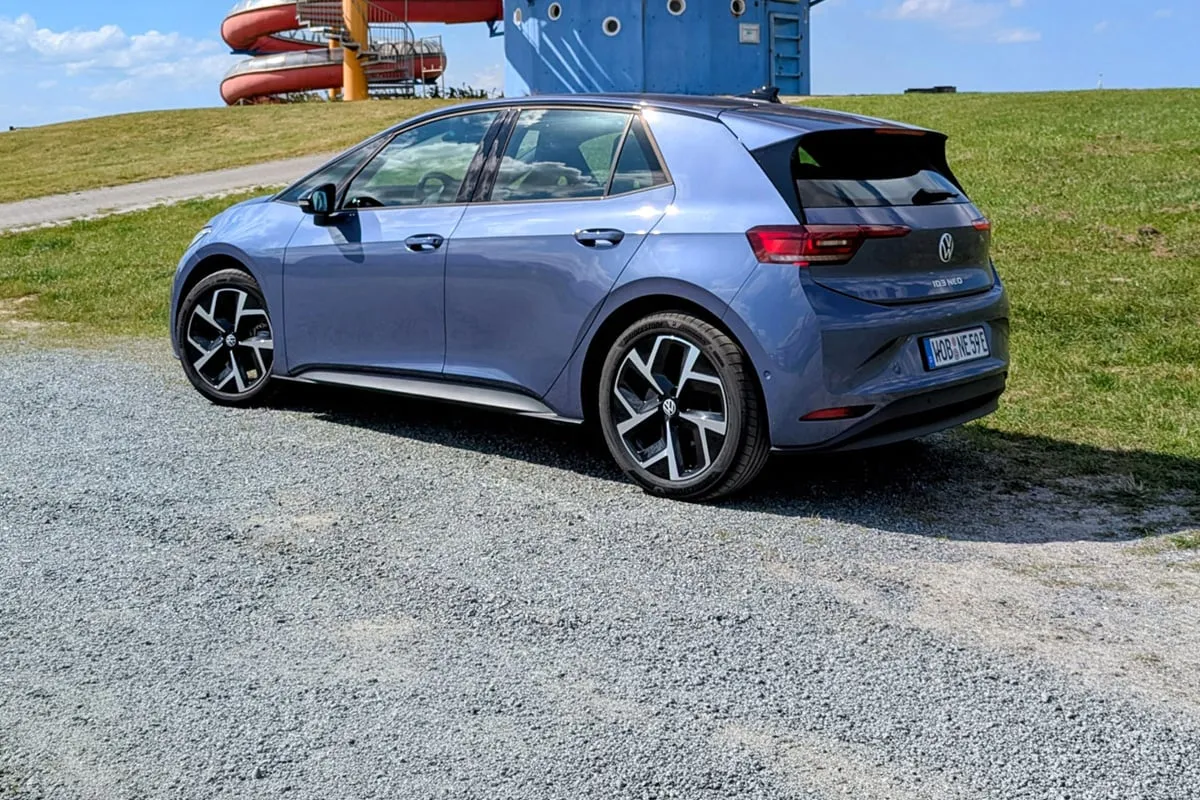
Did anyone say boring? Actually, no one is paying attention to the Volkswagen ID.3. However, there are exceptions with the ID.3 Neo. Some passersby glance at it secretly, while others look directly. The second revision of this electric car, which has taken over the role of the e-Golf until its redesign in 2029, clearly piques some people’s interest. What can the ID.3 Neo do, with a starting price of 33,995 euros?
Volkswagen offers a fixed discount of 2,000 euros on this base price in the Trend version, calling it a purchase bonus. For the ID.3 Life, VW deducts 3,000 euros automatically, and for the Style version (which is the test car), 4,000 euros. Private customers with low household incomes can receive an additional 6,000 euros from the subsidy fund. Money matters.
Only the Skoda Elroq sells better in Germany
Regardless of these calculations, sales figures show that the ID.3 is popular: from January to July, it was the second-most registered electric car in Germany after the Skoda Elroq. If there is a crisis in Wolfsburg, it’s not due to lack of demand.
The Neo differs little from previous ID.3 models in terms of exterior design, more so in the interior, and most significantly in terms of propulsion. Yes, it’s good that the unlit wiper controls for the climate system have been replaced with nice tilt switches. What has a greater impact on the sense of space is the choice of materials: the ID.3 has always been a particularly quiet electric car. Now, the quality of construction and sound insulation enhance rather than undermine the brand’s typical blend of comfort and solidity.
Short turning radius, efficient drive
The ID.3 Neo is easy to handle and simple to operate. Its 10.2-meter turning radius makes it agile even when parking. Those who wish can rely on the premium and highly effective automatic transmission option. The steering provides precise feedback in both slow and fast turns. Additionally, the electric motor mounted on the driven rear axle ensures excellent traction—just like in the original Beetle.
The previous APP 310 electric motor (for English Axial Parallel Position) has been replaced by the APP 350. It delivers 140 kilowatts in the test vehicle, enabling the ID.3 Neo to reach 100 km/h in eight seconds. Similar to the APP550 used in high-performance ID models, the APP350 stands out for its efficiency: according to the onboard computer, the ID.3 Neo averaged 15 kWh/100 km in consumption, even though two-thirds of the distance was on highways.
With an available energy capacity of 58 kilowatt-hours (kWh) in the traction battery, the calculated range is 387 kilometers (km). As usual, this is less than the WLTP value of 485 km. It’s still good for a real-world figure.
550 highway kilometers with one charge stop
Regarding the details: The minimum value of 10.5 kWh/100 km was recorded in urban driving conditions. On rural roads, it was 12.4 kWh/100 km. And on the highway at the recommended speed, it was exactly 20 kWh/100 km.
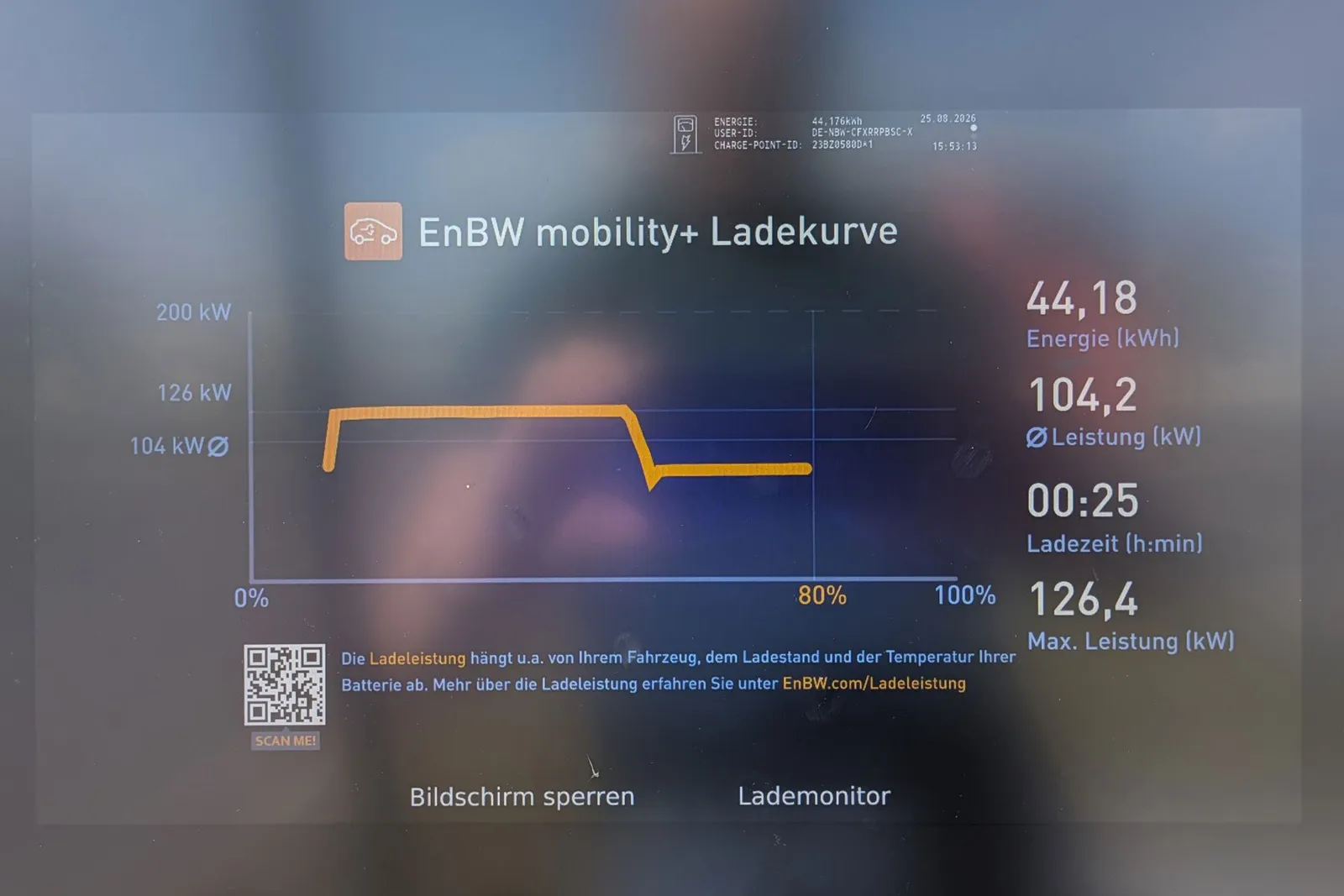
In ideal late-summer conditions, this means that the ID.3 Neo, equipped with a 58 kWh battery, loses about 10% of its charge after traveling around 350 km—time to head to a fast charger! Volkswagen follows ISO 12906 standards and specifies the maximum DC charging power (claimed to be 105 kW), the time it takes to charge from 10% to 80% (25 minutes), and the additional range achieved after a 10-minute DC charge stop (130 km).
In practice, the ID.3 Neo far exceeded the factory specifications in one regard: its DC charging power was 126 kW instead of the claimed 105 kW. In absolute terms, it managed to charge 44 kWh in 25 minutes, enough for roughly another 200 kilometers on the highway. Overall, it’s possible to travel over 550 kilometers with a 25-minute charging stop.
LFP Cells in MEB+
Notably, the charging curve consists of two horizontal segments: The first segment is at around 125 kW. When the battery level reaches about 60 percent, the charging power drops to around 80 kW and remains there. The real test comes in winter: The upgraded Modular Electrification Platform (MEB) has evolved into MEB+, and the 50 and 58 kWh battery sizes now use LFP cells.
LFP stands for lithium-iron-phosphate. This cell chemistry is cost-effective, particularly safe, and highly durable. However, its energy density is lower than that of the existing NMC cells, which are still used in models like the ID.3 GTI.
50 = 58 kWh
Those who plan for a long driving range and want to spend less money might find the perfect combination in the ID.3 Neo with a 50 kWh battery: since the APP350 is more efficient than the previous APP310, this version achieves a range of nearly 410 km, close to that of the previous 58 kWh model. Volkswagen confirmed to electrive upon request that the 50-kWh version of the ID.3 Neo features a traction battery with a software-limited capacity equivalent to 58 kWh. In other words, fully utilizing the charging potential of the ID.3 Neo with 50 kWh is similar to driving an ID.3 Neo with 58 kWh that is constantly in Battery Care Mode, thus only accessing 80 percent of its possible energy capacity.
Winter will show whether Volkswagen can manage the biggest weakness of LFP cells as well as Tesla: LFP cells are sensitive to cold and require targeted heating for fast charging. The entire automotive industry is shifting to LFP cells in China’s wake when it comes to affordable electric vehicles.
With the MEB+, people behind the wheel will notice little to nothing change, aside from lower electricity bills. That’s exactly how it should be.
Red light detection available at an extra cost
Significant progress has also been made in driving automation. Some buyers are indifferent to this, while others are not. For example, the ID.3 Neo equipped with the IQ. Drive Pro package (2,305 euros) features red light detection that works flawlessly even in Hamburg’s urban traffic: the ID.3 Neo stops automatically. Starting again when the light turns green, however, must be confirmed by the driver; a revision of licensing regulations could change this in the medium term.
VW has also significantly improved the handling feel when staying in the center of the lane. The ID.3 Neo remains confident while navigating between lanes and handles skillfully in many situations even outside highways. Without any extra cost and for all customers, the developers have refined the braking pedal feel: the ID.3 Neo allows for controlled deceleration, and the strange sensation of braking as if stepping on North Sea waves is now a thing of the past.
Because it fits so well
Volkswagen has consistently returned to itself with the ID.3 Neo. The third version of the ID.3 embodies clarity, comfort, and efficiency. How well it sells depends on external and internal pricing dynamics; for example, an ID. Polo with a similar specification is only slightly cheaper. This makes the ID.3 a great choice for those who aren’t after something flashy but simply want an excellent, everyday-use electric car. And that’s exactly what they get.