
The Volkswagen ID. UNYX 09 will make its debut on October 24. Its predecessor is selling terribly.
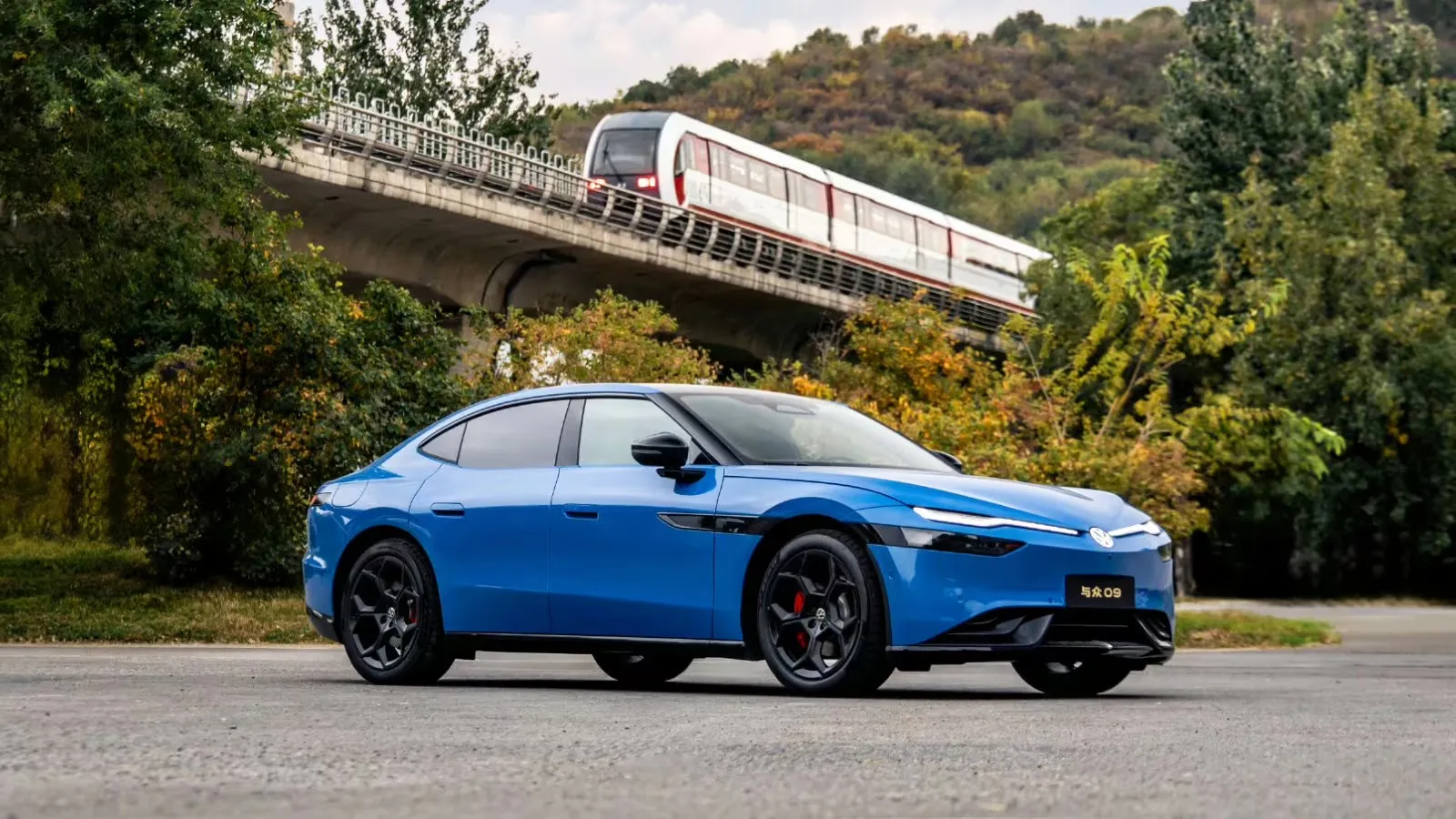
Volkswagen Anhui will introduce the electric sedan ID. UNYX 09 to the Chinese market on October 24, 2026, as the second model developed in partnership with Xpeng. The vehicle will feature an LFP battery with a capacity of nearly 92 kWh, a CLTC range of up to 755 km, and driver assistance systems powered by China’s Turing AI platform.
Table of Contents
Show
Hide
The launch comes at an awkward time, however. According to ThinkerCar, the first product of this collaboration, the SUV ID. UNYX 08, achieved only 7.4% of Volkswagen’s monthly sales target.
ID. UNYX 09 is 5.08 meters long and has 750 TOPS of computing power.
The pre-sale for the ID. UNYX 09 began on September 24. Volkswagen has set prices at 199,900–249,900 yuan, which is approximately 29,750–37,200 dollars. It is a large fastback with a length of 5,081 mm, width of 1,980 mm, and wheelbase of 3,030 mm. In terms of size, this vehicle clearly exceeds the European mid-size category.
Volkswagen ID. UNYX 09
RWD
AWD
Power
230 kW
140 + 230 kW
Drive Type
rear
all wheels
Battery
91,963 kWh LFP
91,963 kWh LFP
CLTC Range
755 km
705 km
Length
5,081 mm
5,081 mm
Wheelbase
3,030 mm
3,030 mm
The base model features an engine with a power output of 230 kW, or 308 horsepower, that drives the rear wheels. The AWD version gets an additional 140 kW unit in the front. Volkswagen did not provide the total system power in the available materials, so it is not advisable to simply add up the powers of both engines.
Both versions use an LFP battery with a capacity of 91.963 kWh and cells from CATL. The claimed ranges of 755 and 705 kilometers were measured using China’s CLTC procedure, which typically yields more optimistic results than Europe’s WLTP standard. As of now, there is no information available on charging speed, refueling time, or actual fuel consumption.
A significant portion of Xpeng’s announcements focuses on its electronics. The Turing AI chip delivers 750 TOPS of computing power, equivalent to 750 trillion operations per second. The car is designed to support NOA for use on highways and in urban areas. NOA is a system that drives the vehicle along designated routes, changes lanes, and responds to road conditions under the driver’s supervision.
Volkswagen also promises assisted driving from the parking spot to the destination. The software utilizes an end-to-end approach, where a neural network processes data from sensors without breaking the entire process into multiple manually programmed stages. It sounds modern, but the quality of such a system depends on its performance on the road, not just the TOPS figure listed in specifications.
The ID. UNYX 08 was expected to sell 13 times better.
ID. UNYX 09 is meant to improve a situation that is difficult to defend with marketing slogans. According to ThinkerCar, the electric SUV ID. UNYX 08 had an average of 267 buyers per month from April to August. Volkswagen had targeted 3,622 units sold per month. Thus, the model achieved only 7.4% of its goal and was sold more than 13 times slower than planned.
Over five months, customers received around 1,300 ID. UNYX 08 units. During the same period, Xiaomi sold nearly 57,000 YU7 units, while Zeekr sold over 21,000 units of its 7X model. This isn’t an ideal head-to-head comparison, but it clearly illustrates the scale of Volkswagen’s problems in China.
The second issue was price. The SUV launched in April at 229,900 yuan, but after five months, Volkswagen reduced the starting price to 189,900 yuan—a decrease of about 17.4%. The competitive Xiaomi YU7 offers a more advanced suite of sensors, while the Zeekr 7X provides faster charging. The German brand’s strengths were not enough to justify such a price gap.
Volkswagen needs Chinese technology, but that’s just half the battle
The partnership with Xpeng began in July 2023. Volkswagen invested $700 million in the Chinese company and acquired about 5% of its shares. The partners agreed to develop two Volkswagen models using the local manufacturer’s platform, electronics, and software. ID. UNYX 08 was the first, with ID. UNYX 09 being the second.
The German automaker is also developing the China Electronic Architecture in parallel, which is created alongside Xpeng. This architecture will be used in future Volkswagen electric vehicles targeted at the Chinese market. Reuters reported that before choosing Xpeng, the company discussed using the Dolphin platform in Jetta models with BYD. It also held talks with Leapmotor, which eventually partnered with Stellantis. It is unclear why Volkswagen’s discussions with BYD did not result in an agreement.
ID. UNYX 09 shows that Volkswagen is now capable of building a car tailored to Chinese specifications: a large battery, local software, powerful computers, and advanced ADAS. However, ID. UNYX 08 proved that Xpeng’s technology alone does not solve issues related to price, distribution, and product recognition.
No plans for selling ID. UNYX 09 in Europe or Poland have been announced. The most important factors now will be the results in China following its launch on October 24. Only then will it become clear whether this sedan will improve the partnership’s balance or share the fate of the overpriced SUV.
LovEV Newsletter
Want more content like this?
Sign up — we’ll send you a weekly summary once the newsletter starts.