
Volkswagen manufactured just 250 units of this car that achieved 0.9 liters per 100 km; now one can fetch 125,000 euros.
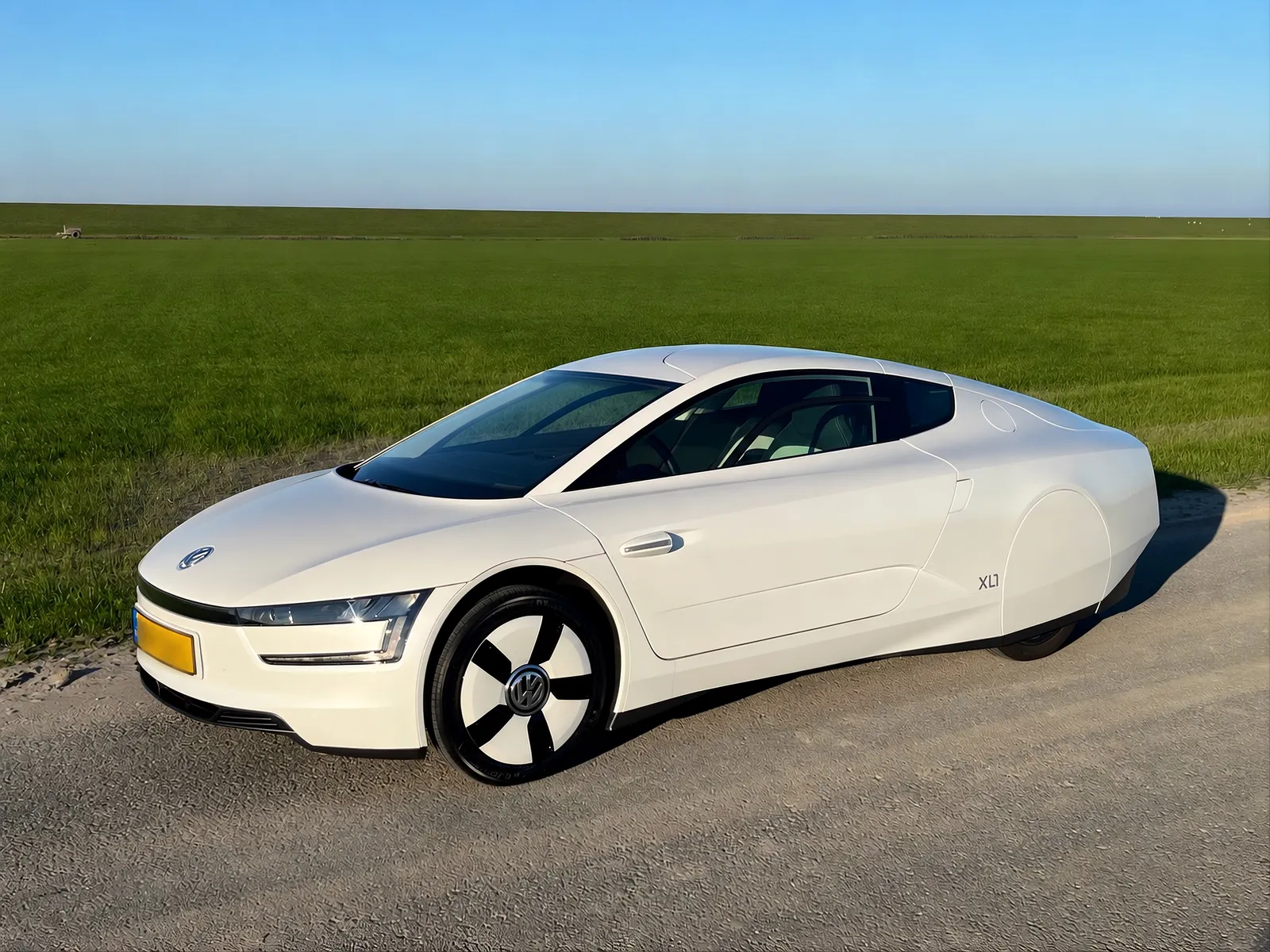
Over a decade ago, Volkswagen surprised the automotive industry with a vehicle that seemed to come from the future. It didn’t stand out because of hundreds of horsepower or extraordinary speeds, but rather for something much less common: it achieved a fuel consumption of just 0.9 liters of diesel per 100 kilometers. That experiment eventually became one of the most exclusive cars in the history of the German brand, and now one of its rare examples is making its way back to the market.
This is the Volkswagen XL1, a plug-in hybrid of which only 250 units were produced and which is currently up for auction on Catawiki. The platform estimates its value to be between 110,000 and 125,000 euros, though the final price will depend on bidding. The auction will remain open until November 12th, featuring a unit registered in 2016 that has covered just 1,672 kilometers in its entire lifetime.
The vehicle was originally delivered in Luxembourg on March 8, 2016, and is currently located in the Netherlands, where it has a Dutch license plate. Finished in Onyx White metallic paint, it still comes with its documentation, maintenance manuals, and original charger. According to the seller’s description, it is also in excellent condition, both outside and inside.
A Volkswagen that consumes less than one liter of diesel per 100 kilometers
The story of the XL1 began with a very specific ambition: to demonstrate how far energy consumption in a road-legal car could be reduced. To achieve this, Volkswagen developed a plug-in hybrid system that combined a small 2-cylinder, 800 cubic centimeter diesel engine capable of producing 48 horsepower with another electric motor producing 27 horsepower. Both worked together with a dual-clutch, seven-speed DSG automatic transmission.
The result was a two-seater car with a combined fuel consumption of 0.9 liters per 100 kilometers and CO₂ emissions of just 21 grams per kilometer. It should be noted that these figures came from the old European NEDC cycle, and since it was a plug-in hybrid, they also depended on the electricity stored in the battery. Therefore, they should not be interpreted as a guaranteed fuel consumption for any driving condition.
Indeed, its 5.5 kWh lithium-ion battery allowed it to travel up to 50 kilometers in pure electric mode, without using the diesel engine. When both systems worked together, the vehicle had a maximum power of 69 HP, sufficient to reach an electronically limited top speed of 160 km/h. These weren’t sports car figures, but that wasn’t the purpose of the project either.
Carbon fiber body, butterfly doors, and just 795 kg
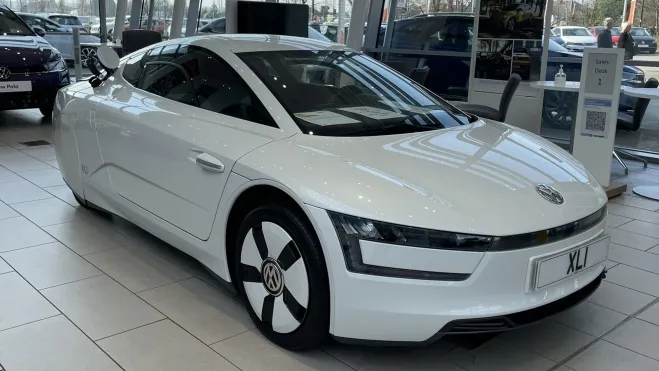
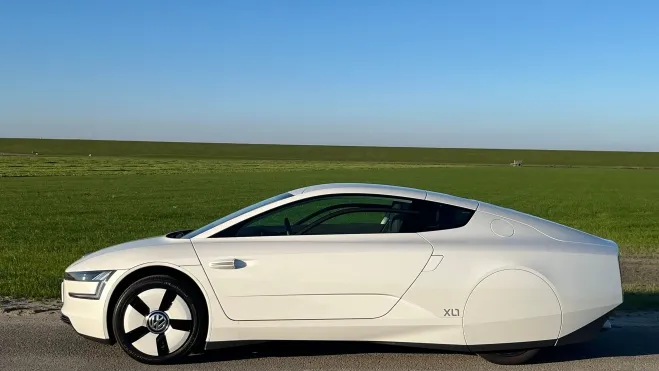
A key factor in its remarkable efficiency lay in its design. Volkswagen opted for an extremely aerodynamic body shape with a teardrop silhouette, a narrow rear section, partially covered rear wheels, and practically flat undercarriage. All these elements contributed to an aerodynamic coefficient of just 0.189, a figure that is exceptional even by today’s standards.
The brand also pushed weight reduction to the extreme. The XL1 used a monocoque structure made of carbon fiber reinforced polymer, along with aluminum, magnesium, and other lightweight materials. Thanks to this approach, its weight was only 795 kilograms, well below that of most modern cars, especially plug-in hybrids.
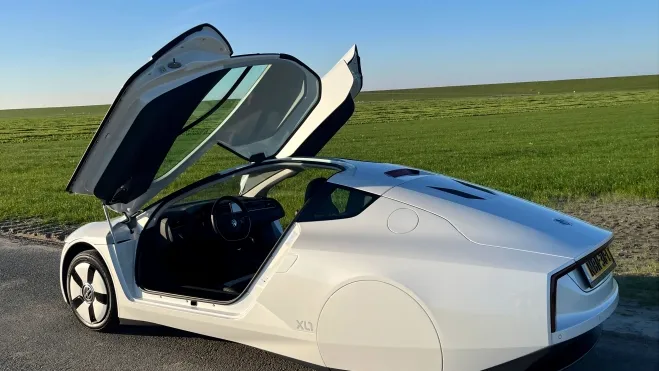
Its exterior design was equally striking. The upward-opening doors resembled those of some supercars, while traditional mirrors were replaced by cameras that displayed images on small screens inside the vehicle. Even the side windows featured small manual openings to eliminate the need for heavier and more complex mechanisms. Every detail followed the same philosophy: minimizing the energy required for movement.
One of the 250 units produced can sell for 125,000 euros
The exclusivity of the XL1 also explains the interest it generates among collectors. Volkswagen introduced it in 2013 and produced it in a nearly artisanal manner at its plant in Osnabrück, Germany. Production was limited to around 250 units, making it one of the most unique models developed by the company in recent decades.
The unit currently seeking a buyer also has an exceptionally low mileage. According to Catawiki’s listing, it has 1,672 kilometers on the clock, retains its original components, and features items such as magnesium wheels, carbon ceramic brakes, and the model-specific cover. The platform has valued it between 110,000 and 125,000 euros, though this estimate is not a confirmed selling price.
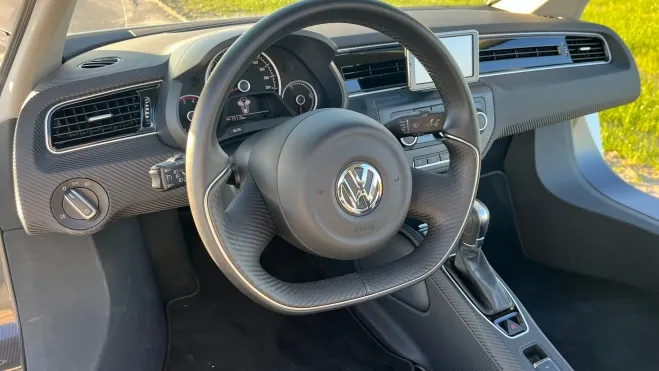
The auction will conclude on November 12, 2026, and will reveal how much collectors are willing to pay for one of Volkswagen’s most ambitious experiments. More than a decade after its introduction, the XL1 remains a car that is difficult to compare to any other: a plug-in hybrid built with materials typically found in supercars, but designed to prove that efficiency could also be taken to extremes.