
Rechargeable hybrid cars: their misuse is worsening!
Rechargeable hybrid cars are seeing improved electric range, but their drivers do not travel more in zero-emission mode. According to an ICCT study of nearly 920,000 vehicles in Europe, the proportion of time spent in electric mode is actually declining... Meanwhile, the actual emissions from PHEVs remain significantly higher than the certified values.
Rechargeable hybrid cars are often presented as “the perfect compromise” for covering daily trips electrically while still having an internal combustion engine for longer distances. With increasingly larger batteries, some models now achieve electric ranges well over 100 kilometers. But in practice, this improvement does not encourage owners to charge their cars more frequently.
Longer electric ranges, but…
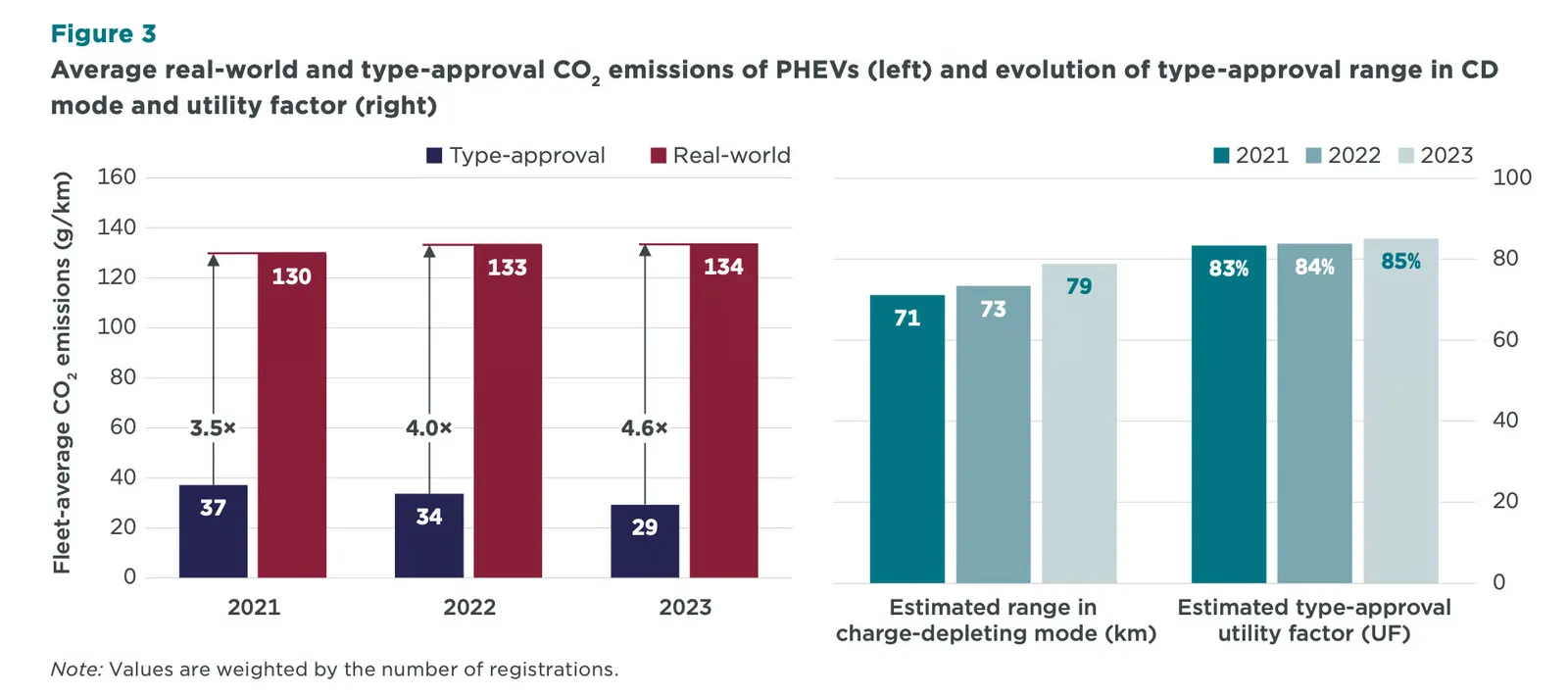
To conduct its study, the ICCT (International Council on Clean Transportation) relied on fuel consumption data recorded from 920,000 plug-in hybrid vehicles registered in Europe between 2021 and 2023. It was found that during this period, the average electric range of PHEVs increased, rising from 58 km to 68 km. How? Thanks to batteries with greater capacity.
At the same time, the proportion of miles driven in “battery-depleting” mode (when the battery is running low) dropped from 46% to 42%. But this does not mean that all of these miles were covered solely by electricity, as the internal combustion engine can also come into play when the battery is under strain. Based on actual measured consumption, ICCT estimates that the share of miles driven using electricity has fallen from 26% for PHEVs registered in 2021 to just 17% for those registered in 2023.
This is a completely counterintuitive result. With greater range, PHEVs should theoretically allow for more trips without using gasoline or diesel. Yet the study finds no improvement in this regard...
Emissions (very) higher than official figures
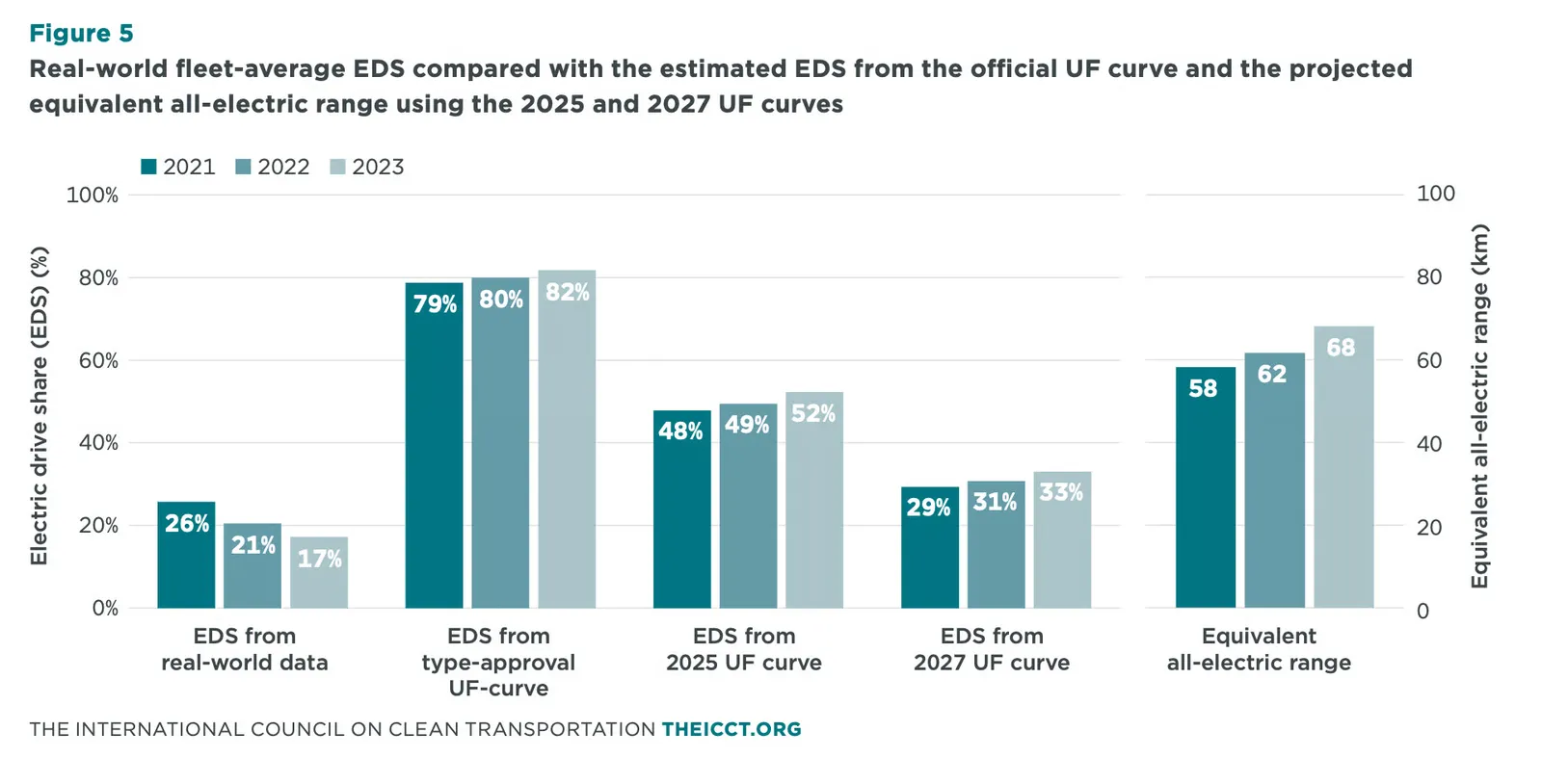
This low use of electric mode obviously has an impact on fuel consumption. The actual average emissions rose from 130 g/km in 2021 to 134 g/km in 2023. Meanwhile, the official figures dropped from 37 to 29 g/km. As a result, the PHEVs studied emitted 3.5 times more CO2 under real conditions than their 2021 approval levels and 4.6 times more in 2023.
Also read
Rechargeable hybrid cars: CO2 emissions up to five times higher than official figures
This discrepancy stems from the “utility factor” used for European homologation. It determines the proportion of kilometers a rechargeable hybrid is supposed to travel with a fully charged battery. The greater its electric range, the higher this theoretical proportion becomes, which mechanically lowers its official emissions.
Europe plans to review its calculations in 2027
But the European Union realized that something was wrong. Brussels began fixing this mechanism in 2025, with a new amendment set to take effect for new vehicle types by the end of 2026, and then apply to all new registrations by the end of 2027. The ACEA, which represents European automakers, however calls for maintaining the current level.
On its part, ICCT advocates for keeping this change in place and even believes it should be regularly updated using real-world usage data. For the NGO, the main goal is to prevent homologation values from continuing to give an overly favorable picture of rechargeable hybrids compared to their actual daily use.