
Rechargeable hybrid cars: what if we reduced their fuel tank size to force them to run on electricity?
To encourage drivers to charge their rechargeable hybrid cars more often, the NGO Transport & Environment proposes a radical measure: limiting their fuel tank capacity to 15 liters. It’s a bold idea that comes alongside other recommendations aimed at reducing the actual emissions from these vehicles.
On paper, rechargeable hybrid cars have everything going for them. They allow daily commutes to be covered by electricity, while still retaining a thermal engine for longer distances. But in practice, drivers don’t always use this technology as intended. This is precisely what the NGO Transport & Environment (T&E) criticizes, offering several suggestions to fix the issue.
A fuel tank limited to just 15 liters?
The most surprising proposal relates to the fuel tank. T&E wants to limit its capacity to 15 liters in future rechargeable hybrids. The goal is to make the use of a thermal engine less convenient, thereby encouraging drivers to charge their vehicles more regularly. With a fuel consumption of 6.7 liters per 100 kilometers, such a tank would allow the vehicle to travel about 220 kilometers on gasoline. This range is sufficient for emergency trips, but it would force drivers to reconsider their habits for long journeys.
Also read
Another new Chinese brand in Europe: Li Auto enters the market with big ambitions
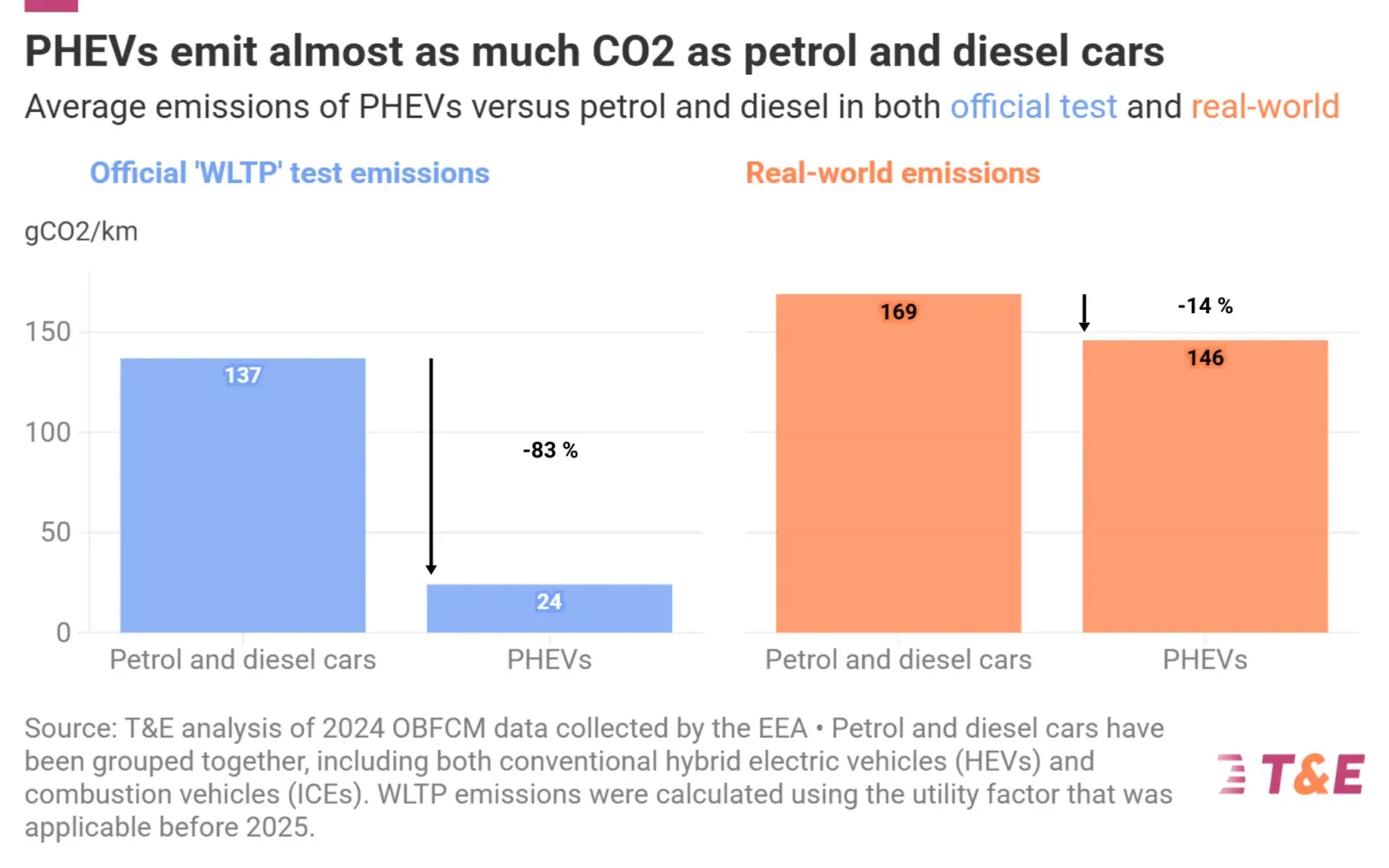
This proposal addresses a well-documented problem. According to T&E, rechargeable hybrids registered in Europe in 2024 emit nearly six times more CO2 under real-world conditions than the figures stated during their approval. This discrepancy is largely due to insufficient use of electric driving mode.
Greater electric range
But reducing the fuel tank size alone would not be sufficient. To make this development acceptable, T&E also suggests significantly increasing the electric range.
The organization believes that a range of 140 to 220 km would allow compliance with the 50 g of CO2/km threshold during certification by 2030. Another approach is to standardize fast charging at over 100 kW, a power level that would enable rapid restoration of electric range during breaks, rather than always refueling with gasoline.
Finally, T&E wants the electric motor to be at least three times more powerful than the internal combustion engine. The idea is to enable the vehicle to run on electricity in more situations, especially during acceleration or on uphill roads. But would drivers be willing to accept such constraints? After all, with a large battery, fast charging, and a small fuel tank, a rechargeable hybrid would ultimately resemble an electric car equipped with a range extender.