
Electric vehicle: Ford claims to be ahead of BYD in terms of efficiency


Ford believes it holds a significant advantage over BYD in a strategic area: the efficiency of its electric powertrains. According to its CEO Jim Farley, the new engines, transmissions, and inverters developed by the American automaker are 30% more efficient than those of its Chinese rival.
Chinese competition is forcing traditional automakers to rethink their approaches. At Ford, this reevaluation takes the form of a new electric platform designed with one goal: to offer cheaper vehicles without compromising their performance. To achieve this, Jim Farley claims significant progress has been made in improving the efficiency of Ford’s powertrains.
Is Ford stronger than BYD?
During the presentation of Ford’s third-quarter 2026 financial results, Jim Farley made a rather bold comparison. According to Ford’s CEO, the electric motors, reducers, and inverters developed for its new Universal Electric Vehicle (UEV) platform are 30% more efficient than those used by BYD.
It should be noted that Jim Farley does not specify which BYD model he is referring to, nor the conditions under which this difference was measured. Therefore, this is not an advantage confirmed by independent tests. Moreover, it does not mean that future Ford vehicles will consume 30% less electricity...
Also read
For Ford’s CEO, it’s already “too late” to compete with Chinese automakers in Europe
The real challenge lies elsewhere. By improving the efficiency of the powertrain, Ford hopes to achieve satisfactory range with a battery of smaller capacity. This is an interesting strategy since the battery accounts for a significant portion of the manufacturing cost of an electric vehicle. Reducing its size also helps to lower the vehicle’s weight.
An electric pickup under $30,000
The first model to benefit from this architecture will be the Ford Fathom, an intermediate-sized electric pickup expected to launch in the United States in 2027. Its starting price is listed at $28,350, excluding delivery fees and taxes. Ford has not yet disclosed the final battery capacity or the certified range.
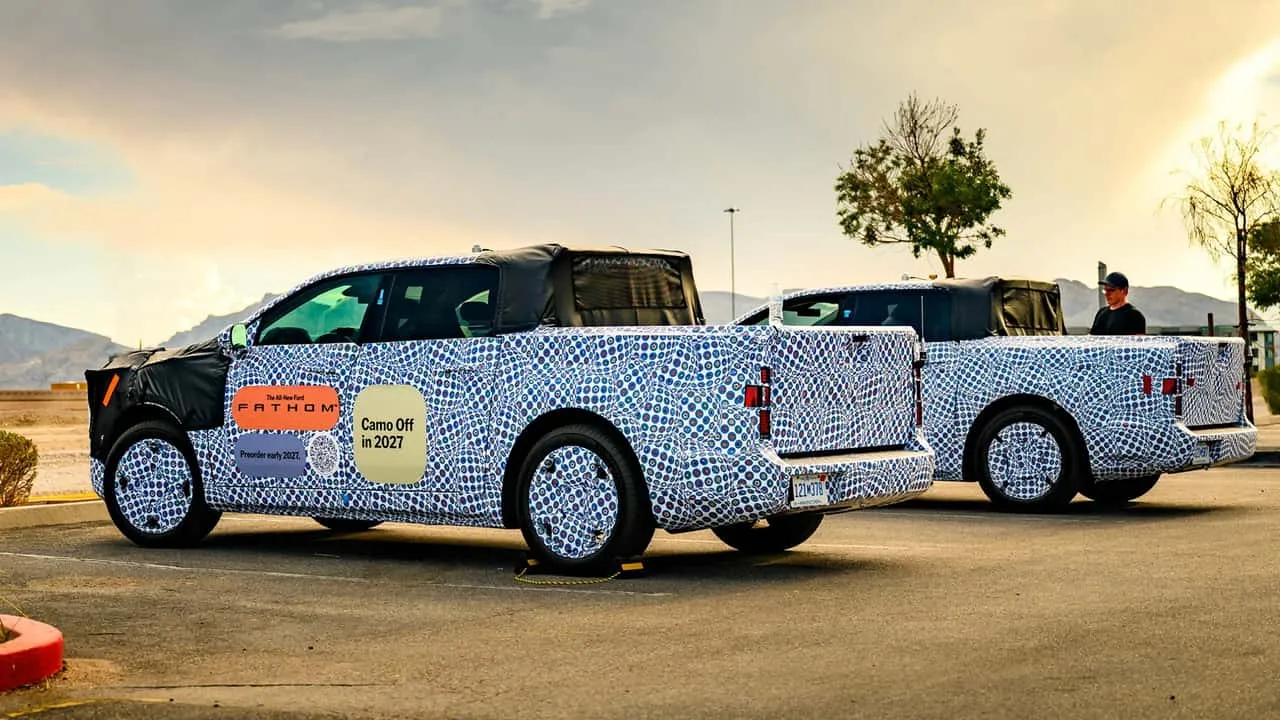
To reduce costs, Ford relies not only on its electric engines. The automaker has also rethought the assembly of its vehicles, using fewer components and a simplified industrial setup to make its future electric vehicles more competitive. It should be noted that BYD has become an unavoidable competitor. Ford even draws inspiration from Chinese methods and acknowledges learning valuable lessons from its collaboration with Geely in Europe, particularly regarding costs and development timelines.
Still, these ambitions and statements need to be turned into actual industrial action. Ford must prove that its efficiency gains translate to real-world performance while still meeting its pricing targets. The technologies developed for the UEV platform could also benefit the brand’s future hybrid models.