
Corporate electric vehicles: benefits and taxation for professionals in 2026
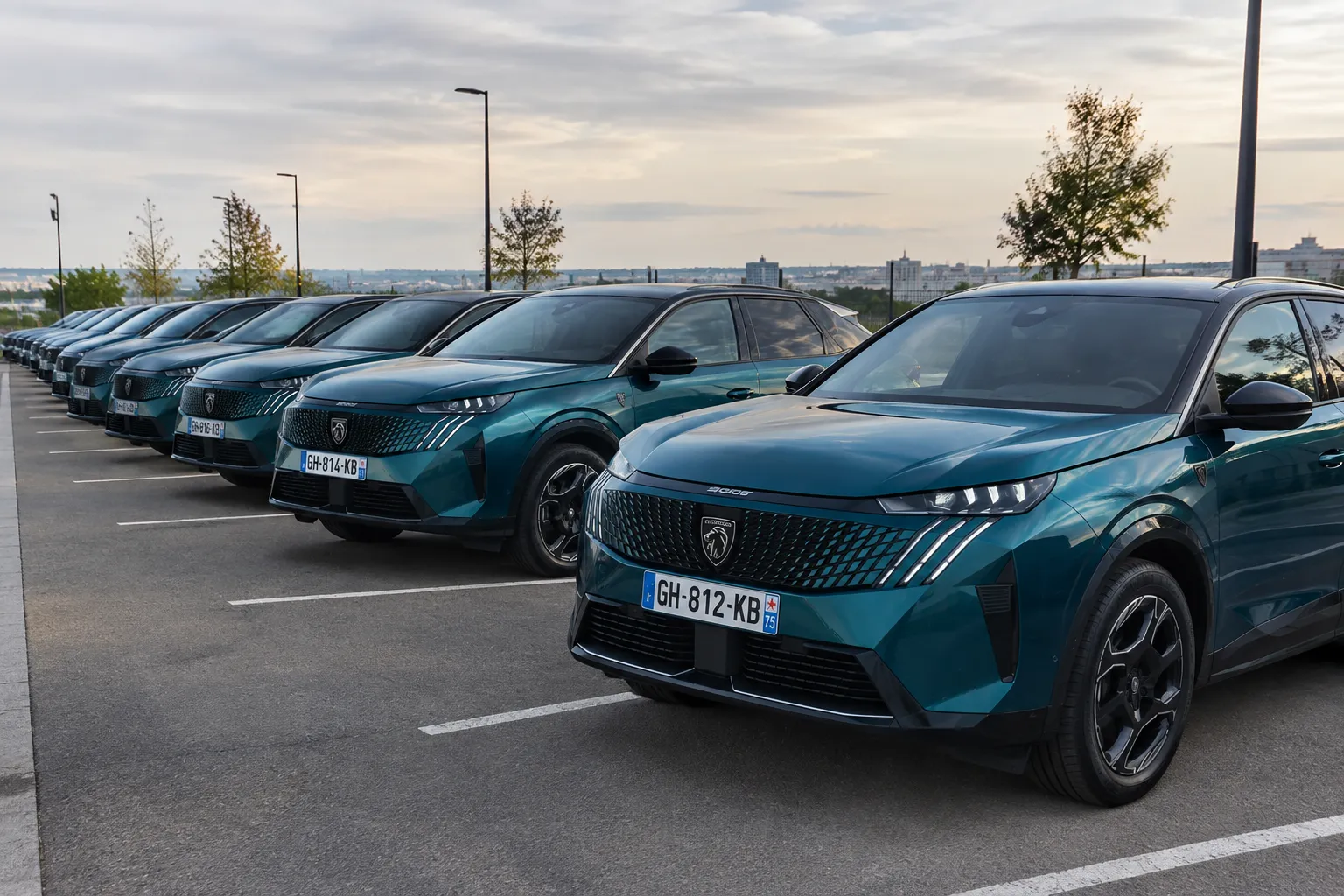
The environmental bonus no longer exists for companies. Yet, electric vehicles remain the best fiscal choice for businesses: reduced in-kind benefits, exemption from annual taxes, and increased depreciation. Here’s a comprehensive overview for 2026.
Electric vehicles in companies: What are the advantages in 2026?
Aid for purchases has diminished for companies. Nevertheless, electric vehicles still hold an advantage in corporate settings. The real factor now is not the subsidy but taxation. Reduced in-kind benefits, tax exemptions, and higher depreciation—all of these work together.
The context also supports this direction. Since 2025, companies managing at least 100 light vehicles must include an increasing proportion of low-emission vehicles (less than 50 g/km of CO2) in their entire fleet: 18% by 2026, up from 15% in 2025. Each missing vehicle triggers an annual incentive tax. For these large fleets, switching to electric vehicles thus becomes a cost-effective option.
Purchase incentives in 2026: what remains
To be clear, for company vehicles, direct incentives have become minimal. The value now lies in the tax benefits, detailed below.
Conversion bonuses and incentives: removed for companies
The environmental bonus no longer exists for legal entities as of December 2, 2024. The conversion subsidy has disappeared in the same way. Therefore, a company can no longer rely on it for purchasing a car.
EEC subsidy: reduced for private cars
Energy savings certificates have replaced the bonus. However, for a company’s private car, the amount remains low, often just a few hundred euros. Higher EEC subsidies are primarily aimed at private individuals and commercial vehicles.
Local incentives
For private cars, local subsidies are rarer than those available for commercial vehicles. They depend on the region and often come with conditions such as dismantling an old vehicle, a price cap, or restrictions within a low-emission zone. Several car-related programs remain reserved for private individuals, as in Lyon or the Greater Paris area. Below are the main subsidies available to professionals in 2026.
Region
Target audience
Subsidy (order of magnitude 2026)
Grand Est region
Enterprises
4,000 € (sedan or utility vehicle < 2.6 t), non-cumulable
Provence-Alpes-Côte d’Azur region
Microenterprises, small businesses, medium-sized enterprises
3,000 € (electric vehicle < 2.5 t)
Ile-de-France region
Small and medium-sized businesses in the Paris area (≤ 50 employees)
Vehicle cost capped at 47,000 € including tax
Eurométropole de Strasbourg
Enterprises
up to 15,000 €, all subsidies combined
Toulouse Métropole
Enterprises with fewer than 250 employees
4,000 to 5,000 € (with vehicle scrapping)
Grand Reims
Enterprises that generate at least 50% of their revenue from ZFE-m
3,000 € (ceiling of 20,000 € for 5 vehicles)
The amounts are approximate figures as of September 2026. These subsidies depend on an annual budget and change rapidly. Applications are often submitted before purchase, supported by relevant documentation. A simple tip: check the schemes available in your region, department, and municipality. Finally, note that the CEE subsidy for a private car remains low, at only around 500 €.
In-kind benefits, the first tax incentive
When an employee uses a company car for personal purposes, it creates a non-monetary benefit. This benefit is included in their taxable income and subject to contributions. For an electric vehicle, the calculation becomes much more favorable.
How is the non-monetary benefit for an electric vehicle calculated?
The flat-rate method is the most common. It is based on 15% of the total purchase price for vehicles under 5 years old. An electric vehicle eligible for an eco-score then receives a 70% reduction, capped at 4,641.60 € per year (2026 value).
Take the example of a vehicle purchased for 35,000 € including tax. The flat-rate amount amounts to 5,250 € per year. For an electric vehicle with an eco-score, the 70% reduction reduces this to 3,675 €, leaving a non-monetary benefit of 1,575 € per year.
Vehicle (purchase price 35,000 € including tax)
Reduction
Annual non-monetary benefit
Per month
Thermal or hybrid
None
5,250 €*
437.50 €
Electric without eco-score
None
5,250 €
437.50 €
Electric with eco-score
70% (3,675 €)
1,575 €
131 €
* Excluding fuel. If the employer covers the fuel cost, it is added to the in-kind benefit. Amounts apply to a car provided starting from February 1, 2025. Electric cars assigned before this date retain a 50% deduction, capped at 2,026.30 €, with no eco-score requirement.
The difference amounts to 3,675 € per year on the employee’s taxable income for two cars at the same price. In reality, the deduction remains 50%, capped at 2,026.30 €, and is also reserved for models with eco-scores.
Another advantage: electricity paid by the employer is not included in the calculation. Both the discount and the exclusion of electricity apply until December 31, 2027.
The eco-score requirement
The 70% discount is not automatic. It is reserved for models that achieve the required environmental score for the eco-bonus. This score takes into account the carbon footprint of manufacturing, which particularly disadvantages cars produced outside Europe.
This criterion plays a significant role in choosing a model. At the same price, two electric cars do not have the same cost for the employee: the one with a high eco-score sees its tangible benefits reduced by more than three times. Companies have understood this well. In the first half of 2026, 82.56% of electric cars registered by businesses had a high eco-score, compared to just over half in 2024.
Charging at work: no in-kind benefits
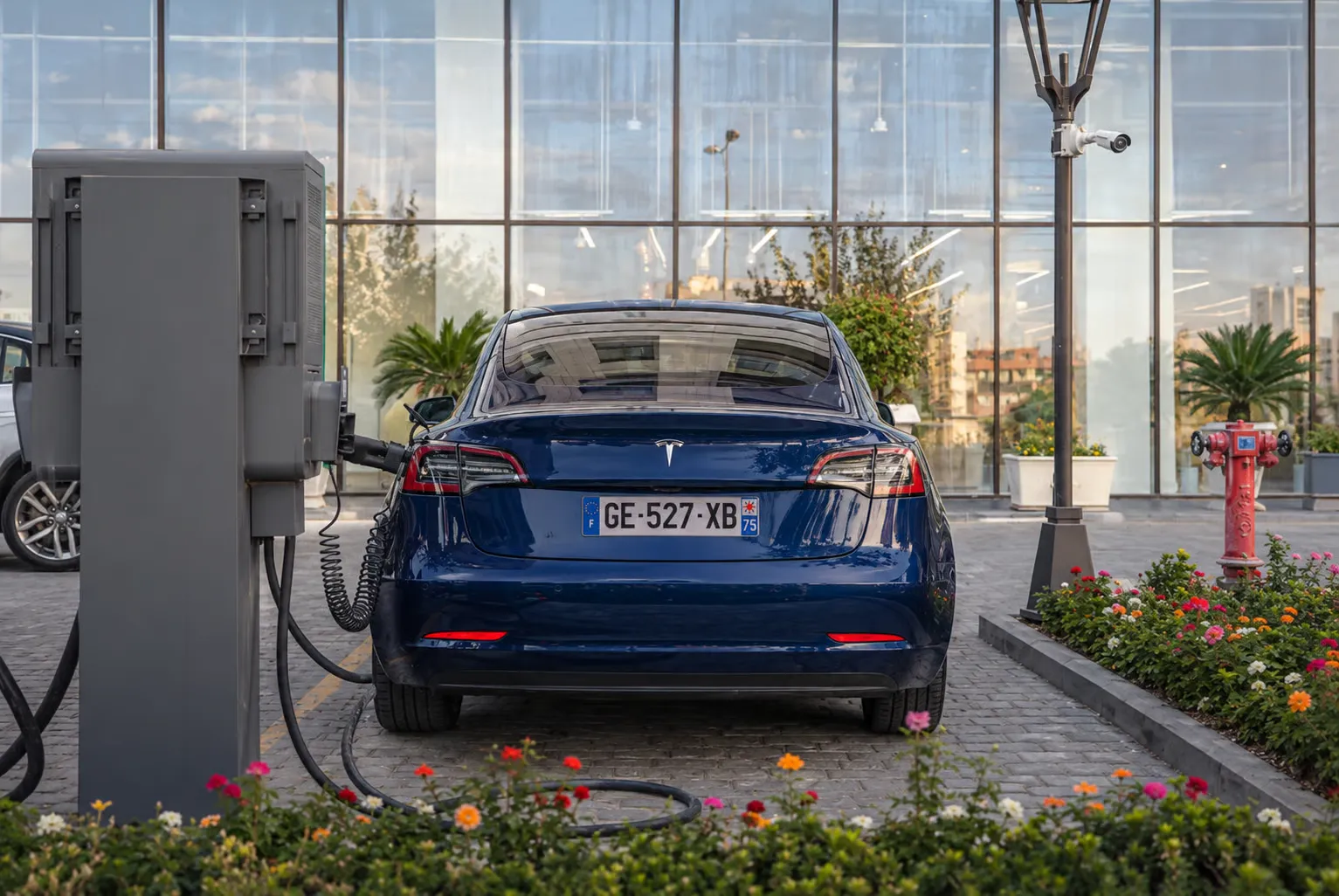
Charging one’s car at the office does not create any in-kind benefits. This rule also applies to employees’ personal vehicles. It remains in effect until December 31, 2027.
Taxes on company vehicles: electric vehicles are exempt
This is one of the largest expenses for a fleet of conventional vehicles. For an electric vehicle, it drops to zero.
The two annual taxes that replaced TVS
The old TVS has been replaced by two annual taxes. The first applies to CO2 emissions, while the second targets air pollutants based on age and engine type. For a conventional car, the cost can quickly reach several hundred euros per year.
Electric cars exempt, hybrids at a disadvantage
A 100% electric car is exempt from both taxes. Hybrids, on the other hand, lost their CO2 exemption starting in 2025. As a result, their tax benefits are reduced compared to fully electric vehicles. For fleets of at least 100 vehicles, a third tax is added: the annual incentive tax linked to the goal of 18% low-emission vehicles mentioned earlier. Each electric car in the fleet brings the company closer to this goal and reduces the cost.
Depreciation and VAT: what companies can deduct
Beyond taxes, electric vehicles have a lower impact on taxable income. Two mechanisms come into play.
Depreciation cap based on CO2
A company car is depreciated within a cap tied to CO2 emissions. Electric vehicles benefit from the highest cap. Beyond that, the corresponding portion of the price is not deductible.
CO2 emissions
Depreciation cap
Less than 20 g/km (electric)
30,000 €
20 to 49 g/km
20,300 €
50 to 160 g/km
18,300 €
More than 160 g/km
9,900 €
The difference speaks for itself: 30,000 € for an electric model, compared to 9,900 € for a highly polluting internal combustion engine vehicle.
Battery depreciated separately
The battery can be depreciated separately if its cost is specified in the invoice. This portion is then exempt from the vehicle’s depreciation cap, improving the overall deduction amount.
VAT: The Limitation for Private Cars
This is the car’s weakness compared to commercial vehicles. VAT on purchasing a private car cannot be reclaimed, except for specific activities such as taxiing, ride-hailing, or leasing. In contrast, VAT on charging electricity can be reclaimed.
Purchase, Lease, or Subsidy?
There are three options available for companies, each with different tax implications.
Purchase, LLD, or LOA
When purchasing, the company writes off the vehicle up to the cap amount. With long-term leasing or LOA, the lease payments are deductible. However, the portion of depreciation exceeding the cap must still be recovered. To compare the options, see the comparison of electric leasing for professionals.
The mileage allowance, an alternative
If there is no company vehicle, the employee can use their personal car. The company then pays them a mileage allowance. Good news for electric vehicles: the rate is increased by 20%. This option avoids in-kind benefits but shifts the use to the employee.
How much does an electric company car really cost?
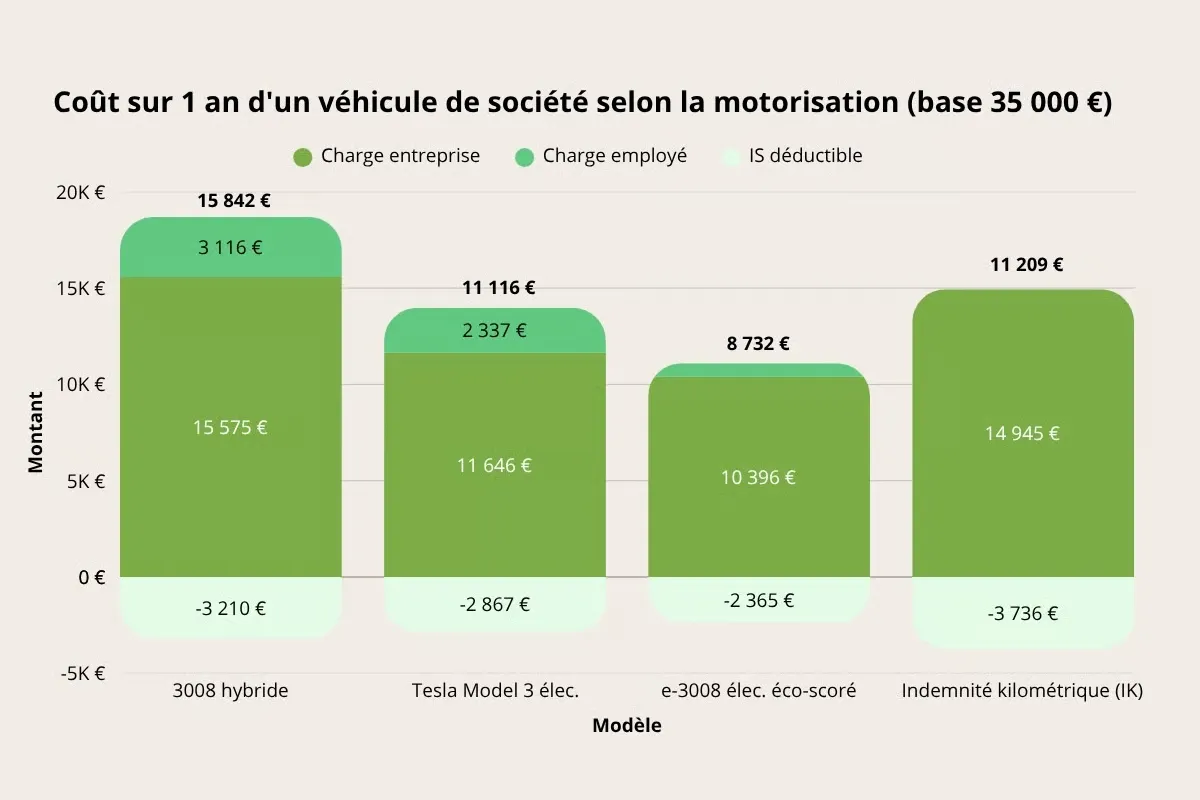
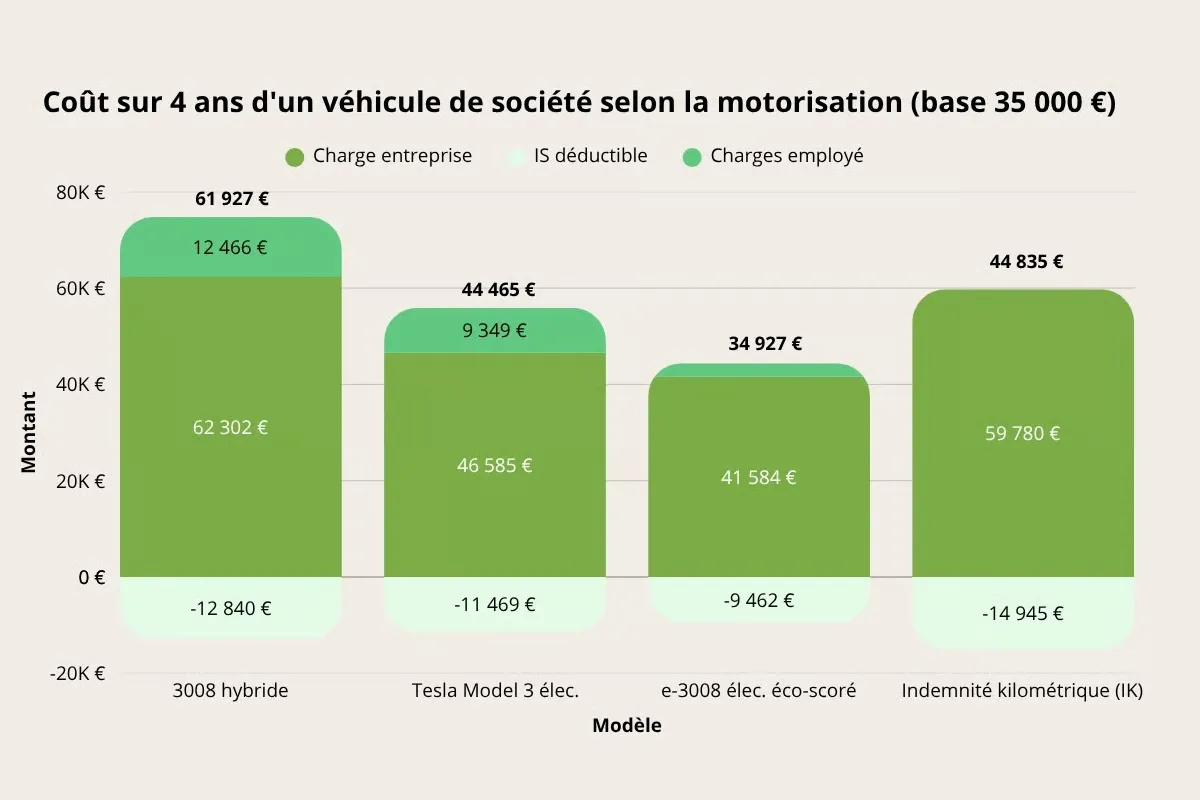
The best way to make a decision remains by considering the total cost. Here is a comparison for illustration, based on 35,000 €. It includes the company’s expenses, the employee’s in-kind benefit, and the savings from corporate tax.
Solution (base 35,000 €)
Annual cost
Cost over 4 years
Peugeot 3008 hybrid
15,842 €
61,927 €
Tesla Model 3 electric
11,116 €
44,465 €
Peugeot e-3008 electric eco-scored version
8,732 €
34,927 €
Mileage allowance
11,209 €
44,835 €
Values provided by 2C Consulting
The eco-scored electric vehicle turns out to be the least expensive. The difference amounts to nearly 27,000 € over four years compared to the hybrid version. The difference between the two electric models stems from their eco-scores. The e-3008, eligible for a 70% discount, significantly reduces the tangible benefits for employees.
These figures are merely examples and should be adjusted based on the model, price, and usage. However, this logic holds true in most cases. For commercial vehicles, see also our article on subsidies and taxation for electric vans.
What’s changed for businesses in 2026
The bonus has been removed for legal entities. The in-kind benefit has been reformed in favor of eco-rated electric vehicles. Hybrids, on the other hand, face higher taxes. The logic is clear: all-electric vehicles now receive the benefits.
Frequently Asked Questions
How is the in-kind benefit for an electric car calculated?
A 15% discount is applied to the total price for vehicles under 5 years old. Eligible electric cars then enjoy a 70% reduction, capped at 4,641.60 € per year.
Does a company-owned electric car pay TVS?
No. A 100% electric vehicle is exempt from the two annual taxes that replaced TVS.
Can VAT be reclaimed on a company-owned electric car?
Not for purchasing a private car, except for activities such as taxiing or leasing. The VAT on charging electricity, however, can be reclaimed.
What bonus for a company in 2026?
No environmental bonus. It was abolished for legal entities at the end of 2024. What remains are a reduced CEE grant and certain local subsidies.
What is the eco-score?
It is the environmental score that determines the bonus. It appears on an official list and excludes certain models produced outside Europe. It triggers a 70% reduction on the in-kind benefit.