
Velettrica launches Drive‑Pod‑16 for a zero-emission sail
Velettrica will introduce the new Drive‑Pod‑16 at the Genoa Yacht Show, an electric motor designed for docking maneuvers and coastal navigation that can be configured in hybrid mode when needed. The most natural configuration utilizes wind power: the electric motor assists the boat even with gentle breezes; for more demanding cruises, however, the generator enables significant range.
The various ranges with Drive‑Pod‑16
We are interested in the possible range in full electric mode. We asked Velettrica about this. “The batteries are modular, and 1 or 2 additional packs can be added to achieve a range of 30 miles easily. With a good set of solar panels, the standard pack can be charged in 3 hours. At cruising speed in full electric mode, around 10 miles can be covered; for maneuvering in port, the batteries can last up to 20 hours on full electric power.”
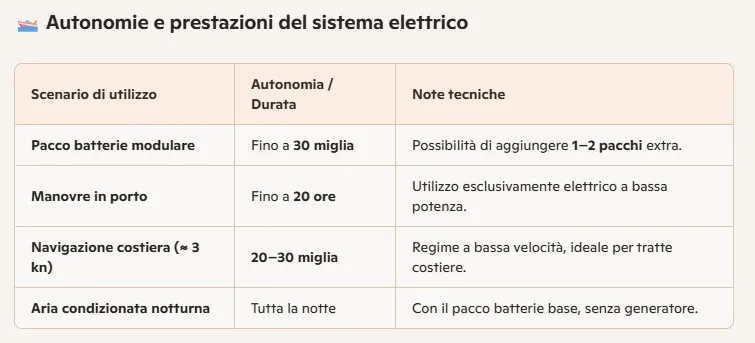
In low-speed coastal navigation (around 3 knots), one can travel 20-30 miles. With the basic battery pack, the air conditioning can run all night without needing to turn on the generator. Considering the sail factor as well, the generator is often unnecessary.
Drive‑Pod‑16 for boats 10 to 14 meters long
Following the launch of Sail‑Pod‑25 at METS 2023, Velettrica, founded in 2021 by sailor Roberto Baffigo’s passion for sailing, has developed and invested in research. With the new electric motor designed for those who need to cover long distances, it is possible to create a hybrid propulsion system that increases range. The project was awarded by MOST, the National Center for Sustainable Mobility. Two technical details: the battery has a capacity of 9 kWh and the motor has a power output of 1.2 kW.
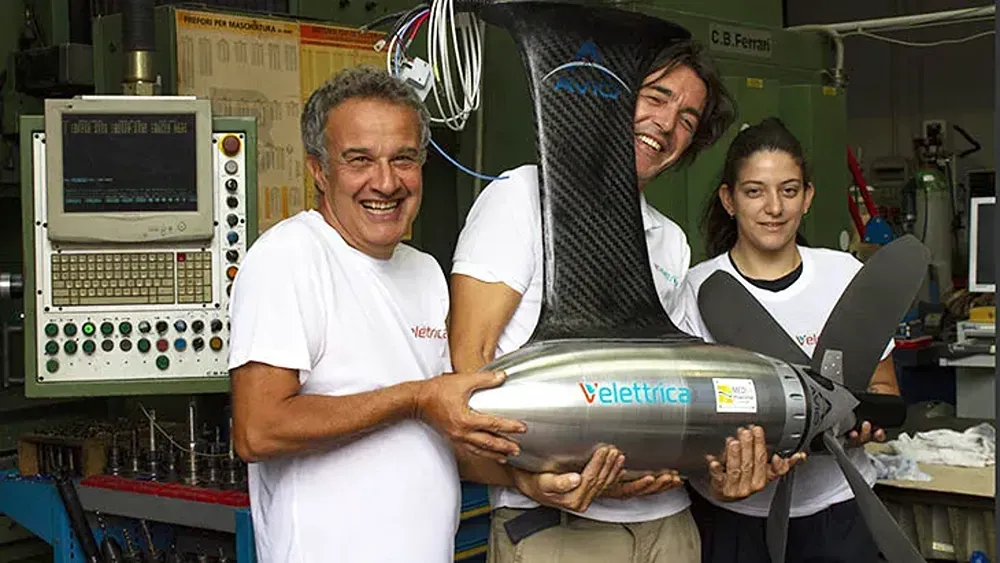
Drive‑Pod was developed for sail and motorized vessels ranging from 10 to 14 meters in length, but the company emphasizes that “its modular design allows it to be used on larger vessels as well. It can serve as auxiliary propulsion on existing yachts up to 20 meters long, turning them into hybrid units capable of performing port maneuvers and coastal navigation in a fully electric and silent mode.”
There’s some light aboard Hypersail, Ferrari’s electric sailboat
Retrofitting cars is difficult; converting them to electric is simpler. This and other systems are easy to install, with modular batteries being placed in place of the old engine.
A hydrodynamic pod outside the hull, recovered and recycled materials
The company’s proposal focuses on the Pod, “a hydrodynamic unit outside the hull that integrates the engine, propeller, and control electronics,” which reduces internal clutter. The patented propeller “was developed to maximize propulsion efficiency at low speeds, improving safety and precision in maneuvering.” The batteries also power all onboard systems, including air conditioning, ensuring a comfortable stay at port.
Sails: only 1% electric, but E‑lektra Marine is born with Beneteau and Fountaine Pajot
The propeller and fin of the Drive‑Pod are made from a recycled polymer based on nylon and carbon fiber. The nylon comes from exhausted or abandoned fishing gear recovered by PiùBlu ETS, while the recycled carbon fiber (rCF) is supplied by Hera Group. The two materials are combined through a process developed and validated by the University of Pisa as part of a project funded by MOST. The rest of the structure is made of aluminum, which is easily recyclable.
Settima Meccanica’s engine
The next-generation synchronous electric motor produced by Settima Meccanica features no permanent magnets and is made from entirely recyclable materials. Regarding energy storage, the company highlights its collaboration with FCE to replace current LiFePO4 cells with sodium-ion batteries. These are the initial elements of the launch announcement, with more details to be released during the Genoa Boat Show.
READ ALSO: Sailing with the TEMO electric motor and watch the VIDEO
Previous Article
Too bulky cars – that’s the problem
Next Article
Enel remains a key player in the transition to electric vehicles