
Vehicle as Home: When the Kia EV5 Becomes a Camping Battery
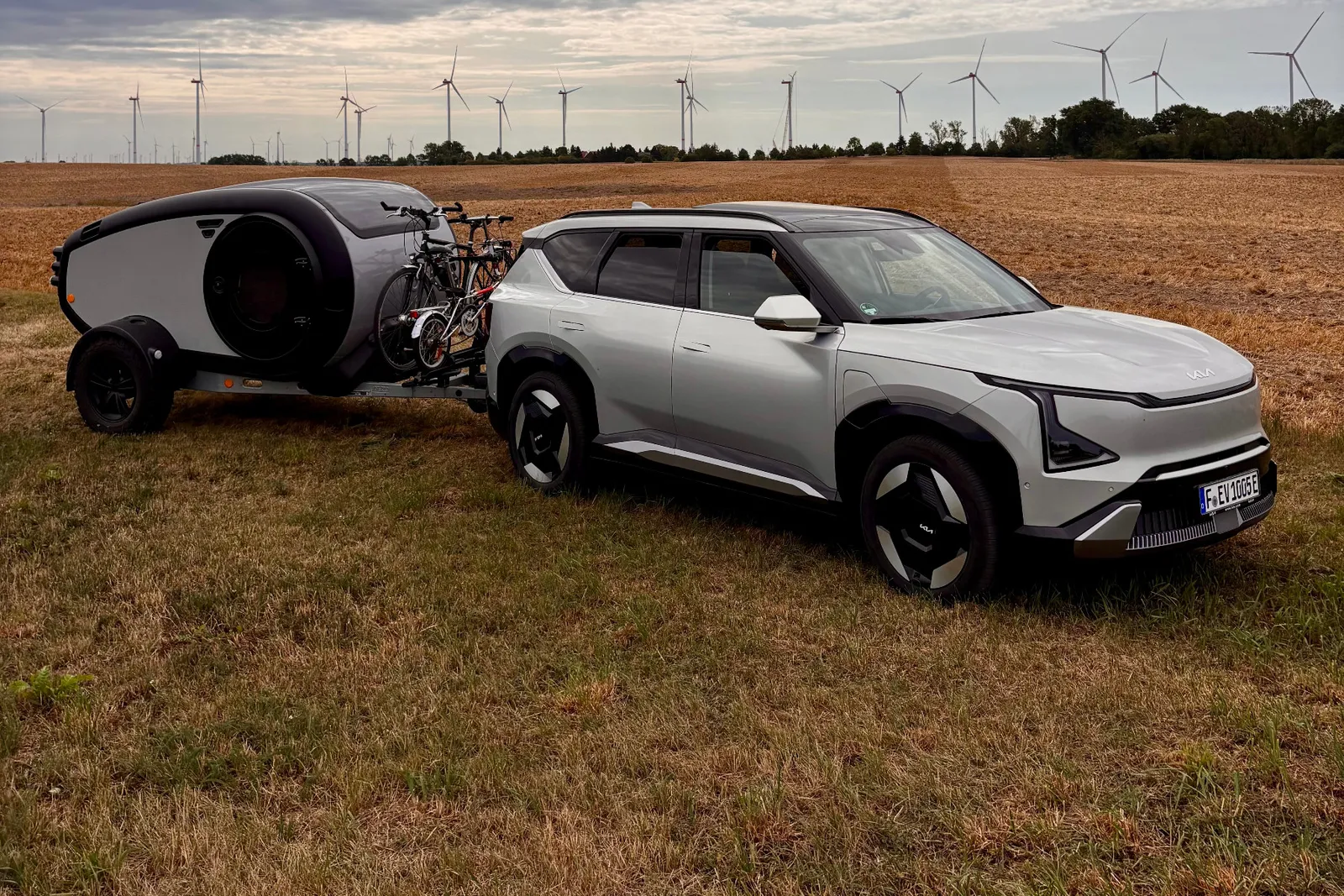
The manufacturer claims a WLTP range of 520 kilometers and an energy consumption of 17.1 kWh per 100 kilometers for the Kia EV5 Earth with front-wheel drive and 19-inch wheels. My summer test vehicle in Ivory Silver Metallic, including optional features, costs 54,250 euros. Need to boil water, charge a laptop, or use a hair dryer — and no outlets in sight? No problem. There’s plenty of electricity available. At one small campsite near Poland’s Baltic Sea coast, it became clear that exactly one feature is among the greatest strengths of the Kia EV5 on this trip, a feature that would likely only get a few lines in a regular driving review: Vehicle-to-Load.
But one step at a time. This is less of a classic test of the Kia EV5—such tests already exist on electrive—and more of a travel report. Just under three weeks of real-life use rather than testing on a designated course. First, Berlin and Brandenburg; then I attached a small camper van and set off through the Feldberger Seenlandschaft, Usedom, and West Pomerania, almost all the way to Łeba on Poland’s Baltic Sea coast, where massive shifting dunes await.
The companion attached to the van: my Mink Camper 2.0. A small teardrop-shaped camper van with a curb weight of 490 kilograms and a maximum allowable total weight of 750 kilograms. It’s quite the opposite of those huge white camper vans that sometimes hide entire families with half their belongings on the highway.
Quite large in Berlin, just right in Brandenburg
Before the Mink can be used on public roads, it needs a few days of normal operation first. And that’s when the EV5 appears large—at least subjectively from the driver’s seat, not just objectively with its 4.61 meters in length and 1.875 meters in width. The hood extends far forward, making its outer edges hard to see clearly, and navigating through Berlin’s tight parking spaces requires getting used to its size first.
Visually, the Kia doesn’t hide its bulk anyway. Its upright front end, mostly closed radiator grille, and distinctive lighting design give it a very prominent appearance. Since the EV5 isn’t yet everywhere on the streets, curious glances are still directed its way from time to time.
Berlin isn’t really its strongest suit. Finding a parking spot is simply more enjoyable with smaller cars.
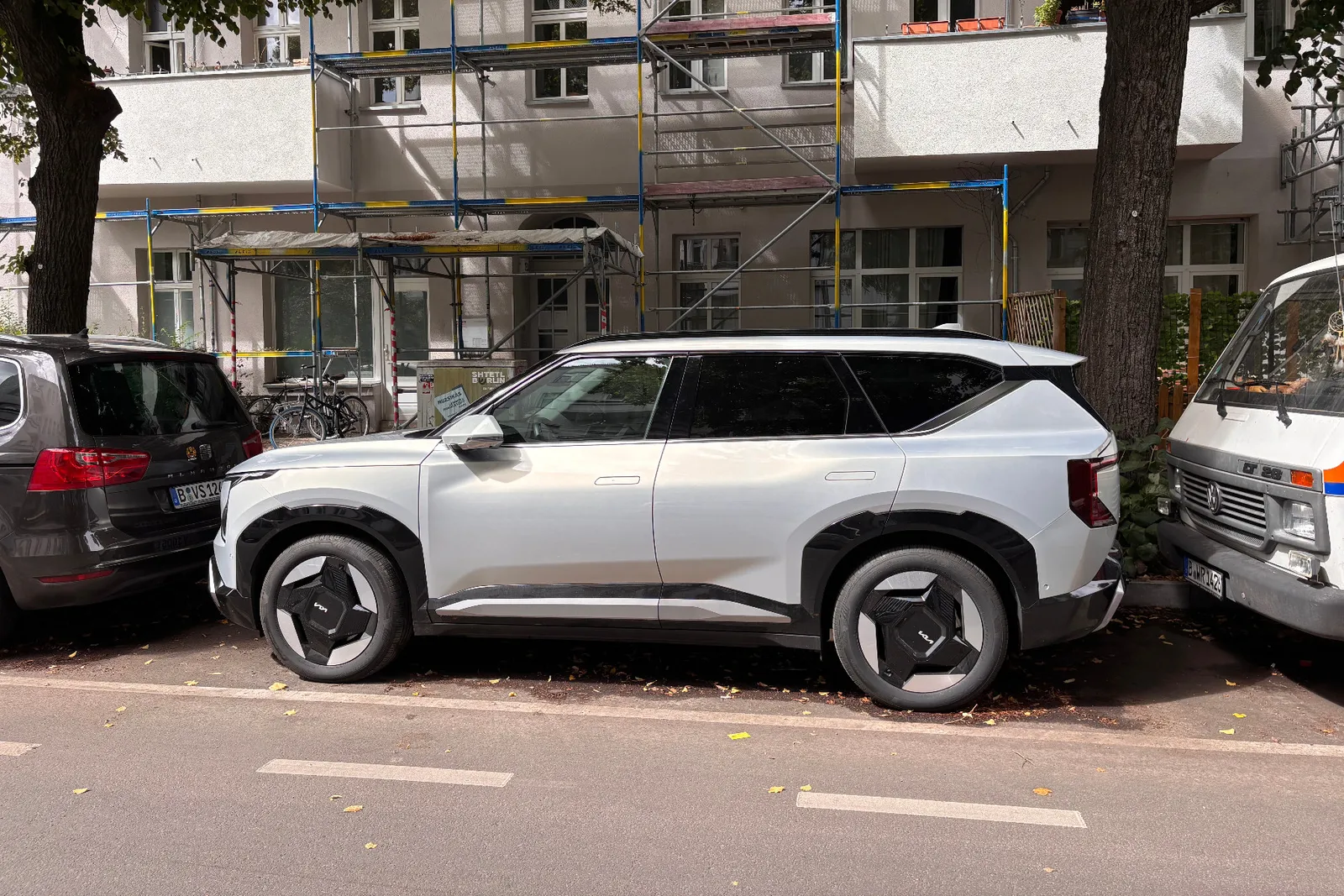
As soon as you head out to Brandenburg, the landscape changes completely. In the Ostprignitz-Ruppin district, there are plenty of narrow roads, poor road edges, and paths where you might have to move onto the gravel to avoid oncoming traffic with just two wheels. It is in such areas that the large Kia truly shines. With 167 millimeters of ground clearance, a high seating position, and a comfortable suspension, you won’t flinch even on a country road.
The suspension is clearly tuned for comfort. It’s almost a bit soft and bouncy. Anyone who has recently sat in a current BMW SUV knows that vehicle offers more precise, refined body control. The Kia EV5 takes a more relaxed approach. Sportiness is different here—the vehicle tilts sideways in corners. But for the task ahead, it works quite well.
Now the Mink comes into play
Because a small camper van is now being attached.
The front-wheel-drive model can pull a braked trailer up to 1,200 kilograms. This is more than enough for the small Mink. Kia delivers 160 kW or 218 horsepower and a maximum of 295 Nm to the front axle in the FWD version. These aren’t impressively high numbers on paper, but combined with the lightweight camper van, they’re more than sufficient.
The advantage of electric propulsion becomes evident from the very first kilometers: no shifting, no revving, no starting struggles. The Kia EV5 pulls the Mink along effortlessly—smoothly, quietly, and without any fuss. That’s exactly how it should be.
After a few kilometers, you almost forget that there’s anything attached at the back. The compact camper remains firmly stable behind the Kia and benefits greatly from its size by staying well within its wind shadow. Even on rougher roads, the combination performs exceptionally well.
Only on dusty or sandy surfaces does the front-wheel drive remind one that 295 Nm must be delivered exclusively to the ground through the front wheels. In such cases, under stronger acceleration, some wheel slip may occur. Anyone who plans to frequently drive their EV5 on wet camping grounds, gravel, or poor roads should consider a four-wheel drive version instead.
The first major stop together is the 3000Grad Festival in the Feldberger Seenlandschaft in the southeast of the Mecklenburgische Seenplatte district. Campers set up on the grass, with the Kia nearby—there’s now a small base camp. Luggage and clothes are stored in the electric car, while sleeping takes place in the Mink.
And this is where the large power bank comes into play for the first time.
81.4 kWh for a kettle and hair dryer
Starting with the Earth trim, the Kia EV5 comes standard equipped with Vehicle-to-Load (V2L) functionality, allowing it to power external devices at up to 3.6 kW. There is also a 230-volt outlet in the trunk along with an adapter for the charging port.
This is nice at festivals. It becomes truly practical during longer trips.
From the Feldberger Seenlandschaft, we headed first to Kamp am Peenestrom across from Usedom. We could have used an electrical outlet at a small water-based rest area, but we didn’t. Why bother? The Mink has its own battery along with a solar panel for lighting and smaller 12-volt devices. When more power is needed, an 81.4-kWh battery is available.
So, with a V2L adapter in the Kia and an extension cable to the camper, the electric car turns into a fairly powerful camping power source.
The next day, we head across Usedom and Świnoujście into Poland, eventually reaching Smołdziński Las near the Baltic Sea coast. We stay there for four days at a small campsite. Once again, the Mink isn’t right next to an electrical outlet. But that doesn’t matter at all. A button press on the V2L adapter: power on. Fill the kettle, charge the laptop, use a hair dryer. Power off. Done.
The kettle has become our favorite power consumer. Anyone who’s tried to boil a larger pot of water for pasta on a small camping gas stove knows why. Heat the water electrically first, then transfer it briefly to the gas stove—done. The next step in evolution is already planned: a small electric stove. The gas stove can then serve only as a backup.
So V2L suddenly takes on a completely different meaning than what’s stated in the specifications. Sure, you can use 3.6 kW to charge an e-bike or power electric tools somewhere. But when camping, this function simply allows you to do without a traditional household power outlet.
I unfortunately didn’t measure separately how many kilowatt-hours actually flowed from the car into daily camping activities over those days. This trip isn’t suitable for a scientific V2L test, but it is useful for getting a practical sense of it.
And what does the camper do with the range?
The probably more interesting question is: How much range does such a camper van actually have? After all, camper vans and electric cars aren’t necessarily natural friends. Additional weight plays a role here, but aerodynamics are even more critical. A tall caravan can significantly increase an electric car’s consumption on the highway.
The Mink has an unfair advantage in this regard: it’s low, compact, and at least partially hidden behind the large front surface of the Kia EV5. At the same time, towing inevitably results in a more moderate travel speed.
And lo and behold: the big range shock we expected during our trip didn’t happen.
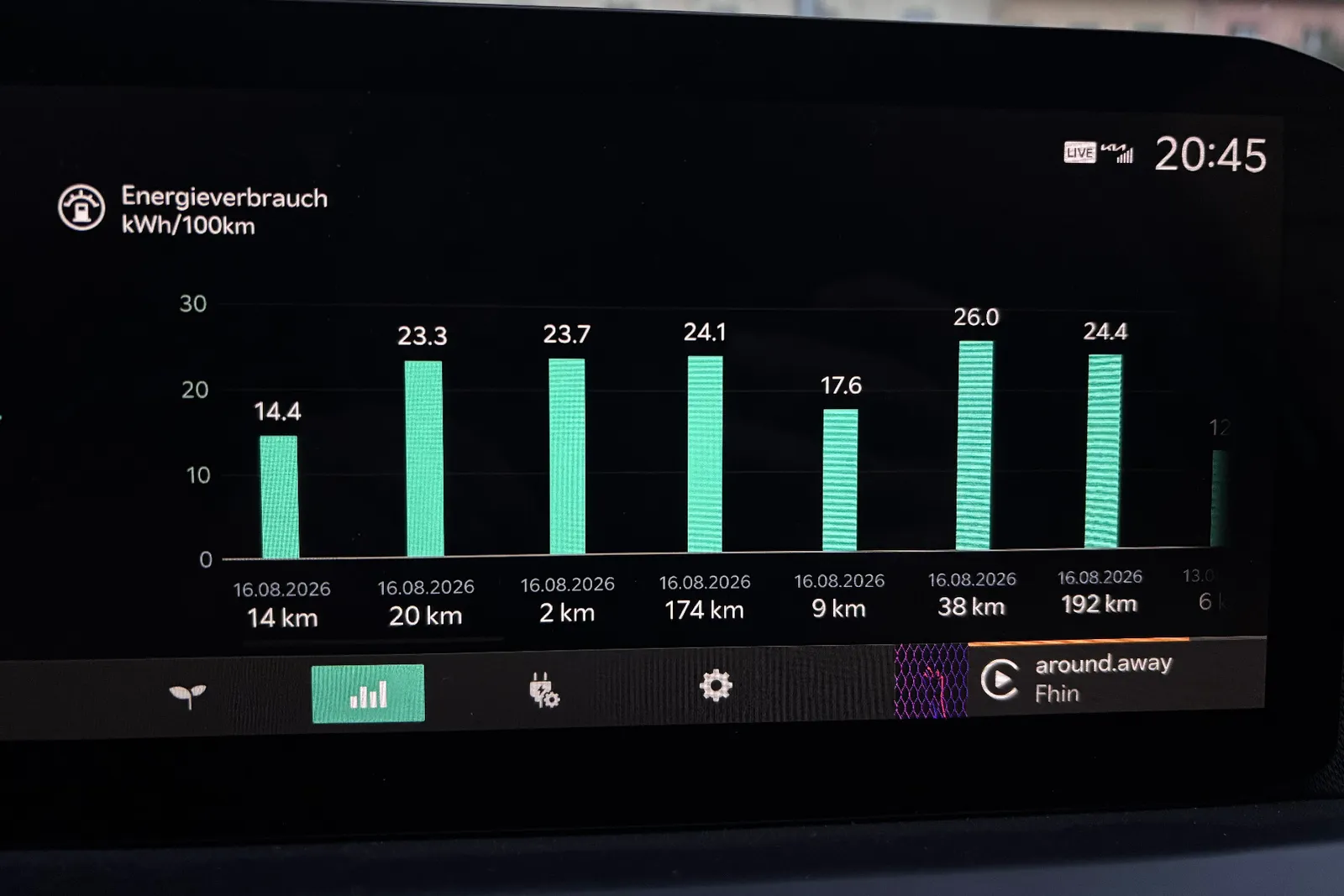
On the first well-documented long highway segment in Poland, the onboard computer shows 24.4 kWh/100 km after 192 kilometers. This is followed by 38 kilometers of faster country roads with 26.0 kWh/100 km. On another 174-kilometer stretch back toward Germany, the figure is 24.1 kWh/100 km at around 22 degrees and light headwind.
For these total 404 kilometers, the average figure shown by the onboard computer is around 24.4 kWh/100 km. This is surprisingly low. Especially since Kia already reports a WLTP highway figure of 23.3 kWh/100 km for the EV5 Earth with 19-inch wheels. The comparison isn’t perfect, of course: Traveling with a trailer results in much slower speeds compared to a fast solo drive on the highway. But that’s exactly what real-world testing is about.
With 24.4 kWh per 100 kilometers, the theoretically maximum range achievable using the nominal 81.4 kWh battery capacity would be around 330 kilometers if the battery were driven completely empty—though of course no one does that. Our realistic driving ranges were more in the 250 to 300 kilometers range, which falls right within a segment where drivers, passengers, or campers would likely need a break anyway. For a pair of an electric SUV weighing over two tons and a trailer, this range is definitely acceptable!
Charging in Poland: The Kia EV5 isn’t the issue
Moreover, the Kia EV5 isn’t aimed at setting records when it comes to fast charging. Its 400-volt architecture can deliver up to 150 kW, with Kia claiming a charging time of 30 minutes to reach 80 percent capacity. Compared to 800-volt systems that offer over 250 or even 300 kW, this doesn’t sound particularly impressive. Yet during our trip, it caused surprisingly little inconvenience.
The bigger problem lies with individual charging stations. In Płoty, the first fast charger we tried was under maintenance, and the station next to it was occupied. Since there was still enough power left in the battery, we headed to a shopping center. There, an older charging station wouldn’t communicate properly with us via ad-hoc payment or its card terminal. In the end, it was the German charging card that worked through roaming. It was more expensive, but at least power flowed.
Later in Łeba, the situation was similar: individual charging points instead of large parking lots, with ad-hoc payment having its own quirks. Once again, the charging card we brought along worked in the end. In practice, things sometimes override even the well-designed infrastructure maps.
The EV5 comes equipped with a small detail for trailer use that turns out to be extremely clever: the charging port is located at the front right, behind the front wheel. In everyday driving, this may take some getting used to. However, when towing a camper, it can be invaluable. If the charging station is at the front of the parking lot, one simply drives forward to charge and then reverses out. No need to disconnect the trailer—provided there’s enough space around. We particularly appreciate charging stations at supermarkets, where there is usually sufficient space for maneuvering or avoiding other traffic. A charging port on the rear would be much less practical in such cases.
The Kia knows something is attached at the back
On the software side as well, Kia has thought about trailers. Once a Mink is connected, the EV5 switches to trailer mode and takes the trailer into account when predicting range. Additionally, it is possible to specify whether a light, medium, or heavy trailer is being pulled.
This works surprisingly reliably during trips. The displayed remaining range adjusts quickly to the significantly higher consumption, thereby reducing some of the range anxiety for the vehicle with a trailer.
It’s particularly curious that the detailed consumption figures during driving aren’t easily accessible. A clear overview of trip consumption, as I’m used to seeing in other vehicles, simply didn’t appear in the Kia EV5. There is only a detailed display on the central 12.3-inch screen behind the steering wheel that one has to locate first. On the middle touchscreen, there is at least a bar chart sorted by days and trips. It was from there that I retrieved the relevant consumption data for this report later.
Overall, the cockpit is a strange mix of digital and highly analog elements. There are plenty of displays, but some information is placed in awkward locations. The right side of the central touchscreen is hard to reach without bending over, and part of the climate control is hidden behind the steering wheel from the driver’s perspective. Additionally, one might accidentally touch the touch surfaces below the display when resting their hands there.
At the same time, there’s still a button or lever for almost everything. Trunk, loading hatch, park brake, gear selection — Kia definitely doesn’t belong to the “just a screen and nothing else” school of design. I personally prefer this approach. It just means the plastic cockpit appears less modern in some areas compared to the strikingly designed exterior.
A helper keeps trying to send me to bed
On long distances—especially when staying in the truck’s wake for extended periods—in this case, the assistance systems become crucial. And things aren’t always easy here.
The attention warning system sometimes wants to make the driver stop right after starting up, and it remains surprisingly persistent. I have no idea what my eyes have done to it.
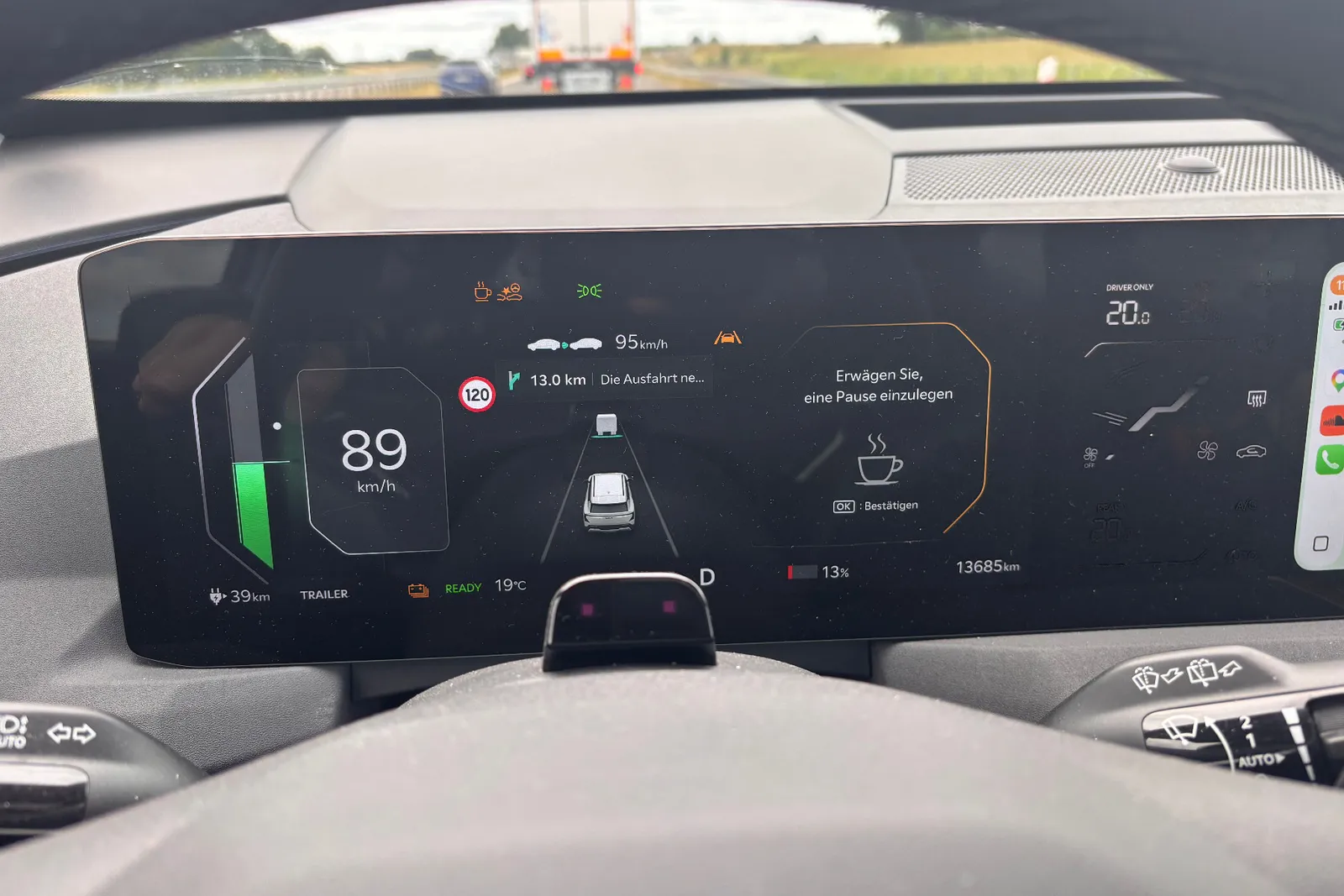
I also don’t feel entirely comfortable with the lane-keeping system on some narrow roads in Poland. The system relies heavily on the right-side lane mark and tries to maintain distance from it—even when oncoming traffic is approaching from ahead. It makes one feel like they’re steering against the car, even though the assistant is supposed to take some of the workload off.
The situation looks better on the highway. There, the EV5 drives smoothly, quietly, and without any unnecessary excitement—even with a camper. The Eco, Normal, and Sport driving modes slightly alter its character, though the “Sport” name might create expectations that a large, softly sprung front-wheel-drive SUV isn’t meant to meet, nor does it have to. The EV5 is a travel vehicle—one that prefers to glide rather than tackle sharp turns. And with the camper attached, that fits quite well.
Large trunk—but not huge
The interior, on the other hand, offers plenty of space. The Kia EV5 has five fully functional seats and an official cargo capacity of 566 liters; with the rear seat folded down, it can hold up to 1,650 liters. There’s also a frunk space available.
Still, subjectively the trunk doesn’t seem quite as huge as its angular body shape would suggest. The dual loading floor takes up a lot of height. As a result, small items, cables, or camping gear can be stored underneath, leaving the actual loading floor almost flat.
On this trip, the Kia serves as a mobile storage space anyway. Sleep is taken in the Mink, while the rest fits in the EV5. And as we know, a surprising amount of stuff accumulates when camping.
Conclusion: For camping, it’s all about what the battery can deliver
At the end of this journey, it’s not the EV5’s charging capacity that stands out. Nor its acceleration. And certainly not its top speed.
It’s the combination of three fairly unremarkable features: a large battery, reasonable towing capacity, and Vehicle-to-Load capability.
The Kia EV5 pulls a small camper with complete ease, offering realistic driving ranges of 250 to 300 kilometers even with a trailer attached, and consumes approximately 24 to 26 kWh per 100 kilometers on our most demanding routes with the Mink. This is far less demanding than one might expect when thinking of “electric car plus camper van.” Of course, the small, relatively aerodynamically efficient Mink helps in this regard. With a family caravan that is two meters fifty tall, the situation would likely be different.
On the other hand, the electric drive opens up new possibilities for camping that a gasoline SUV simply cannot provide. The 81.4-kWh battery isn’t just an energy storage unit for driving but can also serve as a power source for everyday use if desired. Boiling water, charging a laptop, drying hair — and perhaps even cooking entirely electrically in the future. Vehicle-to-Life rather than Vehicle-to-Load.
Perhaps that is the more interesting insight from this trip: When it comes to an electric car with a camper trailer, one should not only discuss how much extra power the trailer consumes. But also what can be done with the power in the car once arrived.