
VDA-E Charging Network Ranking: Ratio of public charging stations to electric vehicles remains stagnant
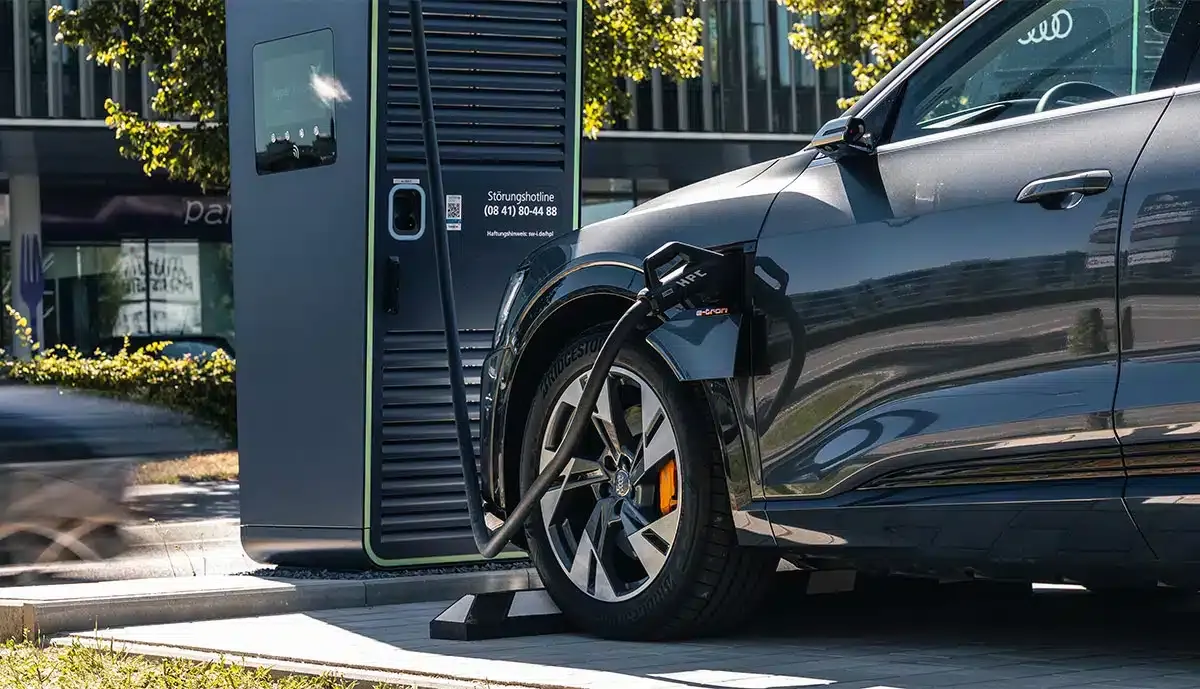
Image: Audi
The current ratio of public charging stations to electric cars in Germany remains almost unchanged compared to the previous year. Both the registration of electric vehicles and the availability of public charging stations have increased in all federal states. Nevertheless, significant differences still exist between federal states as well as between municipalities, highlighting the ongoing need to develop charging infrastructure in Germany.
These are some of the key findings from an analysis by the Association of the Automotive Industry (VDA), known as the VDA E-Charging Network Ranking. As of July 1, 2026, Germany has 211,025 publicly accessible charging points, of which 55,011 are fast charging points, serving 3,591,910 electric vehicles (BEVs + PHEVs). This means that on July 1, there were an average of 17.0 electric vehicles per publicly accessible charging point in Germany.
Thus, the ratio of public charging points to electric vehicles in Germany remains almost unchanged compared to the previous VDA E-Charging Network Ranking (data as of July 1, 2025). At that time, there were 16.7 electric vehicles per publicly accessible charging point.
Approximately 39,000 new charging points, approximately 715,000 new electric vehicles
As of the cutoff date for the new VDA electric charging network ranking (July 1, 2026), the Bundesnetzagentur reported 38,875 more public charging stations than in the previous VDA ranking (as of July 1, 2025). Of these, 14,234 are fast charging stations. Significantly more electric vehicles can be charged at fast charging stations in the same amount of time compared to regular charging stations. During the period under consideration, 14,234 fast charging stations were added, meaning that more than one-third of all new public charging stations added were fast charging stations. This trend reflects a focus on expanding high-capacity fast charging stations with over 149 kW (high-performance charging stations), which have seen increased installation. Across Germany, there are 40,320 high-performance charging stations. They now constitute the majority of fast charging stations and account for approximately one-fifth (19%) of all charging stations in total.
There was also a significant increase in the number of electric cars: between July 1, 2025, and July 1, 2026, 714,859 new electric cars were registered. As of July 1 of this year, there are 3,591,910 electric cars in Germany. Electric cars account for 7.2 percent of the total car fleet in Germany.
The coverage of charging stations has improved slightly compared to the previous VDA ranking, but unfortunately, 30 percent of municipalities (with 500 or more residents) still lack publicly accessible charging stations, and 61 percent still lack publicly accessible fast charging stations.
"Our analysis of public charging infrastructure shows both positives and negatives. The most encouraging aspect is the significant increase in fast charging options. The fact that people can charge their electric vehicles more frequently is good news for consumers and electric mobility," said VDA President Hildegard Müller.
"At the same time, there are still too many gaps on the map, with many communities in Germany offering no public charging facilities at all. Yet a widespread and efficient charging infrastructure is a crucial factor for the success of electric mobility. People need the confidence that they can charge easily and quickly anytime, anywhere. They want to be able to rely on this. That’s why more ambition is needed in expanding public charging options—especially given the sharp increase in electric vehicle registrations."
The VDA president demands that efforts to expand the “Germany Network” promoted by the federal government, which includes over 1,000 fast-charging stations along highways as well as in urban and rural areas, be accelerated. “The Germany Network was supposed to be completed by the end of the year, but legal disputes have caused delays — so there’s an even greater need to speed things up now. Outstanding legal issues must be resolved immediately. The Germany Network must be finished as soon as possible; no further delays are acceptable.”
“Electrified mobility requires sufficient network capacity.”
Müller also emphasizes the importance of faster planning and approval processes as well as the expansion of the power grid. “The development of the power grid is increasingly becoming the key prerequisite for expanding charging infrastructure. With electric mobility—whether in passenger cars or commercial vehicles—new challenges arise especially for power grids. To ensure that the required capacity can actually be provided, power grids must be expanded more quickly and proactively. High-capacity energy grids must not become a bottleneck for the success of electric mobility. Here, policymakers, the Federal Network Agency, and the energy industry must act together and decisively.”
The VDA chief continued, “The German automotive industry will resolutely pursue its path toward climate-neutral and digital mobility. Manufacturers and suppliers are making significant contributions today and in the future through impressive innovations and substantial investments to the success of electric mobility in markets around the world. They continuously expand their product range and offer solutions in all segments. In Germany alone, German manufacturers offer around 110 electric vehicle models. The automotive industry companies are also driving the development of charging infrastructure for passenger and commercial vehicles forward through numerous projects—both in Germany and internationally. We will consistently carry on with this commitment.”
Did you spot any errors? Please let us know
by email
about them. Thank you!
Also interesting
About the author
Thomas Langenbucher is an expert in electromobility with professional experience in the automotive industry and finance sector. Since 2011, he has been covering electric vehicles, sustainable technologies, and mobility solutions for ecomento.de. Learn more.
Reader interactions