
A used Tesla Model 3 with 125,000 km has 92 percent battery health. This is a good result, but nothing exceptional.
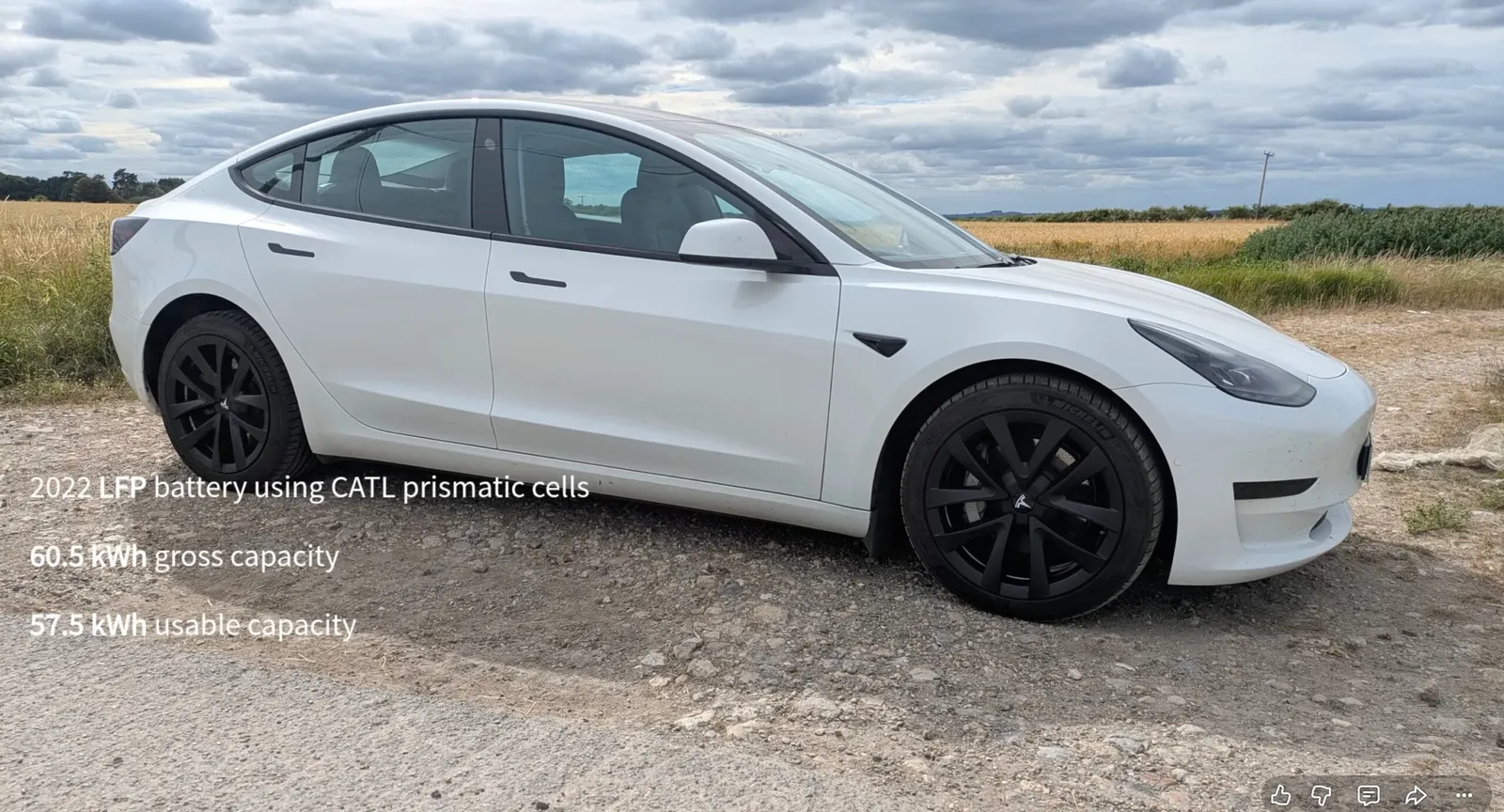
A four-year-old Tesla Model 3 RWD from Shanghai, equipped with an LFP battery and 77,726 miles of mileage—equivalent to 125,088 km—underwent an internal battery health test. The vehicle showed 92 percent battery health, even though the new owners were unaware of its charging history. For buyers of used electric vehicles, this information is more important than marketing claims about “minor degradation.”
The car was purchased by the family of YouTuber Matt Goes Electric with around 76,000 miles (122,000 km) of mileage. It is a 2022 Tesla Model 3 in rear-wheel-drive version, fitted with an LFP pack manufactured in Shanghai. The previous usage pattern remained unclear: it was unknown how frequently the car was charged via DC or how the battery was maintained on a daily basis.
Tesla calculated the battery status itself
Tesla’s built-in battery test requires connecting the car to a charger, discharging it, and then fully charging it again. Once the process was complete, the car indicated approximately 92 percent of its original capacity.
During the test, the car drew 62.4 kWh from the charger. After accounting for typical charging losses of about 10 percent, this results in roughly 56.2 kWh of energy reaching the battery. Comparing this value to the estimated gross capacity of the new pack, which is 60.5 kWh, gives 92.9 percent. So it’s practically the same as what the car showed.
This aligns with other observations. Swedish used electric vehicle seller Carl reported that after 62,000 miles (100,000 km), the Model 3s with LFP batteries retained an average capacity of 93.3 percent.
There’s another calculation, but it’s better not to overestimate it
Here’s where the issue arises. Comparing 56.2 kWh to the gross capacity isn’t ideal, as the driver never has access to the entire amount. Part of the energy is stored in a buffer, and on top of that there are losses and energy consumption from temperature control.
If we were to compare 56.2 kWh with the estimated usable capacity of a new battery, which is 57-57.5 kWh, the result would be absurdly high: 97.7 to 98.6 percent. However, this is more of a spreadsheet exercise than an accurate measurement. We don’t know with laboratory precision the initial state, the actual conversion losses, or how much energy was used for cooling and electronics.
That’s why 92 percent from Tesla’s test is currently the best figure that can be honestly accepted here. A good result? Yes. Outstanding? Not necessarily. After 4 years and almost 78,000 miles, such a figure is more of a disappointment than something impressive.
When buying a used EV, this is exactly what to look for: not the seller’s claims, but a test drive of the car. Would you buy a Tesla with an unknown history if its battery still held 92 percent capacity?
Order your Tesla and take advantage of bonuses for purchasing through the referral link!
LovEV Newsletter
Want more content like this?
Sign up — we’ll send you a weekly summary once the newsletter starts.