
UTMB 2026: Behind the scenes of Green Hat’s support with the Xpeng G6
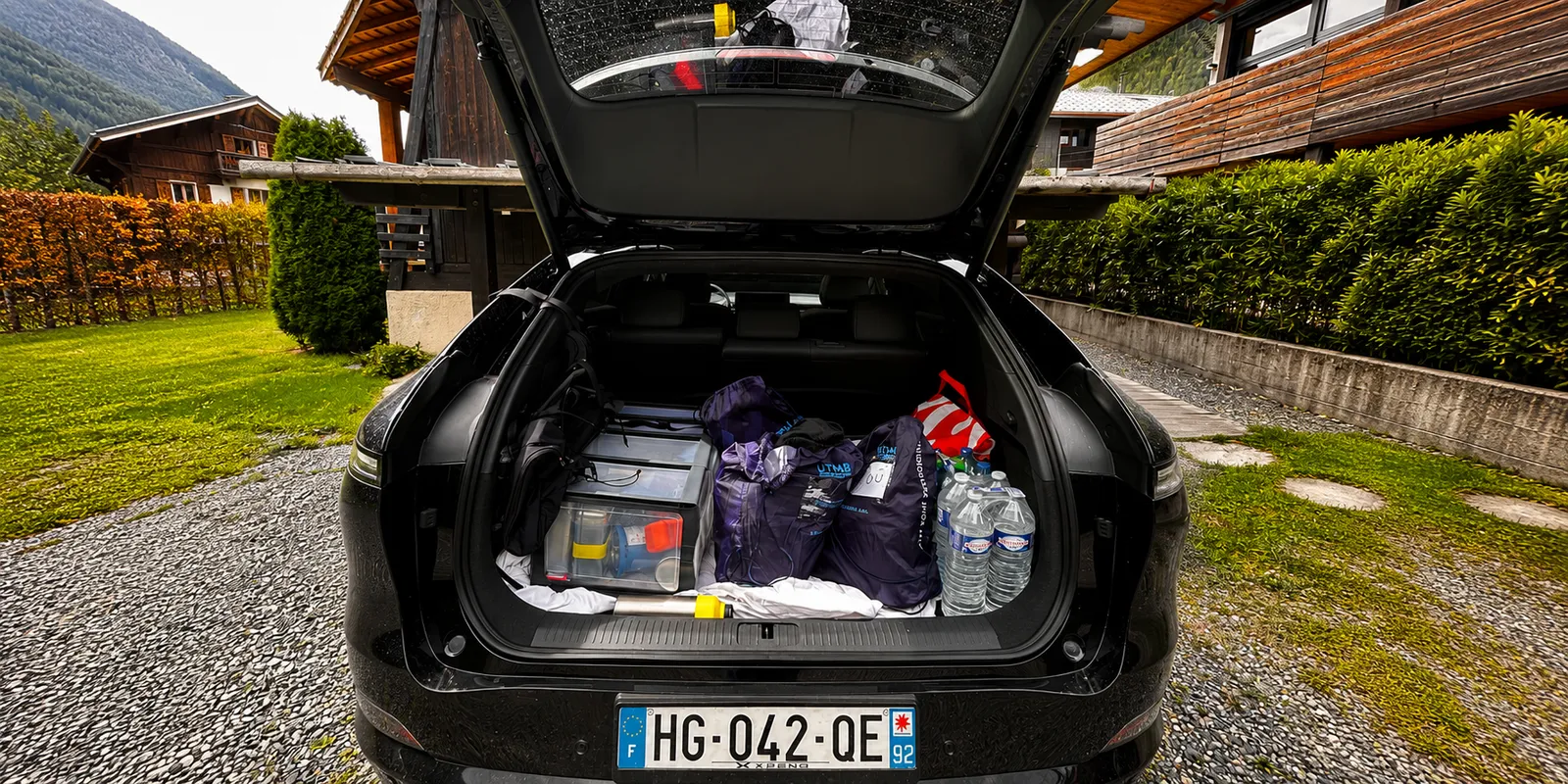
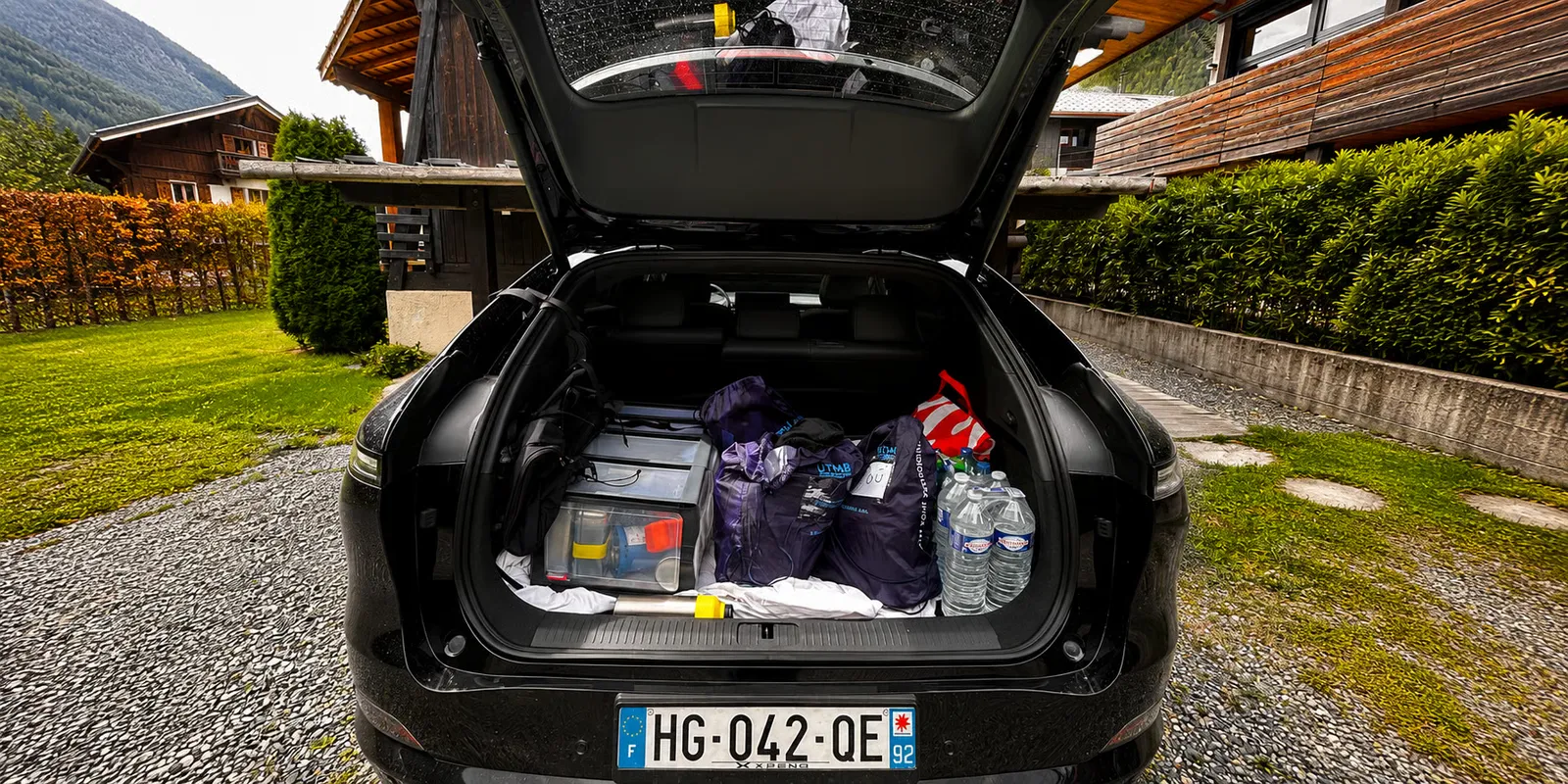
With the 2026 edition of the UTMB (Ultra-Trail du Mont-Blanc) just concluded, let’s take a look at the behind-the-scenes aspect: support services. Following a runner in the UTMB requires crossing three countries, navigating through numerous passes, dealing with closed roads, and never knowing for sure when they will reach the next supply point. This year, Cécile Bertin, a newcomer to electric vehicles, attempted this challenge driving an Xpeng G6 to support Alexandre Boucheix, also known as Casquette Verte. It was an opportunity to see if electric vehicles can truly keep up with one of the most demanding races in the world.
In addition to being an ultra-trail race, the UTMB is also a massive logistical operation organized around the Mont Blanc massif. The flagship event, spanning about 174 kilometers with nearly 10,000 meters of positive elevation gain, takes participants from Chamonix to Italy and Switzerland before returning to the French valley. The best runners complete the course in less than 20 hours (the record this year was set by American Ben Dhiman at 18 hours, 16 minutes, and 29 seconds). For others, the adventure can last nearly two days.
Also read
Testimonial: This Frenchman just bought a Fisker Ocean despite the brand’s bankruptcy — he shares his story!
Among the most well-known faces of French trail running is Alexandre Boucheix, also known as Casquette Verte on Instagram. This ultrarunner, who enjoys significant followings on social media, has built a strong community around his performances as well as his unique way of documenting his races (and training). He is accompanied by support staff who travel to designated points along the route to bring him food, clothing, equipment, and sometimes just a word of encouragement.
Accustomed to conventional cars that aren’t always in top condition, Cécile Bertin decided this year to complete the entire support route in an electric vehicle. After contacting several manufacturers, she received a response from Xpeng, which provided the duo with a G6. Alexandre and Cécile set off on this legendary race late Friday, August 28.
Support over 200 to 300 km
On paper, the task seems almost easy. Full support for the UTMB usually involves 200 to 300 kilometers of driving. This distance is easily covered by many modern electric cars (and not just them), provided, of course, that the battery is fully charged. But focusing solely on kilometers would be misleading. The difficulty of an event like the UTMB lies precisely in the fact that a route planned in advance can quickly fall apart.
The condition of the runners, traffic jams, road closures, crowded parking lots, or even passing through the Mont-Blanc tunnel can completely change the itinerary. In total, Cécile was supposed to stop at four aid stations during the race. In her case, the most favorable scenario ultimately came true. She estimates she covered about 200 km during the event, compared to the initially planned 250 to 300 km. She notably did not need to take the alternate route via the Grand-Saint-Bernard Pass.
This detour is by no means trivial. In fact, the Mont Blanc tunnel regularly becomes one of the main bottlenecks for assistance. When wait times between France and Italy become too long, some teams prefer to bypass the mountain range by going through Switzerland and the Grand Saint Bernard Pass. The extra kilometers add up quickly, compounded by terrain that is not conducive to efficient travel. In short, it’s better to avoid this route, but during the heart of the race, some have no choice but to take it.
Range has never really been the issue
This is one of the first concerns that arise when considering using an electric vehicle to assist in an ultra-trail: will the range be sufficient? In the case of the Xpeng G6 used here, the answer is quite clear. Cécile estimates that she used about 40% of her battery’s capacity throughout her entire assistance route. Although she started with a range of just over 500 km, the dashboard still indicated 303 km remaining in Vallorcine, toward the end of her mission.
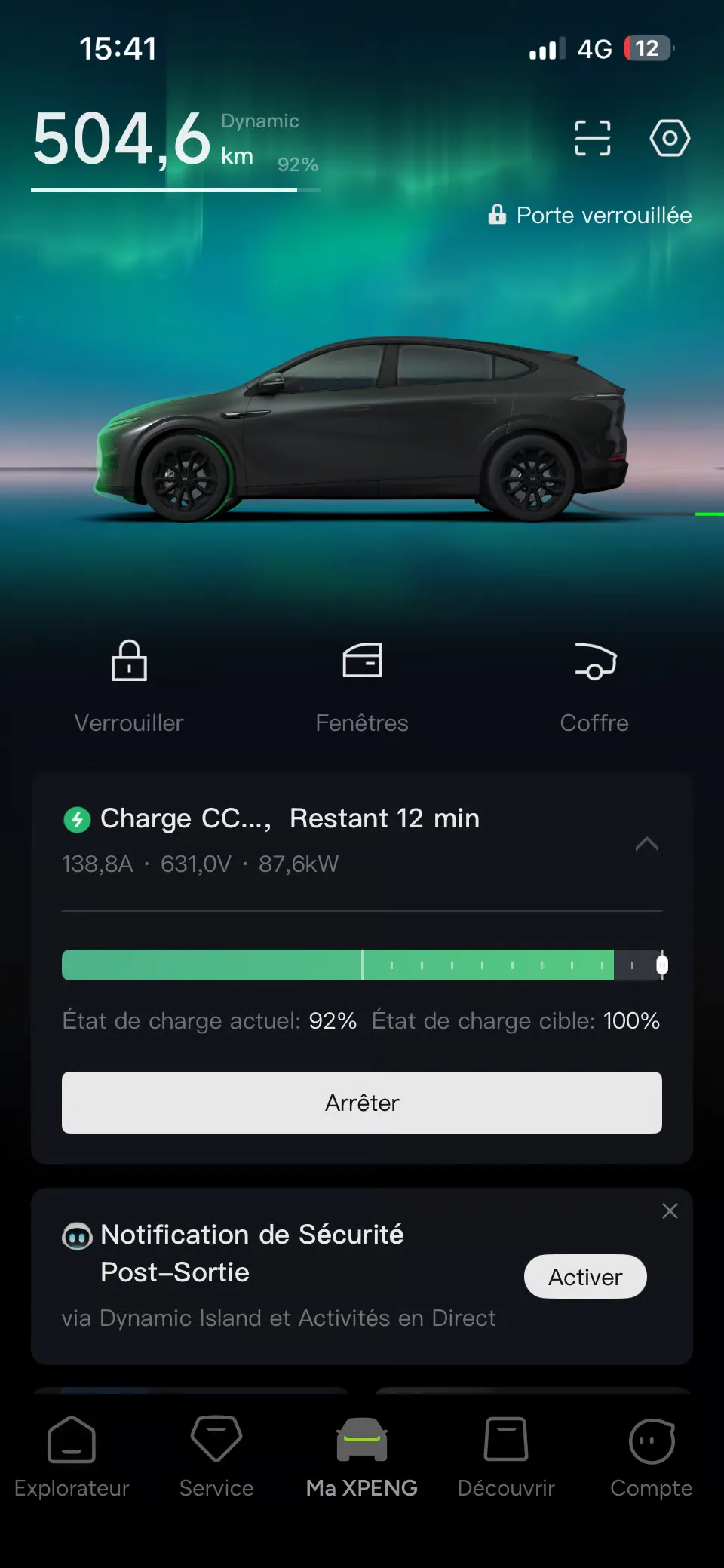
The lead therefore remained significant throughout the race. Cécile had even set herself a simple rule: to keep about 50% of the battery charge as much as possible so she could handle any unexpected situations without immediately searching for a charging station. The terrain certainly isn’t neutral on this route. During the long Alpine climbs, battery consumption rises significantly. But some of this energy can be recovered during descents thanks to regenerative braking. Cécile made full use of this!
In short, this mountainous route never really posed a challenge to our neo-electromobilist’s battery.
The real surprise: charging
If the battery itself wasn’t a problem, it was the charging ecosystem that surprised Cécile even more. As she explored the world of electric vehicles, she chose to prepare her journey thoroughly. Before the race, Cécile charged at a Total station located at the exit of Chamonix. Just in case, she also planned for the possibility of taking a detour through Switzerland by contacting the city hall of Martigny to find easily accessible fast chargers.
Also read
Chinese cars: why is this insurer now refusing to cover certain brands?
Cécile wanted to confirm the availability of the kiosk, its operational status, and whether it was easily accessible. As you know, not all kiosks yet allow payment simply with a credit card. Some require an app, account creation, or a specific subscription card. Moreover, UTMB support leaves little room for surprises when using a kiosk. It’s also not possible to connect to a 22 kW charger, as the charging speed would be too slow.
Throughout her refueling stops (which took place before the race), the main difficulties revolved around payment: QR codes, a necessary phone, accounts that had to be created, and a rejected credit card. In Chamonix, she even explained having to rely on a neighbor who created an guest account for her using their own profile. But this isn’t surprising; despite the increasing number of charging stations in France, UFC Que Choisir recently highlighted the numerous issues surrounding the refueling ecosystem there.
For someone accustomed to the very simple process at a gas station—inserting a card, paying, and leaving—the contrast is significant.
On the UTMB, 30 minutes can change everything
The problem therefore doesn’t stem solely from whether a support station is present or not. It mainly comes down to the time one can dedicate to it. In a race like UTMB, no one knows exactly what time a runner will arrive at the next support point. They might save time, slow down significantly, encounter physical issues, or completely change their pace. Thus, the accompanying person must remain able to set off quickly. A several-hour recharge is simply not feasible.
Even a 30 or 40 minute break must be planned carefully, as missing a refueling stop could mean not seeing one’s runner again for several hours. Cécile draws a very simple conclusion: for this type of mission, one should aim solely at quick recharging. With a vehicle that has a shorter range, she believes the task would become significantly more complicated.
Traveling through three countries also allows for an assessment of the differences in charging infrastructure around the mountain range. Cécile has a fairly positive impression of France and Switzerland, where she found enough charging options to ensure a smooth journey. However, her experience in northern Italy was less satisfactory. Upon arriving in Courmayeur, she discovered very few easily accessible charging stations along her route.
A car that becomes a true home base
During an ultra-trail, the car is not just a means of transportation. It also becomes a base camp. Food, shoes, dry clothes, headlamps, external batteries, and running gear must be organized so they remain easily accessible. A few minutes wasted searching through the trunk can make a difference when a runner arrives earlier than expected. Cécile explains that over the years she has developed her own organization system, adaptable to different vehicles.
Also read
Battery health: Can we really trust the SOH of used electric cars?
In this role as a “mobile base camp,” the available power outlets and the G6’s V2L (Vehicle-to-Load) function proved particularly useful for keeping phones, watches, or lighting devices charged. The Xpeng G6 even offered an advantage that Cécile hadn’t really anticipated. In Courmayeur, Cécile took advantage of a dedicated rest mode: the car significantly reduces its energy consumption while still keeping certain systems active, such as heating or cooling, along with the electrical outlets.
She was able to sleep for about an hour in the car before resuming her duties. This might seem trivial, but in a race where the support driver sometimes spends the entire night driving, waiting, and then setting off again, having the opportunity to rest properly becomes a significant advantage. A gasoline vehicle can certainly heat its cabin when stopped, but this requires the engine to run uselessly for long periods. With an electric vehicle, the silence greatly improves the experience.
This is actually the aspect where Cécile believes the electric car proved to be clearly more practical than a gasoline model.
Following the UTMB in an electric car, it’s easy
Verdict: Yes, it is absolutely possible to follow the UTMB in an electric car. This isn’t surprising, but it shows that electric cars continue to become more widespread. They can now be found everywhere, even on demanding routes like this one. During the race, the Xpeng G6 never required assistance from Green Hat. The range remained comfortable, the terrain didn’t create any critical situations, and the car proved very practical during long periods of waiting.
The main obstacle ultimately lies in charging. Not because charging stations are absent, but because their functionality remains too inconsistent. In a situation where every minute counts, this hurdle quickly becomes a real problem. It’s not an issue with electric vehicles that have long ranges, but it still needs to be kept in mind. Cécile recommends identifying the locations of fast chargers in advance and, if possible, checking their functionality before the race.
And the support team ultimately fulfilled its mission to the end: Alexandre Boucheix crossed the finish line in Chamonix in 24 hours, 17 minutes, and 31 seconds, finishing in 79th place in this 2026 edition. It was a successful experience both from a sporting and an electric vehicle perspective.
Automobile Propre et moi-même thank Cécile for her testimony and prompt response. For your reference, any offensive comments directed at our interviewees, their lives, choices, and/or opinions will be removed. Thank you for your understanding.