
US students develop ‘energy-positive’ solar vehicle
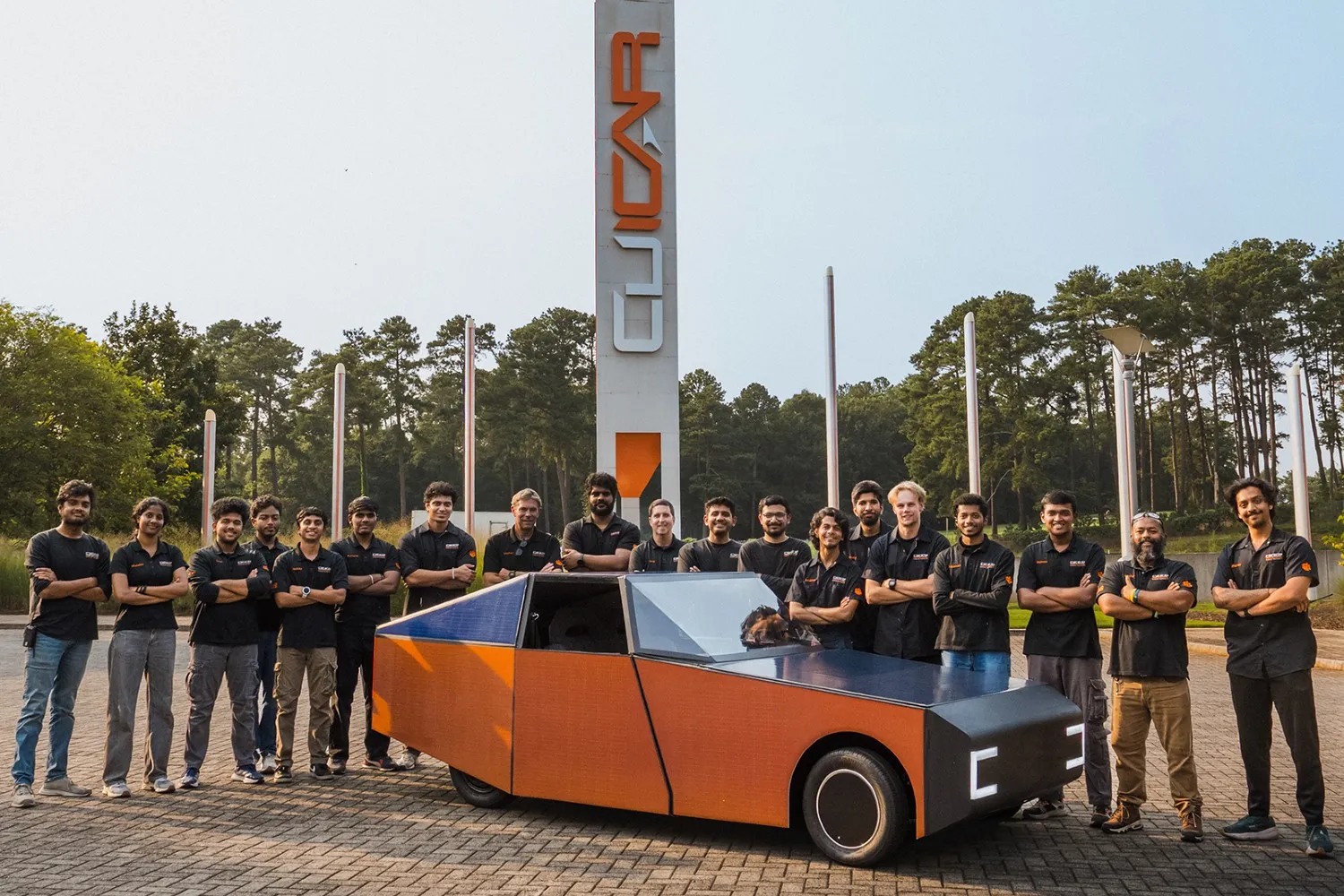
Students at Clemson University have unveiled the Deep Orange 17 electric car prototype. The solar-powered research vehicle can generate more energy than it consumes. BMW and the Fraunhofer Institute for Solar Energy Systems ISE supported its development.
At Clemson University in Greenville, South Carolina, 16 students who recently completed their Master of Science in Automotive Engineering have developed Deep Orange 17, a two-door coupé nicknamed Luminetta.
The somewhat bulky-looking vehicle is described as an ‘energy-positive electric vehicle prototype’ that, according to its creators, generates more energy than it consumes during a typical day of urban commuting. Developed in collaboration with BMW’s research and development team, the prototype combines solar technology, lightweight construction and intelligent vehicle control.
Deep Orange 17 is not the first concept vehicle developed at the South Carolina university. Through its ‘Deep Orange’ programme, successive groups of Clemson University students have designed and built a series of functional prototypes. BMW has been a long-standing partner of the programme.
Work on Deep Orange 17 began in autumn 2024. At the heart of the vehicle’s energy concept are more than 1,700 photovoltaic cells integrated directly into its exterior surfaces, generating electricity both while parked and on the move.
“Rather than serving as an auxiliary feature, solar power is a core part of the vehicle’s propulsion strategy,” the team emphasised.
The cells were developed in collaboration with Germany’s Fraunhofer Institute for Solar Energy Systems ISE. According to the project team, the system also operates in shaded conditions and continuously uses sunlight to recharge the vehicle’s energy storage. A durable outer film protects the solar cells.
To assess the concept under real-world conditions, the students analysed environmental conditions and solar irradiance in Greenville, South Carolina; Frankfurt, Germany; Madrid, Spain; and Mumbai, India. Based on a daily commute of 12 miles (around 20 kilometres), the team says the vehicle generates enough surplus solar energy across all four locations to provide an average of 31 miles (around 50 kilometres) of additional range.
The university has not disclosed details about the drivetrain itself, but says aerodynamics and lightweight construction play a key role in the vehicle’s ‘energy-positive’ concept. The prototype weighs just 550 kilogrammes – around a quarter of the weight of typical production vehicles – while its aerodynamic design ‘draws inspiration from the aerodynamic characteristics of the boxfish.’
Research on the prototype will continue at Clemson University’s International Center for Automotive Research, where it will serve as a platform for further innovations in sustainable mobility. Deep Orange 17 is also expected to be presented at CES 2027 in Las Vegas.