
URE has begun consultations regarding OSD stations. Over 40 chargers could appear on the market.
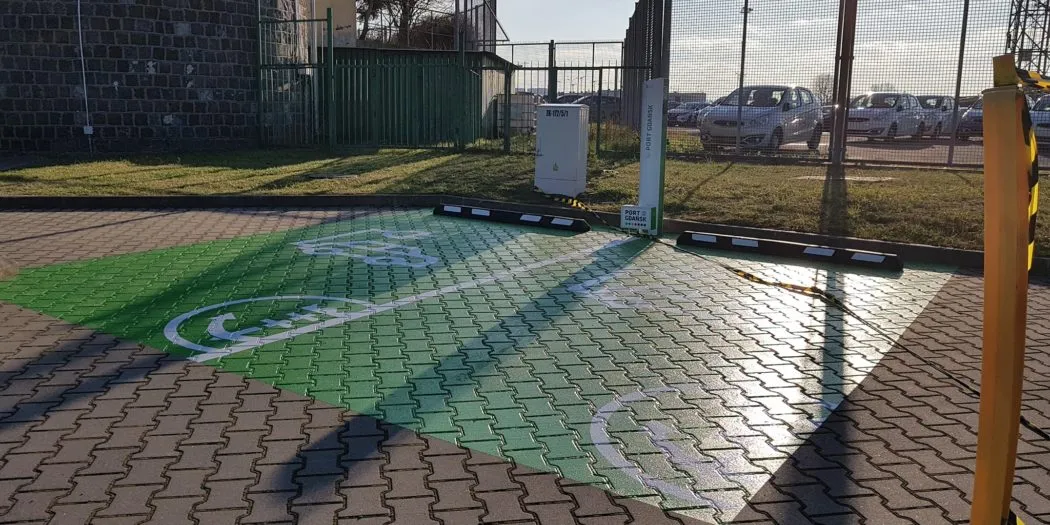
The URE chairman has launched market consultations regarding publicly available charging stations currently owned by distribution system operators. Submissions can be made by November 26, 2026, and the list includes over 40 stations with capacities ranging from 22 to 72 kW.
This is not a new support program nor a major network expansion. It is a market regulation in line with rules that explicitly state that energy distributors should not operate competitive car charging businesses if commercial operators are willing to do so.
Which stations may be put up for sale
The basis is URE Chairman’s notice No. 41/2026 dated August 26, 2026. The attachment contains a list of infrastructure owned by six entities, ranging from large OSDs to industrial companies.
Enea Operator has the largest package, with 33 stations. Of these, 8 are located in Szczecin, 8 in Bydgoszcz, and 17 are under construction in Poznań. Poznań seems the most promising here, but not necessarily the best, as some locations still lack a confirmed legal title to the property.
In addition to Enea, the list includes individual or smaller packages. Grupa Azoty has one station in Tarnów, ESV3 has one in Siechnice, KGHM Polska Miedź has four in Głogów, Legnica, and Lubin, Port Gdańsk has five charging points, and MA Polska has one station in Kielce.
The power capacity of these devices is rather modest for the year 2026. It ranges from 22-72 kW, with some locations having standard AC at 22 kW or weaker DC at 44-50 kW. There are also 72 kW stations with CCS Combo 2 and CHAdeMO capabilities, mainly from Ekoenergetyka. These aren’t suitable for high-speed routes, but they work fine for urban use or fleets.
What URE is concerned about and what the law says
URE does this not on a discretionary basis. Such a market review is mandated by Article 3b, Paragraph 1 of the Electromobility and Alternative Fuels Act and must be conducted at least once every 5 years.
The reasoning is simple. Energy distribution is a natural monopoly, while public charging should operate on market principles. Therefore, the unbundling principle applies, which means separating network operations from competitive activities. If private parties are interested, OSD stations should be put up for sale.
There is also an important restriction under Article 3c of the Act. No other OSD can purchase such infrastructure. Thus, the pool of potential buyers is limited to commercial companies outside the distribution sector.
What’s next and where is the catch
The procedure is formal but fairly simple. The company interested in acquiring it must specify the particular stations and provide details of the authorized representative. Documents can be sent electronically to the e-Doręczeń AE:PL-25259-52521-UECUJ-18 address or in paper form to URE at Towarowa 25a in Warsaw. If a proxy is used, an additional 17 zł tax fee applies.
The most critical moment comes after consultations. If even one party expresses interest in a particular station, the URE President will issue a decision requiring the owner to hold a bidding process for sale. There is a 12-month deadline from the issuance of this decision.
The catch is that not every station on the list has to be equally attractive. Some locations are still under construction, some have unresolved land ownership issues, and many of the existing devices are far less capable than the new 150-400 kW chargers installed along roads today. In short, this is more about streamlining things than competing for the best infrastructure.
For EV drivers, the outcome could be two-fold. If competent operators take over these stations, there’s a chance for better availability, an app, maintenance services, and more reasonable pricing. If no one is interested, it confirms that some of this infrastructure has aged faster than the regulations have kept up.
The market will evaluate not only prices but also the quality and relevance of past investments. Who do you think could actually take over such stations in Poland—GreenWay, Orlen Charge, Ekoen, or maybe a smaller company?
LovEV Newsletter
Want more content like this?
Sign up — we’ll send you a weekly roundup once the newsletter starts.