
A flying Tesla, finally an electric BMW, the comeback of the real pocket Smart, and Europe tightening rules on Chinese hybrids… Welcome to Regen No. 86
Too busy? Regen summarizes the key developments in electric vehicles for you every Sunday in just a few lines.
New Electric Cars and Announcements
We start, of course, with this week’s sensation: nine years after its first reveal, Tesla has finally unveiled its new Roadster, and it… flies. Well, it can leap over a Cybertruck thanks to compressed gas thrusters developed with SpaceX, drive backward on a ramp, and claim a 0 to 100 km/h acceleration time of under 0.59 seconds in the Rocket version (of course, not approved for road use). The technical feat is as crazy as it is useless, aside from helping to clear traffic jams, of course.
A return to reality with the real star of the World Cup: the new Citroën 2 CV. Currently a concept, it’s slated for mass production starting in 2028 (hum…). It remains to be seen what will remain of the Deuche once it shares its platform with Fiat and Leapmotor.
In a similar vein, the Smart #2 finally revives the ForTwo spirit: 2.75 meters long, two seats, a range of 290 km, and priced at 19,990 euros. One minor downside though: production is moving from Hambach to China, ending the EU subsidy that its main rival, the Twingo, enjoys. Otherwise, in terms of design, I’m surprised to see that it hasn’t changed much since the previous version launched just ten years ago.
In fact, Chinese manufacturers are present everywhere in the B-segment market. The Leapmotor B03 directly competes with the R5, while the BYD Dolphin Surf finally comes in a five-seater version. At 1.72 meters wide, good luck to the passenger in the middle seat.
Still BYD, but in a completely different category: the Atto 8, a 7-seater SUV with 775 horsepower, claims to achieve 10% to 97% battery charging in just 9 minutes, provided it uses one of the 3,000 Flash Charging stations planned for Europe by the end of 2027 (rather than the end of 2026 as previously announced).
In the premium segment, Lucid officially enters the French market with the Air priced at 86,900 euros and the Gravity at 95,900 euros, with three sales locations set to open in early 2027—whose addresses are still unknown. To be honest, the Air is absolutely stunning, and even more so in person.
Otherwise, the Moke electric model returns in its second generation with doubled range to 170 km and a price of 42,000 € including taxes. For a Model Y at 80 km/h speed limit as a beach car, Moke is quite optimistic about the pricing.
The Skoda Epiq comes with a Sportline trim that costs up to 43,370 €… without any extra horsepower. It’s impressive.
Finally, to wrap up on the new arrivals, we’ve compiled for you 5 French and 7 foreign models that shouldn’t be missed, shown in photos.
Industry, Economy, and Regulations
Let’s start with the numbers. At BMW, over one out of three cars sold in Europe in the third quarter were 100% electric, while during the same period, its sales in China dropped by 24.8%.
The same pattern holds at Volkswagen, which sells fewer vehicles but sees strong sales of its affordable electric models. In fact, the best-selling electric car in the group this year is a Skoda.
Meanwhile, Xpeng aims to sell 500,000 cars per year in Europe by 2030, more than Ford did last year.
In Brussels, Europe and Beijing have agreed to cap imports of Chinese hybrids at 350,000 units per year, down from the 800,000 expected in 2026. At the same time, BYD confirmed that France is among the countries under consideration for its next European factory.
The government also announced new subsidies of 2,000 euros for electric cars, reserved for models manufactured in Europe. It’s uncertain whether Citroën and Fiat will approve this change, as the Ami and Topolino are assembled in Morocco. That’s unfortunate.
Finally, two complementary analyses of the auto show. On one hand, SUVs are no longer the stars of the automotive world. On the other hand, concept cars are making a strong comeback, especially among Stellantis with seven new models. Or, when there’s hardly anything new to sell, manufacturers offer temporary distractions in the form of show cars with no real purpose. Chinese brands, meanwhile, brought only what they already have in their dealerships, and this will eventually show its effects.
News on batteries and charging
Honda aims to eliminate charging stops by embedding induction coils in roads, enabling up to 150 kW of power while driving, with tests on Japanese highways starting in 2027.
Only 29% of French people consider the charging network sufficient for a fully electric transition, even though the country has over 200,000 charging points. It’s a survey that doesn’t make much sense, to be honest — somewhat like asking people who have never swum if there are enough swimming pools in France, after anti-swimming lobbies have repeatedly claimed in the media that there aren’t enough pools.
The government, on the other hand, has introduced a series of measures as part of its electrification plan, including one that had been long awaited: the mandatory display of the price per kWh on charging stations with 50 kW or more, along with the actual power delivered, from April to November 2027.
There is also a €500 subsidy for a home charging station, but only for one that can be controlled from inside a single-family home and is used in conjunction with the purchase of a used electric vehicle.
Elsewhere, Electra’s CEO outlines his ambitions. The good news is that the company has been profitable since the beginning of the year, confirming that focusing on its core business is paying off.
Pro Tips
The new Renault Trafic E-Tech finally has its prices: ranging from 41,500 to 49,000 euros before taxes, featuring an 800 V architecture, up to 470 km of WLTP range and 17.1 kWh/100 km, the best in its class. With a EU subsidy that can approach 10,000 euros for commercial vehicles, the comparison to diesel models becomes quite attractive.
The Trafic will still face competition from China, with Foton launching its push into the electric van and truck market in France.
Among Uber drivers, Toyota still accounts for 48.3% of the fleet, far ahead of Tesla. However, in Lyon, the Model Y took the lead for the first time.
Finally, Voltaback has raised 2.8 million euros to automate the reimbursement of home charging for company cars.
This Week’s Figure
7. That’s the number of concept cars presented by Stellantis at the 2026 Paris Motor Show. Adding those from Renault and Alpine, it can be said that the French are world champions at creating models that will never see production.
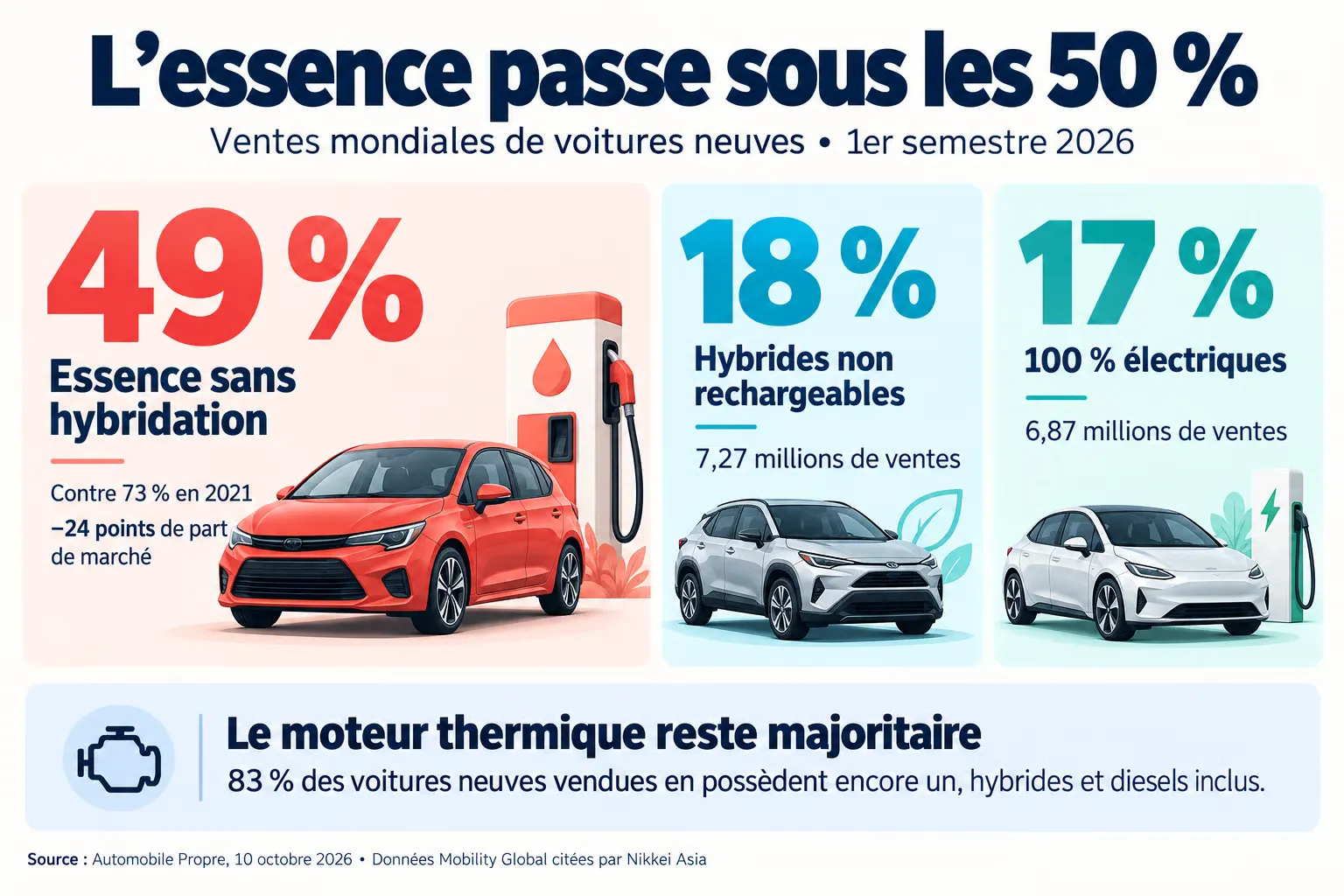
This Week’s Infographic
That’s all from me for today. See you next Sunday for another issue of Regen!