
A new category for charging electric trucks: the EU could amend regulations to expand infrastructure without building new stations
18/10/2026 14:00
Updated to
18/10/2026 14:00
The European Union has just received an alternative proposal to accelerate the deployment of charging infrastructure for electric trucks without relying solely on building new public stations: the International Road Transport Union (IRU) and the organization Transport & Environment (T&E) have asked the European Commission to introduce a specific category for semi-private charging points.
This formula would allow transportation companies, logistics operators, and distribution centers to voluntarily share part of their facilities with other carriers. Additionally, the proposal comes just before the next review of the Alternative Fuels Infrastructure Regulation (AFIR), which sets the requirements for developing Europe’s charging network.
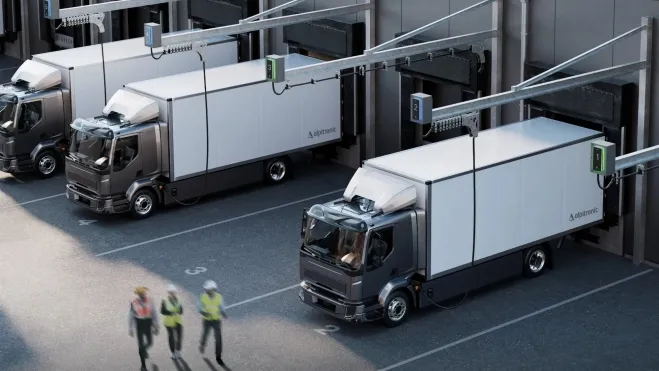
Semi-private charging stations for electric trucks
The initiative stems from the fact that a significant portion of electric truck charging will take place at the companies’ own facilities, where the vehicles remain parked during downtime, loading, and unloading periods. This allows energy supply to be integrated into daily operations, optimizing operational costs and reducing reliance on public infrastructure. However, the problem is that not all transporters have the space, electrical power, investment capacity, or level of activity required to install sufficient chargers at their sites.
This means that for small and medium-sized enterprises, these limitations can become a significant obstacle to electrifying their fleets. It is precisely for them that the proposal by IRU and T&E makes the most sense, as it aims to utilize the charging capacity already available in depots, warehouses, logistics centers, terminals, and loading/unloading areas, as well as through external parties who pay for the service.
In this way, a large company could allow its subcontractors or partner transporters to use certain chargers when they are available, without the need to develop its own infrastructure at each location. Thus, existing facilities would help expand the effective charging capacity and facilitate access to electrification for companies with fewer resources.
Raluca Marian, IRU’s EU political affairs director, said: “A successful transition to zero-emission trucks requires a complete freight ecosystem. Semi-private freight offers the opportunity to maximize the use of existing and future infrastructure, while expanding access for small operators without their own loading facilities, as well as for companies that need to load goods at the locations where they operate.”
A legislative framework that facilitates the transition
However, to make this possible, both organizations urge that the review of AFIR establish minimum criteria for this new category along with appropriate administrative conditions. They call for the removal of barriers related to permits and grid connections, the inclusion of private and semi-private charging in national infrastructure and energy plans, and easier access to government subsidies. Meanwhile, they consider it necessary to adapt European rules on state aid, especially the General Regulation on Category Exemptions (RGEC), in order to avoid disproportionate bureaucratic burdens or situations where charger sharing undermines existing subsidies.
Stef Cornelis, head of Fleets and Freight Transport at T&E, said, “Accelerating the deployment of shared charging stations across Europe brings numerous benefits. Transport companies can charge their vehicles at lower costs without the need for large upfront investments. This way, we make better use of the electricity grid’s capacity, allowing companies to recover their infrastructure investments more quickly. What we need now is a European framework with minimum standards to remove barriers, channel funding, and speed up deployment.”