
A tiny sensor that is crucial for preventing heat leakage: "before the battery fails, chemical changes are reflected in the coolant oil

05/09/2026 15:00
Updated to
05/09/2026 15:00
The degradation of a lithium battery can begin long before its effects become visible. Internal chemical changes generate signals that eventually leave traces in the oil used to cool the system.
Detecting these early signs is the goal of MicroSensOil, a microfluidic device developed by researchers from Tecnológico de Monterrey that aims to predict failures that could lead to fires or explosions.
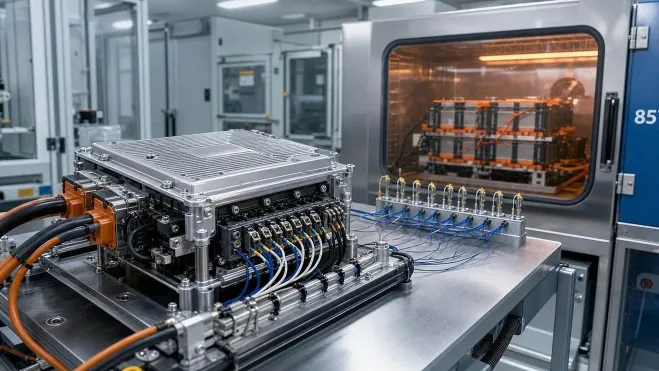
Before BMS: Avoiding Its Limitations
The need for this type of technology is linked to the increasing use of lithium batteries in both electric vehicles and energy storage systems. Their progressive degradation, aging of components, or contamination of cooling fluids can lead to internal reactions that are difficult to detect using conventional systems. In extreme situations, these reactions can result in thermal runaway, a chain reaction associated with overheating that may ultimately cause fires and explosions.
The project is led by David Ramírez Rios, an engineer in digital systems and robotics with a master’s degree in engineering sciences and currently in his third semester of a doctoral program at Tec. The technical advisor is Javier Izquierdo Reyes, an engineer in communications and electronics, holding a doctorate in science and engineering from Tec and with a postdoctoral degree from the Massachusetts Institute of Technology (MIT).
The proposal addresses a limitation of conventional battery management systems, known as BMS. These platforms control electrical parameters such as voltage, current, and temperature to monitor battery behavior and estimate their health status. Though they are essential tools, they can only detect deterioration once the damage has progressed significantly.
MicroSensOil proposes approaching the problem from a different angle: instead of waiting for the battery to exhibit abnormal behavior, it aims to identify chemical signs that appear during the early stages of its aging. To do this, the microsensor analyzes small amounts of coolant oil and tries to detect gases or compounds associated with degradation processes.
"Before a battery fails visibly, internal chemical changes occur that leave traces in the coolant oils," explains Dr. Javier Izquierdo Reyes, a professor and researcher at the School of Engineering and Sciences at Technological Institute of Monterrey. The research, he adds, seeks to detect this "physicochemical signature" of aging before its consequences become apparent.
The goal is to transform reactive maintenance into predictive maintenance. If signs of degradation can be identified early enough, system operators can take actions such as adjusting operating conditions or replacing certain components before a serious failure occurs.
To develop the microsensor, researchers use microfabrication and additive manufacturing techniques. The aim is to integrate electrodes, channels, and analysis systems into microscopic structures, thereby significantly reducing the amount of sample required. After completing the scientific research and experimental validation, the team plans to create a prototype that will be manufactured and tested by scientists from Tec in specialized laboratories at MIT.
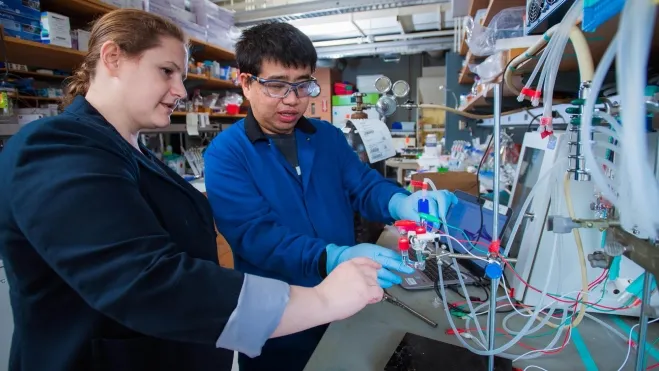
Although the first area of application is electric vehicles, the potential scope is broader. Researchers are considering adapting the platform to analyze dielectric oils used in electrical transformers, as well as to monitor battery packs and other industrial systems, and even exploring possible medical applications. The goal is to turn MicroSensOil into a predictive maintenance tool applicable across various sectors.
The technology also aims to minimize its environmental impact. By enabling early detection of problems and improving the management of energy storage systems, the project seeks to extend their lifespan, optimize the use of industrial fluids, and reduce the generation of hazardous waste.
The factor that could determine the future adoption of MicroSensOil is its economic potential. Unlike conventional laboratory analyses, which may require hundreds of milliliters of oil and expensive equipment, this device aims to conduct rapid tests directly at the battery location, reducing the cost of analysis by 10 to 100 times. The team is now seeking national and international funding to scale up development and turn this technology, conceived in Mexico, into a tool with global applicability.