
UK BEV registrations reach annual high with 32 per cent market share

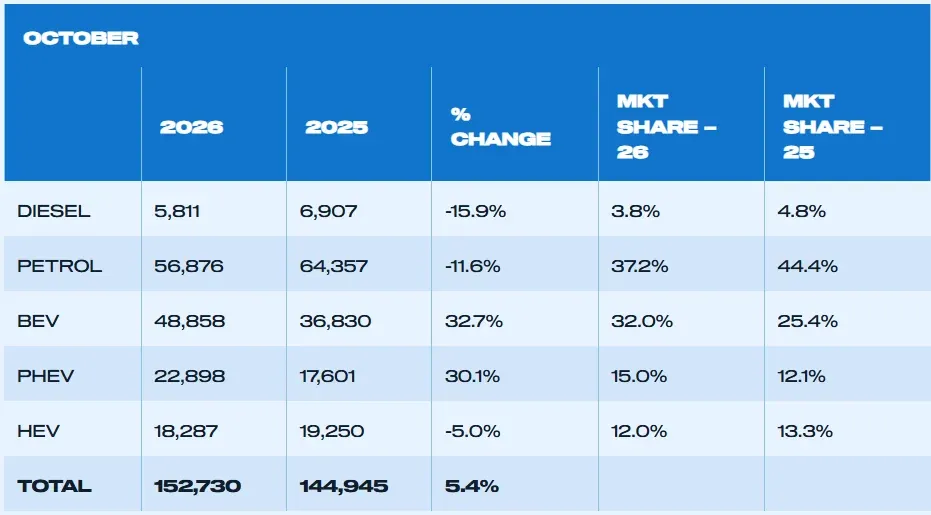
Registrations of new battery-electric cars rose by 32.7 per cent year-on-year in October, reaching 48,858 units. That's according to the Society of Motor Manufacturers and Traders (SMMT), which said BEVs accounted for 32 per cent of the market - their highest share so far this year.
Image: PD Ports
The overall UK new car market grew by 5.4 per cent to 152,730 registrations, marking its 11th consecutive month of growth. However, the increase was slower than the rate recorded across the first ten months of the year, following a strong September driven by the new plate year. Fleet registrations also rose by 5.4 per cent to 89,985 units, while private registrations increased by 4.1 per cent to 58,229. Business registrations meanwhile recorded the strongest growth, up 24.5 per cent to 4,516 units.
Significantly, SMMT states that plug-in hybrid (PHEV) and battery-electric cars accounted for all of the new car market’s growth in October. PHEV registrations rose by 30.1 per cent to 22,898 units, giving the category a 15 per cent market share. BEVs reached 32 per cent, while hybrid EV registrations fell by five per cent to 18,287 units. Together, electrified cars accounted for 59 per cent of new registrations. Meanwhile, registrations of new petrol cars fell by 11.6 per cent (56,876 units); their diesel counterparts likewise saw a drop of 15.9 per cent (5,811 units).
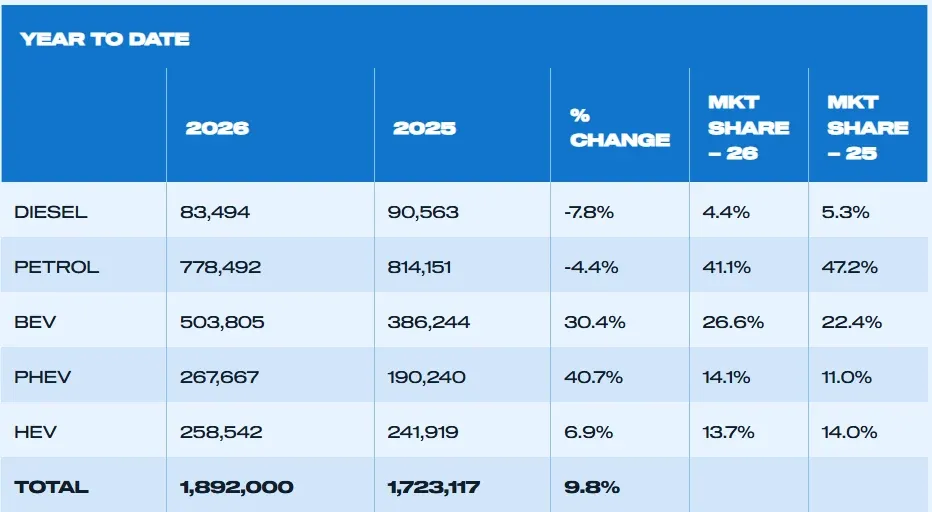
Overall, October saw the number of BEVs registered in the UK this year up to 503,805 – up 30.4 per cent compared with the same period in 2025. This translates to a rise in overall market share from 22.4 per cent to 26.6 per cent. SMMT links this to manufacturers supporting uptake with a growing range of models and incentives, as well as the availability of over 180 BEV models on the UK market. The Society added that the average range of these models now exceeds 300 miles on a single charge.
However: despite growing registrations, the SMMT argues that demand is not keeping pace with the UK’s ZEV mandate. Under current requirements, BEVs must account for 33 per cent of new car sales in 2026, rising to 38 per cent in 2027 and 52 per cent in 2028. The latest SMMT market outlook forecasts a 27.2 per cent BEV share this year, followed by 32 per cent in 2027 and 37.5 per cent in 2028. That would leave the market 14.5 percentage points below the mandate target in 2028 – more than twice the shortfall forecast for this year.
The SMMT also points to potential challenges further down the line, highlighting that manufacturers have spent billions of pounds on discounts, low- and zero-interest finance, deposit contributions and subsidised charging in a bid to encourage drivers to switch to electric cars. It warns that such support is difficult to sustain and could undermine manufacturers’ profitability, future investment, and even the UK’s attractiveness as a place to build vehicles – highlighting that manufacturers have committed £14.3 billion to UK EV manufacturing since 2020.
The industry is thus calling on the government to make substantial changes to the ZEV Mandate review, including revising targets to better reflect consumer demand and provide greater flexibility for manufacturers to meet them. The SMMT argues that policy should make switching to electric easier through long-term certainty on grants and other incentives, more accessible public charging, and the removal of ‘disincentives’. It criticised the government’s confirmation of an electric vehicle duty (eVED) from 2028 as well as its proposed retention of 20 per cent VAT on public charging, stating that these measures send mixed signals to consumers at a time when the market needs further support.
Commenting on the new figures, SMMT chief executive Mike Hawes described them as progress – but one that could come at considerable cost. He warned that the industry and government could not sustain billions in support indefinitely while the gap to mandated targets continues to widen.
“Higher targets may force supply, but they do not create demand,” Hawes said, adding: “The ZEV Mandate review must deliver substantive reform effective immediately to ensure we have a healthy market and an attractive pitch to investors.”