
The EU needs regulations similar to USB-C for electric trucks
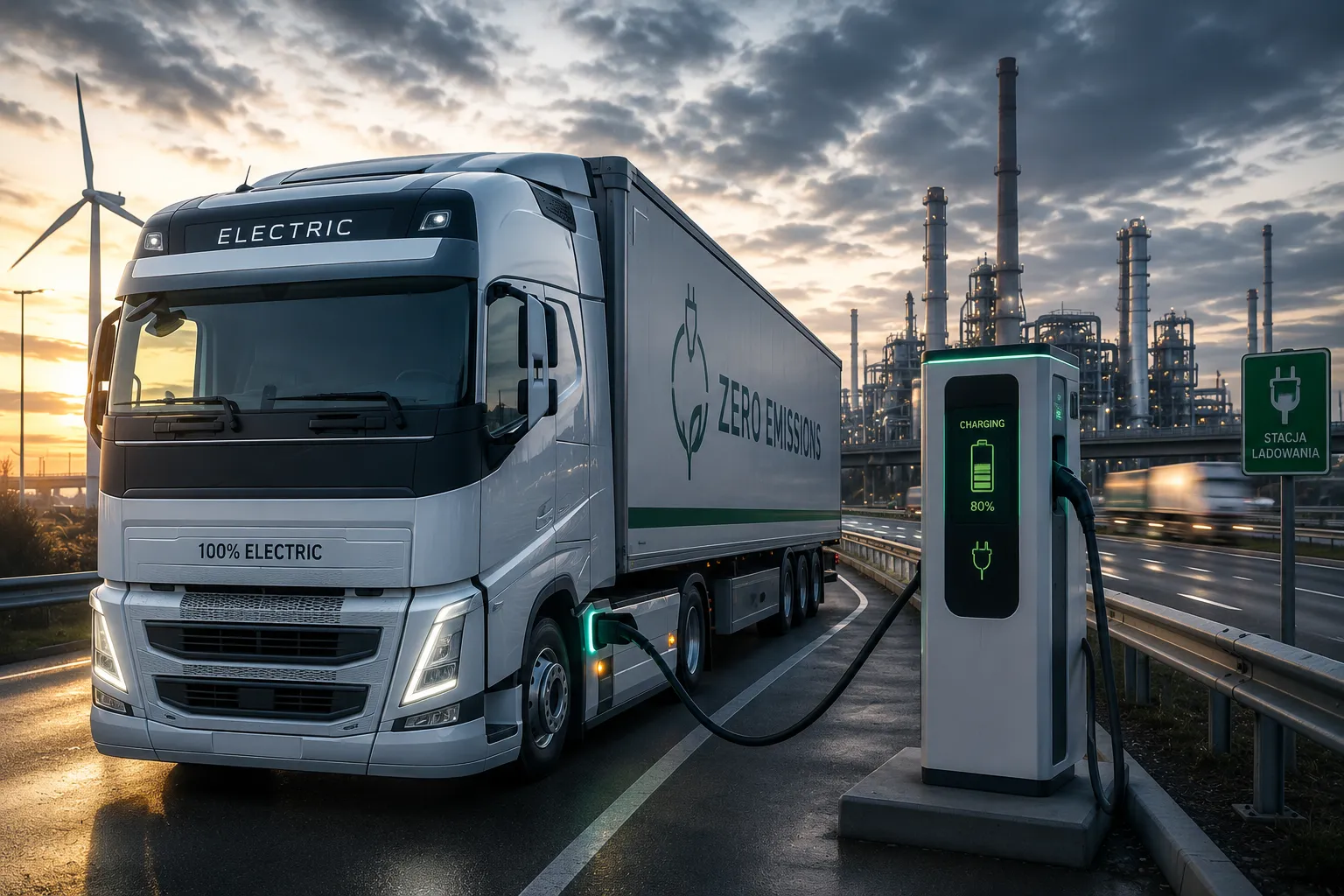
International energy news: Swappable batteries may help in competing with China; French nuclear plants could get additional cooling towers; An American startup will search for lithium in Poland and Germany; Energy storage cannibalization in Europe will increase.
Table of contents
Swappable batteries may help in competing with China
The EU could create conditions for European truck manufacturers to compete in the future with Chinese rivals by focusing more attention not only on high-power chargers but also on replaceable batteries. This could be achieved by imposing uniform standards for such systems, similar to the regulations regarding USB-C connectors for cell phones, believes David Fickling, a Bloomberg columnist.
European truck manufacturers—adds Fickling—are still among the leaders. Daimler, Traton, and Volvo generate revenues of up to 50 billion euros each, while Iveco reports nearly 15 billion euros. Together, they account for almost half of the global revenues from publicly traded truck manufacturers.
Nevertheless, their position relies on internal combustion engines, while the electric segment is developing slowly. In China, however, this part of the market is growing much faster — also because, in addition to chargers, systems based on replaceable batteries are also being developed there.
In April of this year, 17% of trucks sold in China had purely electric powertrains, and for lighter delivery vehicles, this figure was 24%.
There is also increasing emphasis on vehicles with replaceable batteries, a trend supported by companies like CATL — the world’s largest battery manufacturer. Truck manufacturers such as Sany Heavy Industry and XCMG Construction Machinery are installing stations where high-power, high-capacity batteries can be replaced within minutes.
The columnist notes that in the EU, attention is focused instead on building high-power chargers that truck drivers could use during their mandatory 45-minute rest breaks. Moreover, the network of such charging stations remains limited and is largely dependent on investments in power grids.
European truck manufacturers are committed to their specialization, which is diesel engines. Switching to electric drives means they would have to adopt solutions that rely heavily on external suppliers, partly due to the lack of large European battery manufacturers. The company that aimed to fill this gap, Sweden’s Northvolt, went bankrupt before it could start production on a full scale.
According to David Fickling, if Daimler, Volvo, Traton, or other truck manufacturers in the EU want to accelerate the introduction of electric models, they should place more emphasis on swapable batteries—just as is done in China. This way, they will be less dependent on the pace of development in charging infrastructure and better prepared to compete with Chinese manufacturers in the future.
Fickling also suggests that the European Union itself should drive this change by establishing standards that any system based on swapable batteries must meet. This would ensure universality across all vehicles—similar to how USB-C cables became standard for smartphones.
In addition, the EU should also—according to the Bloomberg columnist—strengthen cooperation with South Korea in the battery industry, allowing both sides to compete more effectively against China in this field.
See also: Test of Chinese electric limousine: 3,000 km behind the wheel of Exltantix ES
French nuclear plants may get additional cooling towers
By 2040, EDF plans to spend nearly 9 billion euros adapting its assets to climate changes, especially rising temperatures. Among the planned actions is the construction of additional cooling towers at selected nuclear power plants, according to Bloomberg.
The agency notes that heatwaves are already forcing the company to limit operations at nuclear plants. The resulting average annual losses do not appear significant for now, amounting to 0.3% of potential annual energy production. Nevertheless, these losses already affect energy prices in France and neighboring countries when renewable sources cannot compensate for the shortfall.
EDF expects that in the coming years, as the climate continues to warm, these losses will increase and reach 1.5% per year by 2050. Therefore, the company aims to minimize these losses by investing in adapting its nuclear reactors to higher temperatures.
This is intended to be achieved through an investment plan worth around 8.7 billion euros, which includes adapting 57 reactors and hundreds of dams across the country to extreme weather events such as floods, droughts, and heatwaves.
Some power plants will be equipped with additional small cooling towers that will be built next to the existing ones. Meanwhile, two new nuclear units with a combined capacity of nearly 1.7 GW, to be constructed in Bugey near Lyon, will use cooling towers 200 meters tall—70 meters taller than those built so far.
Bloomberg reports that EDF’s plans also include hydroelectric power — upgrading dams and building new pump-storage plants — to help mitigate the expected decline in production in this sector. Current production amounts to around 40 TWh per year, with projections suggesting it could drop by 1 TWh each subsequent decade.
See also: After solar and energy storage, market speculators are eyeing data centers
American startup seeks lithium in Poland and Germany
The American startup Atana Elements aims to extract lithium in Germany and Poland, near Volkswagen’s battery plants in Salzgitter and LG Energy’s facilities near Wrocław. The company plans to obtain this material from brine wells while also developing geothermal energy, according to the Financial Times.
According to representatives of Atana Elements, as quoted by the newspaper, the company’s plans align with the EU’s strategy to reduce dependence on China for critical raw materials — including lithium, which is essential for the battery industry.
The startup was founded in 2025 in Texas, with Lowercarbon fund and Chilean mining company Antofagasta among its backers. It is also connected to Lilac Solutions, backed by BMW, which has developed a technology for extracting lithium from brine deposits.
Historical geological data and artificial intelligence tools were used to identify locations for exploration in Poland and Germany. Optimistic estimates suggest that up to 26 million tons of lithium carbonate equivalent (LCE) could be obtained in both countries over a 20-year operating period.
The company notes, however, that the ambitious plans are still in very early stages, and it is unclear to what extent these estimates are realistic. Currently, there is a wait for the permits required to begin exploratory drilling.
According to data from the International Energy Agency, demand for this key material for electric mobility and energy storage is expected to grow at an average of 30% per year this decade, up from around 10% in the previous decade.
Meanwhile, forecasts from Wood Mackenzie, Project Blue, Fastmarkets, and Mysteel estimate demand for LCE in the next decade to be between 3.6–6.3 million tons per year, compared to around 1.1 million tons in 2025.
See also: Energy sector officials worried about transformers. Struggles continue over supply of key steel
Cannibalization of energy storage systems in Europe will increase
Between 2027 and 2030, revenues from operating battery energy storage systems in some European countries could drop by anywhere from a few dozen percent to over 40%. Market cannibalization will increase as more projects come online and competition among operators of such installations grows, according to Montel.
The portal cites calculations by Aurora Energy Research, whose analysts estimate that this phenomenon will be most evident in southern European countries, specifically Spain (-15%), Portugal (-19%), and Greece (-21%). The highest declines are expected in Italy (-35%-41%) and Romania (40%).
Revenues will decline as more batteries come online, as investments in storage have accelerated significantly recently. This is driven by both technological advancements and falling costs, as well as various support mechanisms. The goal is to enhance the flexibility of power systems by shifting energy consumption from renewable sources to later hours.
In Italy and Romania, the number of projects expected to be operational by the end of this decade is highest relative to demand, resulting in the steepest expected decline in revenues. In Greece, Portugal, and Spain, however, the energy storage market is still in an earlier stage of development, so greater cannibalization of storage capacity can be expected in the future.
The experts cited by Montel emphasize that investors must be prepared for this phenomenon and, for future operation, should secure a diversified revenue stream that includes, in addition to price arbitrage, support mechanisms such as capacity market contracts and agreements related to other system services.
Careful preparation of the investment in terms of technical parameters is also crucial—optimizing the storage capacity and power to match expected market conditions, thereby avoiding project overscaling.
The location of the facility is equally important—the better the area’s need to balance weather-dependent renewable energy sources, the more favorable it is. Hybrid installations that combine storage with solar and wind farms also offer better prospects.
See also: How to “manage” prosumers? Definitely not by taking over their inverters