
Electric Scooter: The Great Misunderstanding
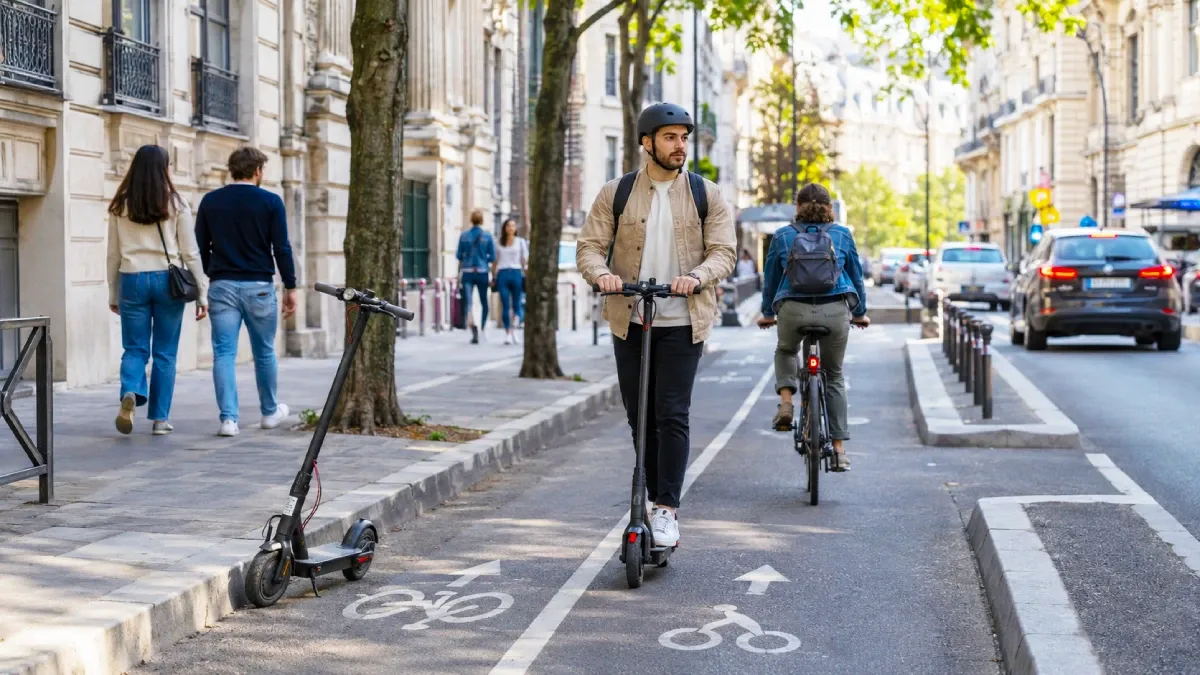
Why the electric scooter is a tragic story that went wrong, and how it reflects the divisions in our societies.
I’m going to talk about a topic that both troubles and saddens me, and which is quite indicative of the tensions in our societies: the war over electric scooters.
A question that might seem trivial or unimportant at first glance, but which actually reveals a lot about how we view mobility and life in society. In its own way, it echoes the divide between car owners and motorcyclists from previous decades.
When scooters were still seen as friendly
Let’s go back a bit, to the years 2005–2010. As our societies and cities gradually realized that we could no longer continue to be constrained by a car-centric policy, and that mobility is inherent to humanity, the first generation of mechanical, foldable, and ultra-lightweight scooters began to emerge.
A market developed around this new trend. This new mode of urban transportation taught us several things: scooters were no longer reserved for children; they could become a credible and low-risk alternative means of transportation, even for young professionals wearing suits or dresses. Moreover, they were completely eco-friendly in use, although their manufacturing and recycling present different challenges.
Naturally, during the previous decade, these devices became motorized, electrified, and connected. The electric scooter then turned into a real mode of urban, even suburban, transportation. It was first adopted by a tech-savvy audience before becoming popular among the general public.
I personally started using and enjoying this mode of transportation with the early models from Xiaomi, alternating it with my electric-assist bike depending on the situation and my obligations. That’s when I realized I would probably never use my car in the city again, even if it were already electric, unless there was an exceptional need.
Up to that point, everything was going fairly well, and this small community of mobile users managed to coexist harmoniously.
Then free-floating arrived.
Free-floating, or the beginning of trouble
Then the first self-service rental platforms arrived, such as Lime and Bird. A new profession, and even a whole new world—the free-floating industry, which allows people to pick up and drop off scooters wherever and whenever they want. And, some would say unfortunately, however they want.
All of this became possible thanks to technology, with GPS for locating the device and an app for activating it and making payments.
I belong to those eternal optimists, some might say naïves, who saw this new paradigm as a true revolution that would finally ease the congestion in our cities and improve air quality, all in joy and good spirits.
I was wrong.
The machines quickly became problematic, mainly due to the lack of civility and mutual respect among some users, who turned what was promised to be an ideal mode of transportation into a living hell: dangerous driving for themselves and others, no understanding of basic traffic laws or etiquette, two people riding on the same vehicle, vandalism, and leaving them abandoned anywhere on the sidewalks... Sometimes even at the bottom of a river.
In short, the situation was hopeless, and the grumpy people had plenty of reasons to shout and demand a ban on these devilish machines — with the call for a ban being as essential to them as sardines are to oil.
As a result, some municipalities held public consultations before banning free-floating scooters from their streets. The most notable example is likely Paris in April 2023. The outcome was striking, with 89.03% of voters opposing the continuation of free-service scooters. A referendum against them? Yes, but with an important nuance: out of over 1.38 million registered voters, only 103,084 participated, accounting for 7.46%.
While other local authorities opted for a more pragmatic approach, with strict regulations, a limited number of operators, and mandatory locations for storing the scooters, almost all of them still signed the death warrant for the “true” free-floating system as it existed at its inception—the only one, in my humble opinion, that truly made sense.
Alright. It was probably necessary, even urgent. Let’s accept that.
But by regulating the rental of electric scooters on a pay-as-you-go basis, local authorities have, as was highly predictable, only addressed part of the problem. Specifically, the issue of uncontrolled occupation of public spaces, and to a lesser extent, the environmental impact associated with the rapid replacement of the first generations of shared scooters.
On the other hand, they haven’t resolved the issues of safety and coexistence, as some users simply turned to buying their own scooters, without necessarily improving their behavior on roads and especially sidewalks.
Scooters really don’t have a designated space
But holding only the users accountable would also be a bit too simplistic. Because there’s another issue that gets discussed quite little: we’ve created a new mode of transportation without truly reserving space for it in the city.
The regulations are actually quite clear: in urban areas, an electric scooter must use bike lanes and paths when they exist. If not, it can travel on roads with a speed limit of 50 km/h. Pedestrian sidewalks are off-limits, unless the mayor decides otherwise, in which case the speed must be limited to 6 km/h and pedestrians must not be disturbed.
All of this seems quite logical. In real life, however, it’s sometimes much less straightforward.
At 20 or 25 km/h, standing on a board equipped with small wheels, one can feel particularly vulnerable among cars, trucks, and buses. On a narrow bike path, an e-scooter traveling at 25 km/h doesn’t always coexist smoothly with a bicycle moving at 15 km/h. And when it moves onto the sidewalk to avoid all these vehicles, it’s obviously the pedestrians who become vulnerable in turn.
In short, being neither a bicycle nor a scooter nor a pedestrian, the e-scooter primarily uses infrastructure designed for others. This is perhaps one of the major misunderstandings surrounding it—blaming it for failing to integrate while we’ve actually thought very little about how to integrate it properly.
Rising accident rates?
Of course, there’s still the issue of safety. And in this regard, recent figures are not very reassuring.
In mainland France, 79 users of motorized personal transport devices lost their lives in 2025, compared to 45 in 2024. The National Interministerial Observatory for Road Safety also estimates that there were around 1,100 serious injuries, a 38% increase in one year.
The trend does not seem to be slowing down. For the twelve months leading up to June 2026, ONISR estimated that there were around 1,300 seriously injured users of EDPm devices, which is another 33% increase from the previous twelve months.
One might therefore conclude that electric scooters are becoming increasingly dangerous. But that would be to jump to conclusions a bit quickly.
In reality, we do not precisely know the trend of the number of accidents relative to the number of users and especially the number of kilometers traveled. Yet it is this indicator that would truly allow us to determine whether individual risk is increasing or whether we are simply observing the consequences of widespread use.
Another interesting statistic is that ONISR already indicated that 70% of those injured in EDPm accidents were hurt due to a fall without any third party or obstacle involved. In other words, contrary to the image of a scooter rider crashing into others, the first victim of a scooter is very often the person riding it themselves.
This isn’t really surprising once you know a bit about the device. Small wheels that are extremely sensitive to potholes, rails, curbs, or slippery surfaces, an upright position, limited suspension, sometimes poor braking, and almost no protection in case of a fall.
Regulations are also beginning to change accordingly. One must now be at least 14 years old to operate an electric scooter, ride alone, have liability insurance, and adhere to a maximum speed of 25 km/h. The device must also be equipped with brakes, lights, a sound alarm, and reflective devices.
And since August 7, 2026, a new step has even been taken in Paris and the departments of Hauts-de-Seine, Seine-Saint-Denis, and Val-de-Marne, where helmets and retroreflective equipment are now mandatory on public roads. Other departments had already implemented similar measures.
The e-scooter is thus gradually moving out of the realm of toys legally and being recognized for what it truly is: a vehicle, which isn’t necessarily a bad thing after all.
When the E-Scooter Becomes a Small Motorcycle
But while regulations are being established, the market seems at times to be completely unregulated.
Alongside the lightweight urban scooters, devices that resemble small saddleless motorcycles have emerged. These machines weigh 30, 40, or sometimes even over 50 kg, come with dual engines, sophisticated suspensions, huge tires, and performance levels that have nothing to do with the original concept at all.
Keep in mind that some models can reach speeds of 60, 80, or even over 100 km/h, and they can be purchased very easily with just a few clicks.
That said, there is an important nuance: these machines are not “outside any regulatory framework.” In fact, it’s quite the opposite, because for a vehicle to be considered a motorized personal transport device and operate as such on public roads, it must adhere to a maximum speed of 25 km/h. Beyond that, or if it is unregulated, it falls outside this category and is subject to other requirements, particularly those applicable to mopeds.
The real paradox lies in the fact that one can freely purchase machines capable of highway speeds, yet they cannot be used as ordinary scooters on public roads.
This only serves to fuel the anger of opponents even more. And, let’s admit it, it provides them with some solid arguments.
But once again, the issue of regulation arises. Riding a scooter at 60 km/h on a cycling path is already illegal. Riding two people on it is already prohibited. Driving on the sidewalk is also forbidden, and insurance is already mandatory. So should we really keep inventing new restrictions, or should we start by ensuring proper compliance with those that already exist?
Can a scooter replace a car?
Another misconception: we generally refer to it as an “electric scooter” as if all uses are identical, when in fact the usage of a personal scooter and that of a shared scooter are very different.
A national survey conducted by 6t for ADEME helps measure this gap. Among owners of personal e-scooters, 32% of their trips would have been made by car if the scooter had not been available. Public transportation comes next at 20%, walking at 15%, and cycling at 14%.
The situation is different for shared e-scooters. In 41% of cases, they primarily replace walking, and in 30% of cases, they replace public transportation, with cars accounting for only 7% of the mode shift.
This difference means that personal e-scooters can truly serve as an alternative to cars, especially in suburban areas and less dense regions, while shared e-scooters function more as a complement to other urban mobility options.
And perhaps that is why its use is among the most interesting. About 21% of e-scooter trips are intermodal. In less densely populated areas, when personal e-scooter users combine multiple modes of transport, they pair them with public transit in 78% of cases. The small foldable device then becomes the missing link between home and the train station, between the stop and the office, or between a transfer parking lot and the city center. Try doing the same in a crowded train with a traditional bicycle...
This is where we have arrived. Or how a promising idea has turned into a source of division and conflict.
Yet the electric scooter checked almost all the boxes for the future urban personal mobility device: zero emissions during use, compact size meaning it takes up little public space, fast for short distances, easy to store and keep at home thus less prone to theft, and perfectly complementary to other modes of transport in an intermodal approach.
One could then imagine a future where cities were redesigned around it, bicycles, and other personal mobility devices, and especially freed from the dominance of cars.
In short, an eco-friendly dream. But also, more simply, a dream for any ordinary, pragmatic user.
The Great Misunderstanding
Unfortunately, the excesses of both groups have ruined this slightly idyllic vision, and sustainable mobility has become difficult.
We initially associated electric scooters with free-floating vehicles, thanks to images of abandoned machines blocking sidewalks that permanently damaged the reputation of millions of owners who simply fold theirs under their desks.
We then conflated the device with its users. Because a minority uses them carelessly, sometimes it’s the very concept of the scooter that gets questioned.
We also created a new mode of transportation without truly defining its appropriate space, only to later criticize it for not coexisting well with those whose space it occupies.
The funniest part of this story? Some of the cities that were most aggressive in reducing car usage are also the ones that were harshest toward a mode of transportation meant to replace cars in the first place.
In Paris, a city governed by the left and environmentalists that has for years pursued an explicit policy of reducing car usage, shared e-scooters have completely disappeared. It’s a strange fate for a device that was just a few years ago presented as one of the symbols of future urban mobility.
And above all, a real shame.