
Tractors: Landini ready for electric and autonomous driving
In recent years, Landini has followed a clear trajectory: first hybrid vehicles, about which we wrote in 2020, and now electric ones. At Eima 2026, the agricultural machinery exhibition in Bologna, the historic Argo Tractors brand unveiled the REX4 Full Electric and the REX4 AutoPilot, marking a shift toward zero-emission propulsion and autonomous driving. “From fully electric propulsion to autonomous driving, passing through a new medium-power transmission with 4 and 6 powershift options, to digital management of equipment and systems dedicated to precision agriculture.” It is this dual transition — energy and digital — that aims to reduce the environmental impact of agricultural activities and make field work more efficient.
Landini REX4 Full Electric for vineyards, orchards, and specialty crops
The key feature of the Landini REX4 Full Electric that will be unveiled at Eima is the electrification of a specialized tractor developed while maintaining dimensions, center of gravity, and weight consistent with the traditional REX4 range, “without compromising on compactness or the range of configurations and attachments designed for vineyards, orchards, and specialized crops.” In other words, the electric version does not diminish the functions of conventional tractors: it retains the same operational versatility, the same ability to work in tight spaces, and the same compatibility with professional attachments already widely used in the industry.
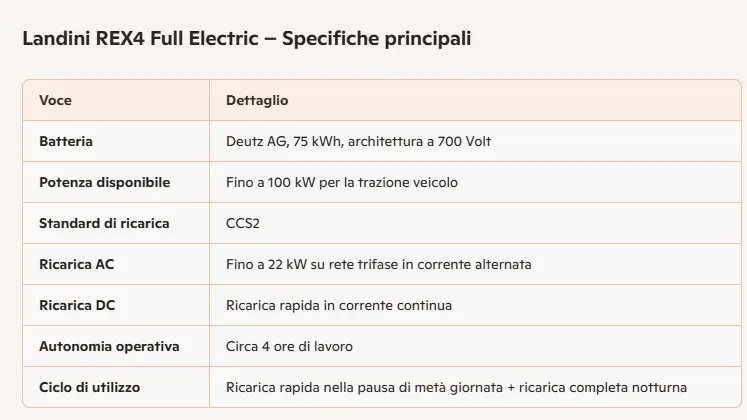
But the shift to electric versions isn’t limited to changing the propulsion system. “This transition required a new structural design: instead of an internal combustion engine, a semi-chassis—borrowed from Landini’s higher-power models—connects the front and rear of the tractor and supports the battery pack installed under the hood.” Let’s take a look at the batteries: a Deutz AG unit with 75 kWh and 700 volts, capable of delivering up to 100 kW, which powers the electric motors for vehicle traction and PTO, the mechanical device that allows power to be drawn from a vehicle’s engine to operate external equipment.
Tractors awaiting electrification: Rex 4 Electra, the Landini hybrid
The management of energy flows is handled by the Power Management System, a controller developed internally by Argo Tractors that coordinates the battery, engines, inverter, and onboard devices, optimizing consumption while providing additional power when needed.
Regenerative braking and 4 hours of range
The REX4 Full Electric recovers energy during braking and throttle release, featuring multiple levels of regenerative braking that are particularly effective in downhill situations where a conventional transmission would dissipate energy as heat. It uses the CCS2 standard for charging, with up to 22 kW of power on three-phase AC grids, in addition to the option for fast charging via DC external chargers. The estimated range is around 4 hours of operation, allowing for a quick charge during the midday break and a full charge at night.
The tractor is already equipped to power future electricized attachments, while all onboard systems — from the 12V system to cabin air conditioning and heating — are operated electrically. There is so much electricity available, yet agricultural businesses generate a high amount of energy from renewable sources: 47% of their total needs, but little of it is used in machinery. Nevertheless, electrification through self-generated power could make these businesses highly competitive.
Landini REX 4-120F AutoPilot: the autonomous driving version
The company highlights the innovation of this project — an experimental approach aimed at bringing advanced automation to the world of specialized tractors — but the Landini REX4‑120F AutoPilot remains a conventional machine that can still be operated and driven by the operator at any time.
Africa: solar-powered agricultural machinery in arid lands
Let’s take a look at the details. The autonomous guidance system relies on GPS RTK technology and operates within areas pre-mapped by a certified operator, who defines safety boundaries, working zones, and rows, generating a map used to program missions through a dedicated application. The prototype was initially developed for use with a towed sprayer, a strategic tool for rapid interventions on crops, with further development planned to extend it to machines for managing row spacing, canopy layers, and undergrowth.
The system achieves a maximum working speed of 7 km/h, reduced to 2 km/h during turns, and can only operate within the defined safety boundaries, without access to public roads.
In terms of hardware, the system consists of two RTK antennas and a ground reference system for managing steering; three LiDAR sensors with a dedicated control unit are installed to handle safety and emergency situations. The status of operations can also be monitored remotely via a dedicated app thanks to the presence of cameras.
To manage autonomous braking, the REX4-120F is equipped with a new electro-hydraulic system that can be controlled directly from the control unit. Safety is ensured through a combination of satellite navigation, certified mapping, and LiDAR detection.
READ ALSO AND WATCH THE VIDEO GUIDE ON HOW TO PARTICIPATE IN THE BONUS COLONNINE PROGRAM
Previous Article
An electric journey for the season/4 Campania "Upside Down"
