
Transport & Environment: Plug-in hybrids are polluting more every year
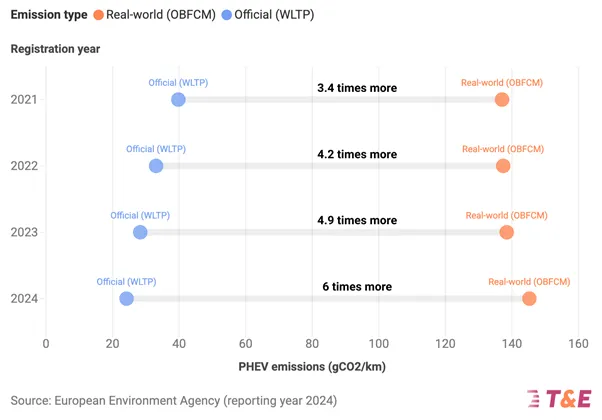
European plug-in hybrids emit much more CO₂ in real-world driving conditions than the official figures provided by manufacturers suggest. This was already known. However, according to a new analysis by Transport & Environment (T&E) based on data from around 220,000 PHEVs, actual emissions in 2024 reached 145 g of CO₂/km, compared to 138 g in 2023 and just 24 g/km as reported by official tests. In essence, the gap between declared and actual emissions has widened to six times.
While manufacturers are calling for stricter rules to be relaxed, an update to European standards is intended to make tests more reflective of real-world usage.
Polluting PHEVs? Real-world data shows that…
Plug-in hybrids are becoming cleaner in tests, but not on the road. The most significant issue isn’t just the gap between the lab and reality, but its progression over time. In 2023, PHEVs registered in Europe had an average real-world emission of 138 g/km, compared to 28 g/km in official tests. A year later, the real-world figure rose to 145 g/km, while the official figure dropped to 24 g/km.
In other words, in just one year, real-world emissions increased by 5%, while those reported by homologation procedures decreased by 15%. As a result, the gap widened from about five to six times.
The comparison with purely endothermic vehicles is equally significant. According to T&E, in 2024 these latter vehicles had an average emission level of 169 g/km. Therefore, PHEVs prove to be only slightly more efficient in real driving conditions, covering much shorter distances compared to what the homologation data suggest.
Overestimated electric range
A significant part of the explanation lies in the so-called “utility factor,” the parameter used in European calculations to estimate what proportion of a PHEV’s mileage is covered by electric power.
The system is based on the assumption that a significant portion of travel is done using electricity from the battery. However, data collected through OBFCM (On Board Fuel Consumption Monitoring) systems installed in cars show that actual usage is very different from the assumptions underlying the tests.
T&E’s analysis of 2023 data found that the method used by regulators assumed an 84% electric driving rate, while actual data showed only 27%.
The result is clear: if a PHEV is rarely charged, the internal combustion engine is used far more than what is specified in the certification.
Germans don’t like plug-in cars, Italians do
Emissions even when driving purely electric
There is also an aspect that is less intuitive. A PHEV is not necessarily emission-free even when it is in electric mode.
According to T&E’s analysis of previous data, in electric mode PHEVs consumed an average of 3 liters of gasoline per 100 km, resulting in approximately 68 g of CO₂/km. This is due to the configuration of hybrid systems: under certain conditions, especially at high speeds or when there is a high power demand, the internal combustion engine can start operating even when the driver is using electric mode.
The problem becomes even more apparent in heavy and powerful PHEVs. Data shows that models with an electric range of over 75 km are not necessarily those with the lowest actual emissions: the weight and power of the internal combustion engine can offset some of the advantages provided by a larger battery.
Bruussels’ “corrections”
The European Union has begun to intervene specifically on the utility factor parameter. The new methodologies introduced for 2025-2026 and those planned for 2027-2028 gradually reduce the share of electricity usage considered in official calculations.
According to T&E, however, even with the future corrections planned, a gap would remain: actual emissions could still be 18% higher than the WLTP values.
The issue also relates to the transition to EVs
T&E claims that the automotive industry, through its lobbying efforts, is seeking to scale back or eliminate the updates to the utility factor mandated by European regulations.
The issue isn’t just about the accuracy of a number listed on the technical sheet. The way Europe calculates PHEV emissions directly affects regulatory incentives to sell these vehicles rather than fully electric models.
This topic is particularly interesting because PHEVs can make sense in certain uses, especially when they are regularly charged and cover most of their daily distances electrically. But the “plug-in hybrid” label alone is not a guarantee of low emissions.
Also check Marco Berti Quattrini’s Electric Week
Previous Article
PresaDiretta returns to energy: renewables, fossil fuels, and electric mobility
Next Article
Chinese market: Electric vehicles double those of internal combustion engines and make it into the Top Ten