
Toyota wants to loosen European car regulations: wise or self-serving?

Toyota wants Europe to relax its plans for the automotive industry. The Japanese manufacturer is calling for looser rules for cars produced in Europe and more time to transition to electric driving. But Toyota also has its own interests at stake, as the brand has long focused primarily on hybrids.
Toyota wants to change two European regulations
The European automotive industry is under significant pressure. Competition from China is increasing, while car manufacturers must invest billions in electric vehicles, battery technology, and new factories. At the same time, Brussels wants new cars to emit ever less CO2.
The European Commission is therefore working on two key plans. The Industrial Accelerator Act aims to strengthen Europe’s industry by boosting production and investment within the continent. The Automotive Package focuses on issues such as CO2 emissions from new cars and the transition to electric driving.
Toyota has criticized both plans. The brand believes that Europe’s production requirements risk becoming too strict, and that the CO2 targets do not adequately account for the speed at which consumers are switching to electric cars. According to Toyota, these regulations could actually weaken Europe’s automotive industry.
When is a car actually European?
Firstly, Toyota wants Europe to view the origin of cars differently. The European Union aims to encourage manufacturers to produce more cars and parts within the EU. This can be achieved through things like government subsidies, public procurement, and corporate vehicle fleets.
Toyota believes that consideration should not only be given to the country where a car is built. The development, design, and production of parts also represent economic value.
An example illustrates this point. Suppose a Toyota is built in Turkey, using parts and technology that were partially developed in the European Union. Under a strict European origin rule, that car might not meet the requirements, even though European companies and workers are involved in its creation.
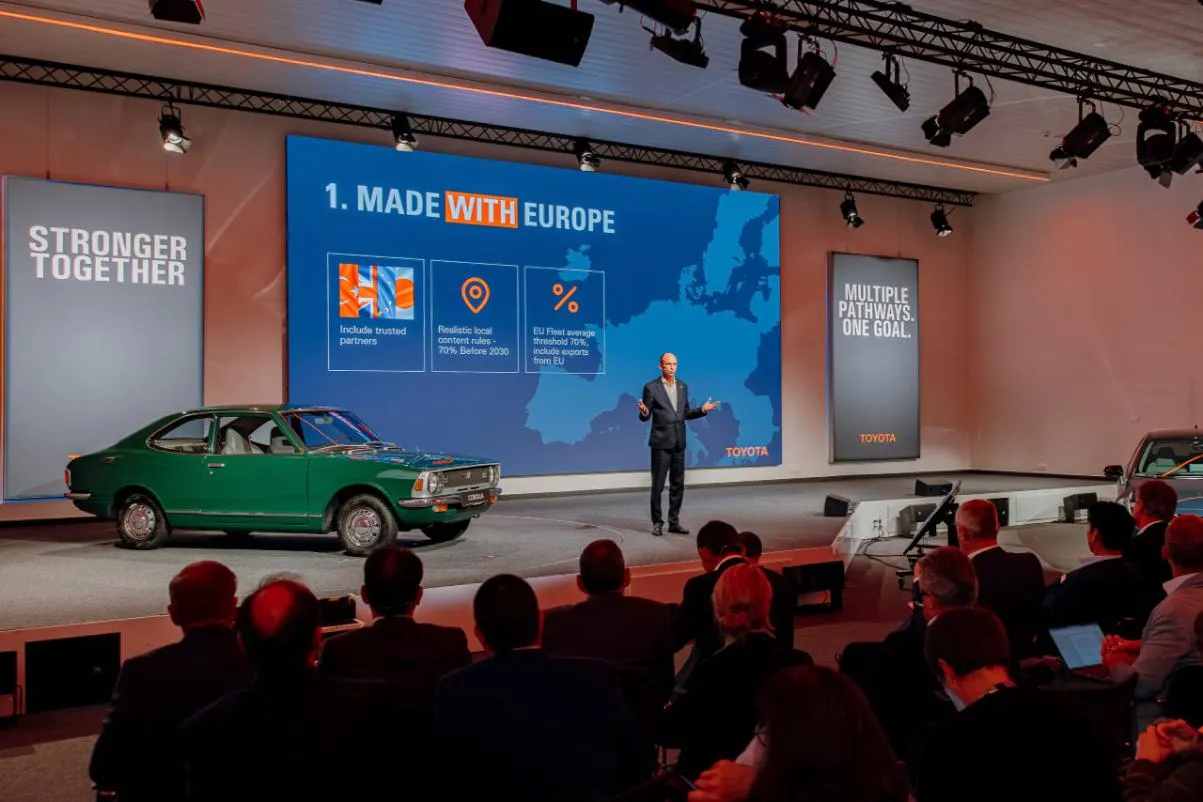
Toyota therefore advocates for a broader approach, which it calls “Made with Europe.” Under this framework, important trading partners such as the United Kingdom, Turkey, and Japan should also be included on certain conditions.
This isn’t entirely unreasonable. Toyota has been operating in Europe for over sixty years and has several factories and R&D centers here. By including trading partners as well, the brand believes a combined automobile market of around 31 million vehicles could be created. Such scale would be necessary to compete with China and the United States.
Toyota wants 70 percent European value
Toyota proposes that after a three-year transition period, at least 70 percent of the value of a car must come from Europe and recognized trading partner countries. The brand wants to include not only components but also the value of development, technology, and assembly.
In addition, Toyota proposes a second threshold. Of all cars sold by a manufacturer, at least 70 percent should meet the new origin requirements. This is more flexible than the proposed 85 percent.
This clearly refers to the origin of cars and components, not the propulsion type. A hybrid Toyota can meet these production requirements just as well as a fully electric car. Toyota also wants the main new requirements not to take effect before 2030, so that manufacturers have enough time to adjust their production. For cars with hydrogen fuel cells, the brand wants to make an exception for now.
Toyota Wants More Time for Electric Driving
The second point of Toyota’s criticism is unrelated to where cars are produced. It concerns European CO2 regulations and the speed at which new cars must become electric.
European automakers must continuously reduce the average CO2 emissions of their newly sold cars. This does not mean that a certain percentage must be electric, but in practice it becomes increasingly difficult to meet the targets without selling large numbers of fully electric vehicles.
According to Toyota, around 45 percent of all newly sold passenger cars will be fully electric by 2030. To meet European CO2 targets, Toyota’s calculations suggest a share of over 55 percent would be required.
That is the problem, according to the manufacturer. The regulations demand a faster transition than Toyota considers feasible based on expected consumer demand.
Toyota therefore wants manufacturers to have time to reduce their emissions over five years, from 2028 to 2032. Those who fall short in one year can make up for it in a subsequent year. For vans, Toyota seeks an even greater reduction target, aiming for 35 percent CO2 cuts by 2030 and 80 percent by 2035.
Toyota’s request for more time does not mean the brand is abandoning electric vehicles. The manufacturer is already making significant progress and is working on a dedicated electric platform for the European market. However, Toyota wants to prevent stricter regulations from too quickly limiting sales of hybrids and other propulsion technologies.
Room for internal combustion engine cars even after 2035
The European CO2 regulations for 2035 represent another key point of discussion. Under the original legislation, new passenger cars were required to emit 100 percent less CO2 on average by that year compared to 2021. In practice, this would leave almost no room except for fully electric cars and hydrogen-powered vehicles.
The European Commission has now proposed relaxing this requirement to a 90 percent CO2 reduction. The remaining emissions could then be offset under certain conditions, for example with sustainably produced steel and renewable fuels.
Toyota supports this direction and wants such fuels to play a greater role. The brand also advocates for a separate category of vehicles that can run exclusively on approved renewable fuels. These should be considered emission-free under regulations, although CO2 may still emerge from the exhaust during driving.
France and Germany also reached a provisional compromise on European vehicle regulations on October 16. Both countries want to set the reduction target for 2035 at 90 percent, without requiring additional compensation. They are also open to granting the United Kingdom a special status regarding European origin rules. Japan and Turkey are currently excluded from this proposal. The plans still need to go through European decision-making processes.
Toyota also wants more flexible rules for the United Kingdom
Toyota is not focusing only on Brussels. In the United Kingdom, there is a separate requirement for selling zero-emission vehicles, known as the Zero Emission Vehicle mandate.
Manufacturers are required to sell a certain percentage of zero-emission vehicles. By 2030, the targets are 80 percent for passenger cars and 70 percent for vans.
Toyota believes these percentages are too high and wants to reduce them to a maximum of 50 percent for passenger cars and 40 percent for vans. Additionally, the brand is calling for clear guidelines by 2035 so that manufacturers know where to invest in the coming years.
Toyota is also defending its own interests
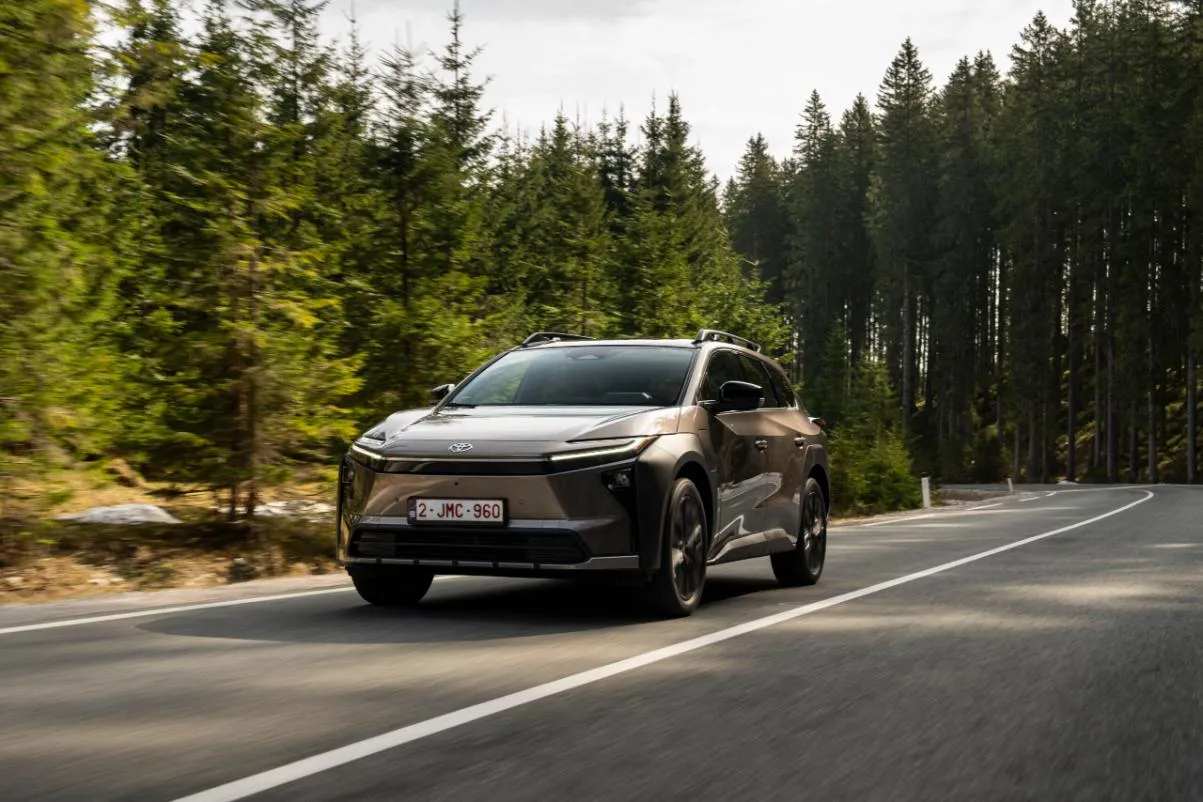
Toyota presents its proposals as a way to keep the European auto industry competitive. But we must not forget that the Japanese manufacturer itself has a significant reason to want to relax the rules. Toyota was one of the pioneers in hybrid propulsion, but it began focusing seriously on fully electric vehicles much later than various competitors. The bZ4X, Toyota’s first model developed specifically as an electric car, did not appear until 2022.
We still see this reflected in sales figures. In 2025, Toyota sold around 52,000 fully electric vehicles of its own brand in Europe, compared to over 1.14 million vehicles in total. Toyota is now making significant progress. In the first half of 2026, electric vehicle sales more than doubled, and the share of fully electric vehicles under Toyota Motor Europe, including Lexus, reached 11 percent. However, hybrids still make up the majority.
Tighter CO2 regulations are therefore less favorable for Toyota than for manufacturers that are further ahead with fully electric vehicles. More time means Toyota can continue to benefit from its existing models and hybrid technology for longer.
The push for “Made with Europe” also deserves critical examination. Toyota emphasizes that it has been manufacturing and investing in Europe for decades. That is true, but it remains a Japanese company with a global production network. By excluding countries like Japan and Turkey from European origin rules, cars and parts from outside the EU can be more easily counted. In doing so, Toyota attempts to align the new rules better with its own production and interests.
More time is not automatically better for Europe
That doesn’t mean Toyota isn’t raising a valid concern in some areas. Electric cars aren’t yet affordable for everyone, and charging infrastructure isn’t developing at the same pace everywhere. Manufacturers also can’t adjust their production overnight.
But the question is whether relaxing regulations is the right solution. It could also lead manufacturers to slow down the development of affordable electric cars. And it is these models that are needed to make electric driving attractive to a much larger group of drivers.
That, in our view, is the weak point in Toyota’s approach. The brand is asking Europe for more time for a transition during which it itself has invested less heavily over the years compared to some competitors. This is understandable from a business perspective. At the same time, Europe must ask itself whether this actually strengthens its own automotive industry.
Because while Toyota and other manufacturers are advocating for more time, Chinese competitors continue to invest heavily in electric vehicles. Looser regulations may help manufacturers in the short term, but they do not guarantee that they will remain competitive in the long run. Eventually, they will still need to bring out electric vehicles that are competitive both technically and in terms of price.
Text: Arjan Hordijk