
Total’s subsidiary Saft produces solid-state batteries in Bordeaux
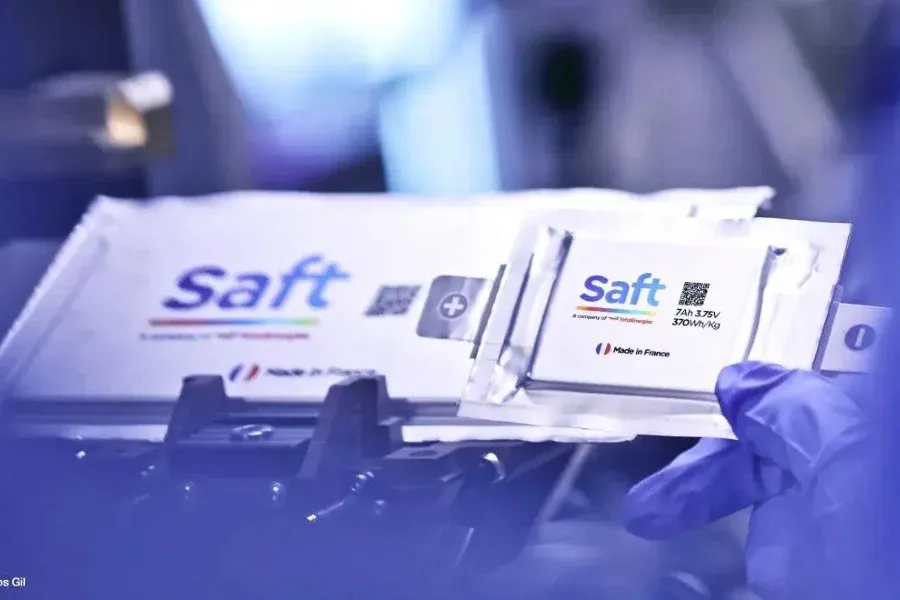
Saft, the battery manufacturer owned by the TotalEnergies group, is launching new production lines for solid-state batteries at its facility in Bordeaux. These batteries are intended primarily for use in aerospace applications. Saft does not mention any potential use in road vehicles.
Image: Saft
Saft claims to be the first French manufacturer to produce self-developed solid-state batteries that use both sulfide and polymer electrolytes at room temperature. The Total subsidiary cites aerospace as a potential application area, where “improvements in safety, performance, and energy density are particularly valuable,” according to a accompanying statement. In the aviation sector, Saft has already made a significant impact by recently delivering semi-solid state batteries in collaboration with partner Safran.
The new production lines in Bordeaux — known as the hub of European aviation — are designed for various technologies according to Saft, specifically both polymer-based solid-state batteries and sulfide-based solid batteries. These facilities operate explicitly at room temperature. Saft remains very vague regarding the batteries themselves, stating only that they are particularly safe and compact. The energy density is said to be up to 50 percent higher than that of conventional lithium-ion batteries. Additionally, production uses dry electrode processes, which is intended to reduce CO2 emissions during manufacturing by up to 40 percent.
Saft CEO Cedric Duclos commented, “Solid-state batteries are among the most promising innovations to meet tomorrow’s electrification needs. These new production lines represent a significant milestone for Saft: we are turning years of research into real industrial capacity. This underscores our commitment to establishing France and Europe as leaders in this strategic technology.”
With Blue Solutions from the Bolloré group, France has another manufacturer of commercially available solid-state batteries. In this case, it uses a lithium-metal-polymer technology (LMP). However, Blue Solutions is currently being restructured after encountering battery issues in series applications, particularly in buses.
Saft is primarily known to us as a partner in the joint venture Automotive Cells Company (ACC). The manufacturer is owned by Saft, Stellantis, and Mercedes-Benz, and it produces nickel-based cells and modules in France, which are currently mainly supplied to Stellantis. The facility in Douvrin was originally supposed to be supplemented by two additional plants in Germany and Italy. However, the joint venture is now focused only on getting its single cell factory in France up and running. The other two major projects have been canceled.
In addition, SAFT has also repeatedly shown enthusiasm for research. Together with Stellantis and other partners, this Total subsidiary is working on a battery with integrated inverter and charging functions. Under the European research project SUBLIME, SAFT also collaborated with other players starting in 2023 to develop solid-state batteries based on sulfides. And through the TALISSMAN project, SAFT is working with partners to develop lithium-sulfur batteries for electric vehicles.