
Tesla reported 236 ADAS system failures in July 2026. Four were fatal and concealed in the reports
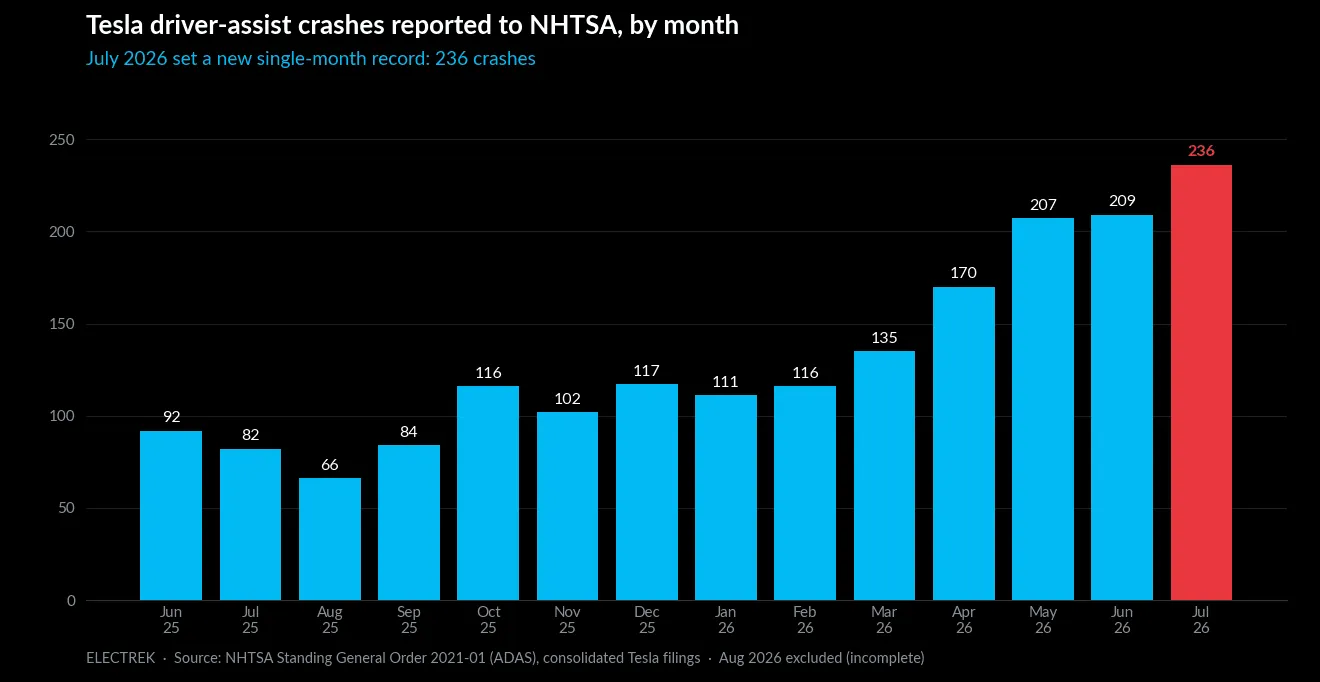
July 2026 was the worst month in Tesla’s history of reporting accidents involving its driving assistance systems to NHTSA. The company reported 236 incidents, and in its 4 fatal reports, it confirmed that Autopilot or FSD was active.
Table of Contents
Show
Hide
There is another issue as well. In two multi-vehicle tragedies, Tesla listed 1 death per federal report, even though 5 people actually died there.
A Record-Breaking July and Four Deaths with Systems Active
Tesla reports such incidents under an NHTSA mandate from 2021. These are accidents where a Level 2 system was active within 30 seconds before the collision. This year’s trend is clearly upward: 135 reports in March, 207 in May, 209 in June, and now 236 in July.
The July documents listed 7 deaths, of which Electrek linked 4 separate fatal accidents to publicly known cases. In each case, Tesla marked the system as “Verified Engaged,” meaning it confirmed via telemetry that the system was active. At the same time, it hid three fields: the incident description, the software version, and information indicating whether the road was within the system’s permitted operating range. This no longer appears to be legal caution but rather an information policy.
The first incident occurred in Upper Marlboro, Maryland, on July 12 around 00:45. A Tesla Model 3 turning left failed to yield to a Harley-Davidson motorcycle traveling straight. Three people died: 48-year-old Matthew Vowell, 47-year-old Krystal Vowell, and the 22-year-old Tesla passenger Adriana Maxwell. The vehicle was being used for ridesharing. Tesla’s report mentioned turning left at 20 mph with the system active and video footage preserved. Such a maneuver is more typical of FSD than of basic Autopilot.
The second incident took place in San Mateo, California, on July 15. A 2016 Tesla Model S left the road, hit a pole, and caught fire. The driver died. Tesla reported the system was active and the speed was 52 mph. Road departure is also the most common type of accident in Tesla’s entire dataset of reports.
The third incident occurred in Ione, California, on July 22 around 7:18 a.m. A new Tesla Model Y from 2026, traveling at 54 mph, crossed into oncoming traffic, brushed against a Honda, and then collided head-on with a Cadillac. Shelby Waldie, 25, died, and a 2-year-old child was taken to the hospital. Police are investigating why the car crossed the center line. This cannot be verified from the report because the description of the incident was redacted.
The fourth incident happened in Ashby, Minnesota, on July 20 around 3:57 p.m., on I-94 in a construction zone. A Ford collided with a Tesla, and then both vehicles were hit by a third car. Two people died: Harold Ennulat, 73, the driver of the Tesla, and the 24-year-old driver of the Ford. According to police, it was possible the Ford was traveling against traffic, so the Tesla might not be at fault. However, the system was active at 50 mph, and the Tesla has EDR and video records. These details are also not shown.
Tesla underreports the number of casualties in its reports
A second issue arises, equally problematic. Tesla lists only one field, “highest injury severity,” in each report. As a result, in Upper Marlboro where 3 people died and in Ashby where 2 people died, the reports each show 1 death.
If the entire dataset is calculated this way, all subsequent safety comparisons start from a underestimated level. That’s poor.
Electrek also points out that other manufacturers typically do not edit their documents in this manner. GM does not hide accident descriptions with its Super Cruise system, while Tesla has blacked out the narrative in 100% of its reports and GM in 0%. The mere fact that the system was active 30 seconds before an accident does not yet prove software fault. However, without an incident description, it’s impossible to distinguish between a system error and a situation where the driver could have done something differently or had no chance at all.
For Tesla drivers, the meaning is simple: marketing claims “Full Self-Driving,” but legally it’s still only Level 2 with a human being responsible for everything. And when tragedies occur, the most interesting fields in the report are left blank. What do you think NHTSA should make mandatory to publish in such cases?
Order your Tesla and take advantage of purchase bonuses using the referral link!
LovEV Newsletter
Want more content like this?
Sign up — we’ll send you a weekly summary once the newsletter starts.