
Tesla announces fixing flaws in FSD. Feature returns after 7 years of the same promises
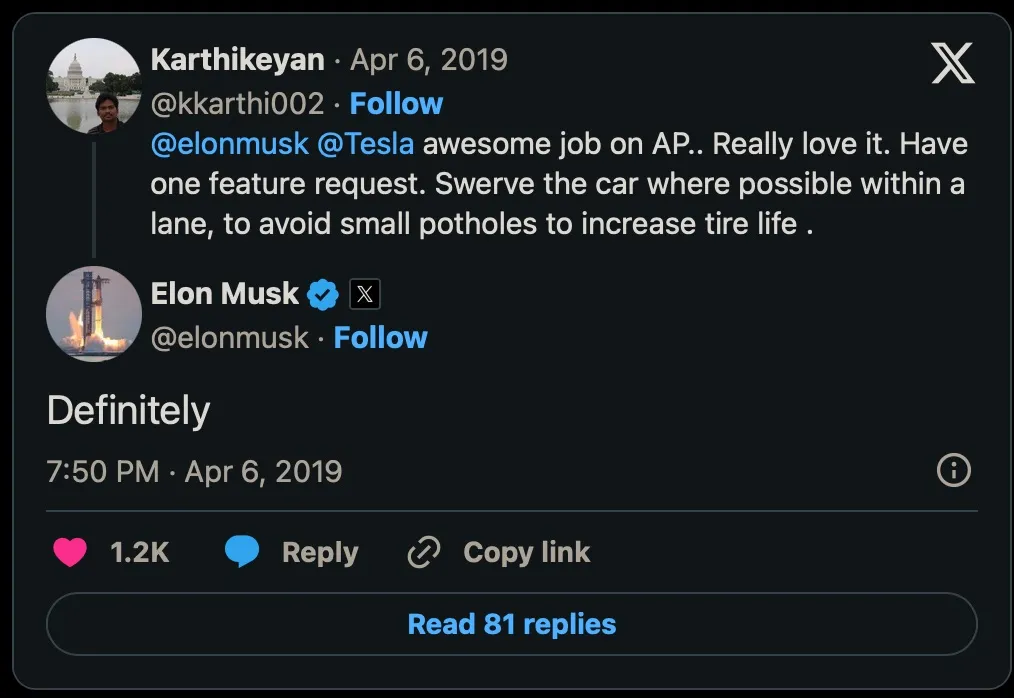
Elon Musk once again announced that Tesla will add pothole avoidance to FSD. The statement was made on August 31, 2026, although the feature has been mentioned in public announcements since 2019 and is listed in FSD notes starting from version 14.3 dated April 7, 2026. It makes sense to drivers, but this time the issue isn’t the idea itself, rather the credibility of the timeline.
Table of Contents
Show
Hide
Tesla has not specified in which FSD version the feature will appear. Musk only said it will happen “soon.”
FSD is supposed to avoid potholes, but it already does this partially today
The new feature doesn’t appear out of nowhere. Tesla cars with the current FSD sometimes already respond to larger potholes in the asphalt, though this behavior is not predictable nor officially described as a fully functional feature. In one recorded case, FSD 14.2.2.5 adjusted the car so that the damaged road section passed between the wheels.
However, this still seems more like a side effect of road perception rather than intentional, repeatable “pothole avoidance.” It’s unclear whether the system recognized the pothole or simply treated it as an obstacle on the road.
Tesla has included pothole avoidance in the list of upcoming improvements since FSD version 14.3. This suggests the topic is already in development, not just another post from Musk on X. That said, we’ve seen similar “coming soon” stages before.
The problem isn’t new. Musk talked about it the same way in 2019.
The first public announcement came in April 2019. At that time, Tesla’s owner requested minor adjustments to the road surface within the tire area so that the car could protect the tires and rims from potholes. Musk agreed.
And that’s where it practically stopped.
In 2020, Tesla’s CEO added that active height control and suspension damping would also be integrated with FSD. Part of this plan was indeed implemented in vehicles with pneumatic suspensions. The 2022.20 update added automatic suspension adjustment for Model S and Model X before sections of poor road conditions.
However, today this topic holds much less significance than it did a few years ago. Production of Model S and Model X has been discontinued, so practically only the Cybertruck remains in Tesla’s lineup with adjustable suspensions. For Model 3 and Model Y, what’s crucial is not “lifting the car” but actually detecting potholes and adjusting the driving path.
This is where the stairs begin.
Tesla’s hardware should be able to handle this, but “should” isn’t enough
On paper, Tesla has its advantages. The HW4 platform offers more memory and computing power than HW3, and the cameras have about 4.5 times higher resolution. This helps in detecting small surface elements, especially from a distance.
From a human perspective, this issue seems quite trivial. The driver sees a pothole, slightly adjusts the course, and moves on. The computer must do the same thing, but without leaving the lane, without hitting another car, without making a sudden maneuver, and while determining whether the object is actually a pothole, a patch, a shadow, or a puddle.
And that’s exactly why such a function is more difficult than it appears in marketing shorthand. Simply “seeing” isn’t enough. A decision is also needed about when it’s worth avoiding damage and when it’s safer to drive over it.
Tesla already has a database for pothole maps
The most interesting part here isn’t Musk’s tweet itself, but rather what Tesla can do with the data from its fleet. The company has long been creating surface quality maps based on data collected by users’ cars. This database is used by the adaptive suspension system, which can prepare the vehicle for a worse road section even before reaching it.
If Tesla expands this mechanism to specific potholes, it could create a crowdsourced map of larger defects on roads. In practice, the car would not only react to what the camera sees at that moment but also know in advance that there’s a problematic area ahead a few dozen meters away.
This opens two paths. The first is simple: making a slight adjustment within the lane or choosing a better part of the traffic lane. The second is more ambitious: prioritizing a smoother lane even before reaching the damaged area, if road conditions permit it.
It sounds good. But again, this is potential, not a ready-made feature.
Tesla’s “Coming soon” has a poor track record already
The biggest problem with this promise isn’t the potholes themselves. It’s the word “soon.” Tesla and Elon Musk have used it very broadly over the years, especially regarding FSD.
Over this time, the software has indeed made progress. Today’s FSD performs much better on highways and urban roads than it did a few years ago, capable of reaching a specified address and parking itself. Compared to many traditional ADAS systems, Tesla remains strong. Yet at the same time, Musk’s list of unmet deadlines is so long that every new announcement must be evaluated based on reality, not fan enthusiasm.
This is why the current declaration is both reasonable and suspicious. Reasonable because avoiding potholes offers a real benefit to drivers. Suspicious because we’re talking about a feature promised to the public 7 years ago.
What does this mean for drivers and Tesla’s robotaxis?
For an average Tesla owner, the issue is simple. Potholes mean faster tire wear, a risk of damaged rims, and simply poorer comfort. In Europe, including Poland, this isn’t some exotic problem from American suburbs—it’s a common occurrence on many local roads after winter.
There’s another aspect to consider. Tesla is developing autonomous driving services and heavily promoting Cybercab as well as robotaxis. If the company wants to convince the market that its vehicles can drive without a driver or steering wheel, it should also handle practical issues like potholes effectively. It may seem trivial, but it’s precisely such details where marketing often falls short of reality.
For now, we have not an implementation but merely a revival of an old promise. If this feature actually makes it into one of the upcoming FSD versions and works consistently, drivers will notice it right away. If not, the topic will resurface in a year with the same comments.
The most interesting part is that avoiding potholes might turn out to be a more tangible test of “autonomy” than yet another flashy declaration about AI. What do you think? Will Tesla deliver this by 2026, or will “soon” once again mean several more years?
Order your Tesla and take advantage of purchase bonuses using the referral link!